Unlock instant, AI-driven research and patent intelligence for your innovation.

Method and system for patching ROM code

a technology of rom code and patch method, which is applied in the field of readonly memory, can solve the problems of unauthorized access to the code within the rom, the inability to change the rom fabricated on the soc, and the discovery of errors or “bugs” in the rom cod

Inactive Publication Date: 2007-12-18
SAFENET
View PDF13 Cites 11 Cited by
  • Summary
  • Abstract
  • Description
  • Claims
  • Application Information

AI Technical Summary

Benefits of technology

[0021]Therefore, it is an advantage of embodiments of the present invention to provide method and system for “repairing” ROM code functions that do not require the re-fabrication of the chip on which the ROM resides.
[0022]It is a further advantage of embodiments of the present invention to provide method and system for “repairing” ROM code that does not increase the code size by the addition of test code at the beginning of code functions that are likely to contain bugs.
[0023]It is a further advantage of embodiments of the present invention to provide method and system for “repairing” ROM code that does not diminish the performance of the application with which the ROM is associated by run-time execution of test code at the beginning of code functions that are likely to contain bugs, or by run-time fetching of patches from memory outside of ROM that may require an increased access time.
[0024]It is a further advantage of embodiments of the present invention to provide method and system for “repairing” ROM code that does not allow perpetuation of a bug from an untested code function into other code functions within the ROM.
[0025]It is a further advantage of embodiments of the present invention to provide method and system for adding new code functions to the ROM code after the ROM has been programmed.
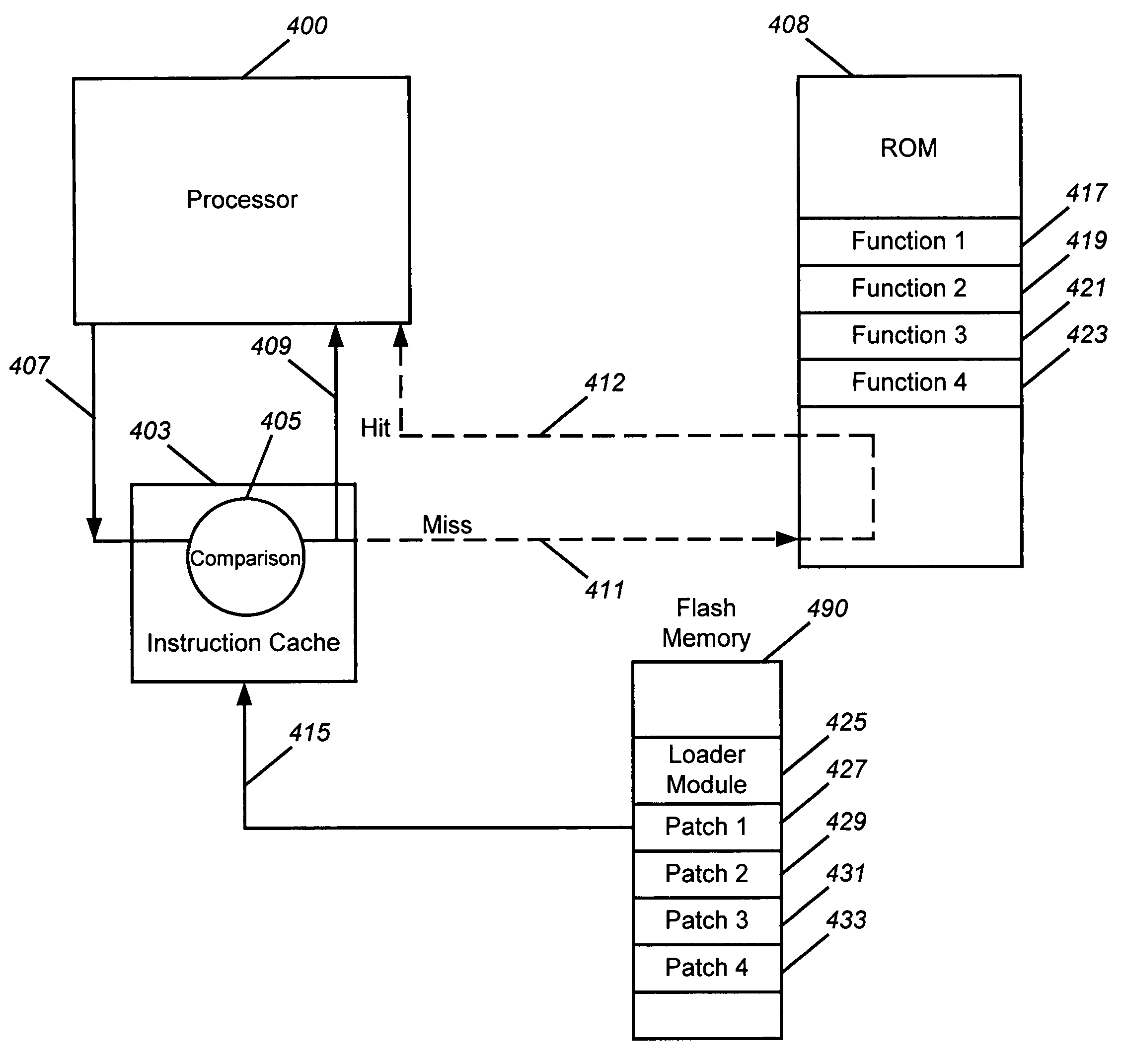
[0027]During system boot-up, any patches or new code functions present in the first memory are transferred into a second memory by means of a loader module in the first memory. The second memory allows faster access by the processor and is memory-mapped to the ROM. After transfer of the patches or new code functions to the second memory, the loader module will return to the first instruction to be executed.

Problems solved by technology

Because ROM resides on the SoC and is programmed in manufacturing, unauthorized access to the code within the ROM is made more difficult.
One such drawback is that the ROM fabricated on the SoC cannot be changed.
However, frequently errors or “bugs” in the ROM code are discovered after the ROM has been fabricated on the SoC.
This method of repairing bugs can be very expensive and time consuming.
In addition, subsequent testing of the re-fabricated SoC may reveal additional bugs requiring another re-fabrication and additional expenses and delays.
However, this method of overriding bugs has two problems associated with it.
First, the extra lines of test code placed at the beginning of those code functions with a likelihood of containing bugs diminishes the performance of the SoC.
Second, the performance of the SoC is further diminished by the run-time fetching of patches from flash memory 290 to replace ROM code functions containing bugs.
This diminished performance is due to increased access time resulting from the lower frequencies achievable outside of the SoC.
While this would be the surest way of repairing all bugs and ensuring reliability, the increase in code lines and subsequent diminished performance of the SoC would be unacceptable.
Even if very few code functions are tested there will be some diminished performance of the SoC.
Another problem with this method results from the fact that because not every code function is tested, the possibility exists that bugs will remain in untested code functions.
These untested code functions can not be repaired by the method described above, because there is no test bit associated with untested code functions.
Thus, it can be seen from the above discussion that if an untested code function contains a bug and if the results of the execution of that code function by the processor are shared with other code functions through code branching, then the number of unreliable code functions increases.
Even tested code functions that have previously been “repaired” may nevertheless become unreliable again after branching to another code function.
Finally, in addition to the difficulties involved in repairing bugs in the ROM code discussed above, it is also impossible to add additional code functions to the ROM code.

Method used

the structure of the environmentally friendly knitted fabric provided by the present invention; figure 2 Flow chart of the yarn wrapping machine for environmentally friendly knitted fabrics and storage devices; image 3 Is the parameter map of the yarn covering machine
View more

Image

Smart Image Click on the blue labels to locate them in the text.
Viewing Examples
Smart Image
  • Method and system for patching ROM code
  • Method and system for patching ROM code
  • Method and system for patching ROM code

Examples

Experimental program
Comparison scheme
Effect test

Embodiment Construction

[0037]In the following description of preferred embodiments, reference is made to the accompanying drawings which form a part hereof, and in which is shown by way of illustration specific embodiments in which the invention may be practiced. It is to be understood that other embodiments may be utilized and structural changes may be made without departing from the scope of the preferred embodiments of the present invention.

[0038]The method of run-time testing of code functions discussed in the background section of the present application has three major problems. First, ROM code grows due to the additional test code required at the beginning of suspected code functions. Second, the performance of the SoC suffers due to the additional time required by the system during run-time to run the test codes, sample the test bits and fetch the patches. Third, it is unlikely that the system designer will anticipate all code functions that require test code, leading to perpetuation of a bug in a...

the structure of the environmentally friendly knitted fabric provided by the present invention; figure 2 Flow chart of the yarn wrapping machine for environmentally friendly knitted fabrics and storage devices; image 3 Is the parameter map of the yarn covering machine
Login to View More

PUM

No PUM Login to View More

Abstract

A method and system for overriding selected ROM code functions or adding new ROM code functions within a processing system. A system designer determines an existing ROM address for the selected existing code function or a desired ROM address for the new code function. The system designer then programs a patch to replace the selected existing code function or programs a new code function. The patch or new code function is then loaded into a first memory. A loader module is also programmed and loaded into the first memory. Upon system boot-up, the loader module transfers any patches or new code functions within the first memory into a second memory that is memory-mapped to the ROM. This second memory can be accessed by the processor at a faster rate than the processor can access ROM. During a processor request cycle, the processor first examines the second memory for the presence of a desired ROM code function. If a patch or a new code function that has been transferred into the second memory maps to the location of the desired code function in ROM, then the processor will fetch the patch or new code function from the second memory.

Description

BACKGROUND OF THE INVENTION[0001]1. Field of the Invention[0002]The present invention relates, generally, to read-only memory (ROM) within a system on a chip (SoC) and, in preferred embodiments, to method and system for overriding selected ROM code functions or adding new code functions within an SoC.[0003]2. Description of Related Art[0004]An SoC is used in many computer and communication applications. An SoC generally comprises a microprocessor embedded on a chip. The microprocessor is coupled to a local bus on the chip. Included on this single chip are the hardware components required for a specific application. SoCs are usually more application-specific than general integrated circuits.[0005]FIG. 1 illustrates exemplary SoC 101. SoC 101 comprises processor 100, which is electrically coupled to instruction cache 102 and data cache 104. Instruction cache 102 and data cache 104 are electrically coupled to processor local bus 106. SoC 101 also comprises various other hardware compon...

Claims

the structure of the environmentally friendly knitted fabric provided by the present invention; figure 2 Flow chart of the yarn wrapping machine for environmentally friendly knitted fabrics and storage devices; image 3 Is the parameter map of the yarn covering machine
Login to View More

Application Information

Patent Timeline
no application Login to View More
IPC IPC(8): G06F9/44G06F1/24G06F12/00G06F9/445G06F12/06
CPCG06F12/0638G06F8/66
Inventor BROUWER, ROGER J.
Owner SAFENET
Features
  • R&D
  • Intellectual Property
  • Life Sciences
  • Materials
  • Tech Scout
Why Patsnap Eureka
  • Unparalleled Data Quality
  • Higher Quality Content
  • 60% Fewer Hallucinations
Social media
Patsnap Eureka Blog
Learn More