
Azaindole-derivatives as factor Xa inhibitors
a technology of azaindole and derivatives, which is applied in the field of compounds, can solve the problems of unstable angina, acute myocardial infarction, and unsatisfactory property profile of these compounds
- Summary
- Abstract
- Description
- Claims
- Application Information
AI Technical Summary
Benefits of technology
Problems solved by technology
Method used
Image

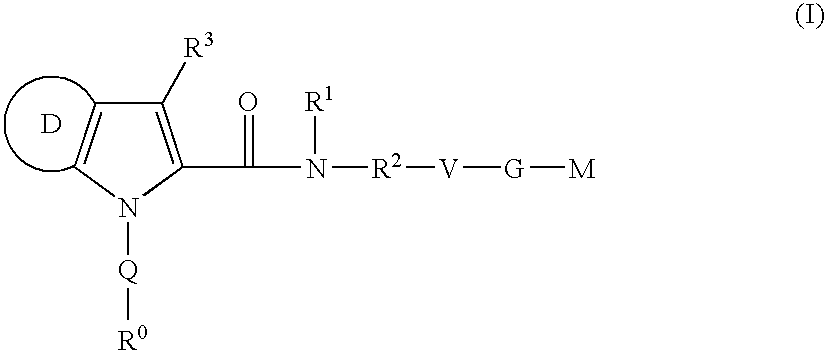
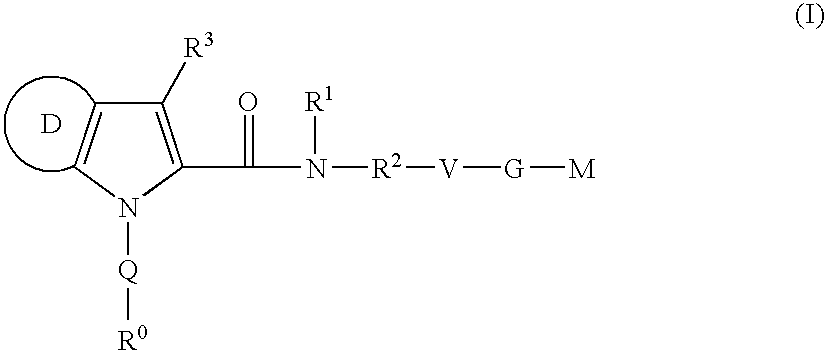
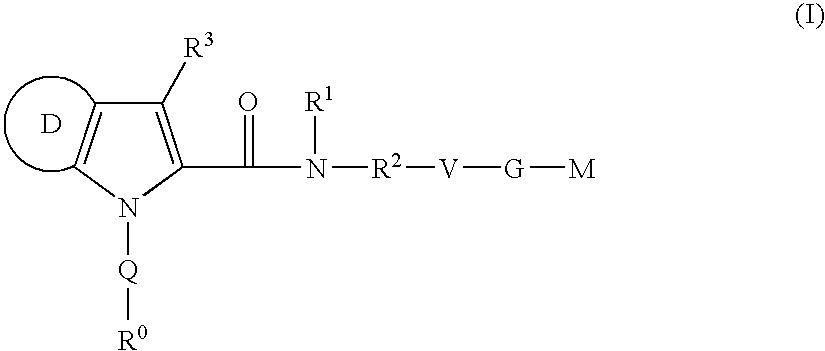
Examples
example 1
1-[5-(5-Chloro-thiophen-2-yl)-isoxazol-3-ylmethyl]-1H-pyrrolo[2,3-b]pyridine-2-carboxylic acid (1-isopropyl-piperidin-4-yl)-amide
(i) 1H-Pyrrolo[2,3-b]pyridine-2-carboxylic acid methyl ester
[0595]0.495 g (1.64 mmol) of 1-benzenesulfonyl-1H-pyrrolo[2,3-b]pyridine-2-carboxylic acid was dissolved in 5 mL of methanol and 3 mL of 2N aqueous sodium hydroxide. The reaction was stirred at 40° C. for 8 h. The solvent was removed under reduced pressure. Residual volatiles were removed by twice codistilling with toluene. The residue was suspended in methanolic hydrochloric acid and stirred for 16 h at RT. The solvent was removed under reduced pressure. The residue was dissolved in ethyl acetate and washed with saturated aqueous sodium bicarbonate solution, and saturated aqueous sodium chloride solution. The organic phase was dried with sodium sulfate, filtered and the solvent was removed under reduced pressure.
[0596]Yield 0.201 g. MS (CI+): m / e=177 (M+H+).
(ii) 1-[5-(5-Chloro-thiophen-2-yl)-isox...
example 2
1-[5-(5-Chloro-thiophen-2-yl)-isoxazol-3-ylmethyl]-2-(1-isopropyl-piperidin-4-ylcarbamoyl)-1H-pyrrolo[2,3-b]pyridine-5-carboxylic acid methyl ester
(i) 6-Amino-nicotinic acid methyl ester
[0603]To a solution of 10 g 6-Amino-nicotinic acid in 100 mL MeOH, 0.8 mL concentrated H2SO4 were added and the mixture was heated to 60° C. for 12 h. Then the reaction mixture was concentrated under reduced pressure. After addition of 50 mL ice water the mixture was brought to pH 8 by addition of K2CO3. The aqueous phase was extracted with ethyl acetate (3×100 ml) and the combined organic layers were dried over MgSO4. Removal of the solvent yielded 5.5 g of the desired product which was subjected to the following reaction without further purification.
[0604]Yield: 5.5 g.
(ii) 6-Amino-5-iodo-nicotinic acid methyl ester
[0605]To 5 g 6-Amino-nicotinic acid methyl ester and 16.2 g Bis(pyridine)iodonium(I) tetrafluoroborate in 250 mL DCM, 7.6 mL Trifluoromethanesulfonic acid were added dropwise at 0° C. The...
example 3
1-[5-(5-Chloro-thiophen-2-yl)-isoxazol-3-ylmethyl]-2-(1-isopropyl-piperidin-4-ylcarbamoyl)-1H-pyrrolo[2,3-b]pyridine-5-carboxylic acid
[0611]To a solution of 630 mg of 1-[5-(5-Chloro-thiophen-2-yl)-isoxazol-3-ylmethyl]-2-(1-isopropyl-piperidin-4-ylcarbamoyl)-1H-pyrrolo[2,3-b]pyridine-5-carboxylic acid methyl ester in 60 mL MeOH, 8.7 mL of a 1M aqueous NaOH solution were added. The reaction mixture was heated to 60° C. for 3 h. After cooling to RT 8.8 mL of a 1M aqueous HCl were added and the solvents were removed under reduced pressure. The residue was stirred with water / MeCN 2:1 and the precipitated product was collected by filtration.
[0612]Yield: 276 mg MS (ES+): m / e=528, chloro pattern.
PUM
| Property | Measurement | Unit |
|---|---|---|
| weight | aaaaa | aaaaa |
| pH | aaaaa | aaaaa |
| pH | aaaaa | aaaaa |
Abstract
Description
Claims
Application Information
 Login to View More