
System and method for compensating for PVT variation effects on the delay line of a clock signal
a clock signal and delay line technology, applied in the field of electronic data storage, can solve problems such as mapping errors, limit the speed of read operations, and the current implementation of master-to-slave systems may have stringent duty cycle requirements
- Summary
- Abstract
- Description
- Claims
- Application Information
AI Technical Summary
Benefits of technology
Problems solved by technology
Method used
Image

Examples
Embodiment Construction
[0013]Reference will now be made in detail to the present invention, examples of which are illustrated in the accompanying drawings.
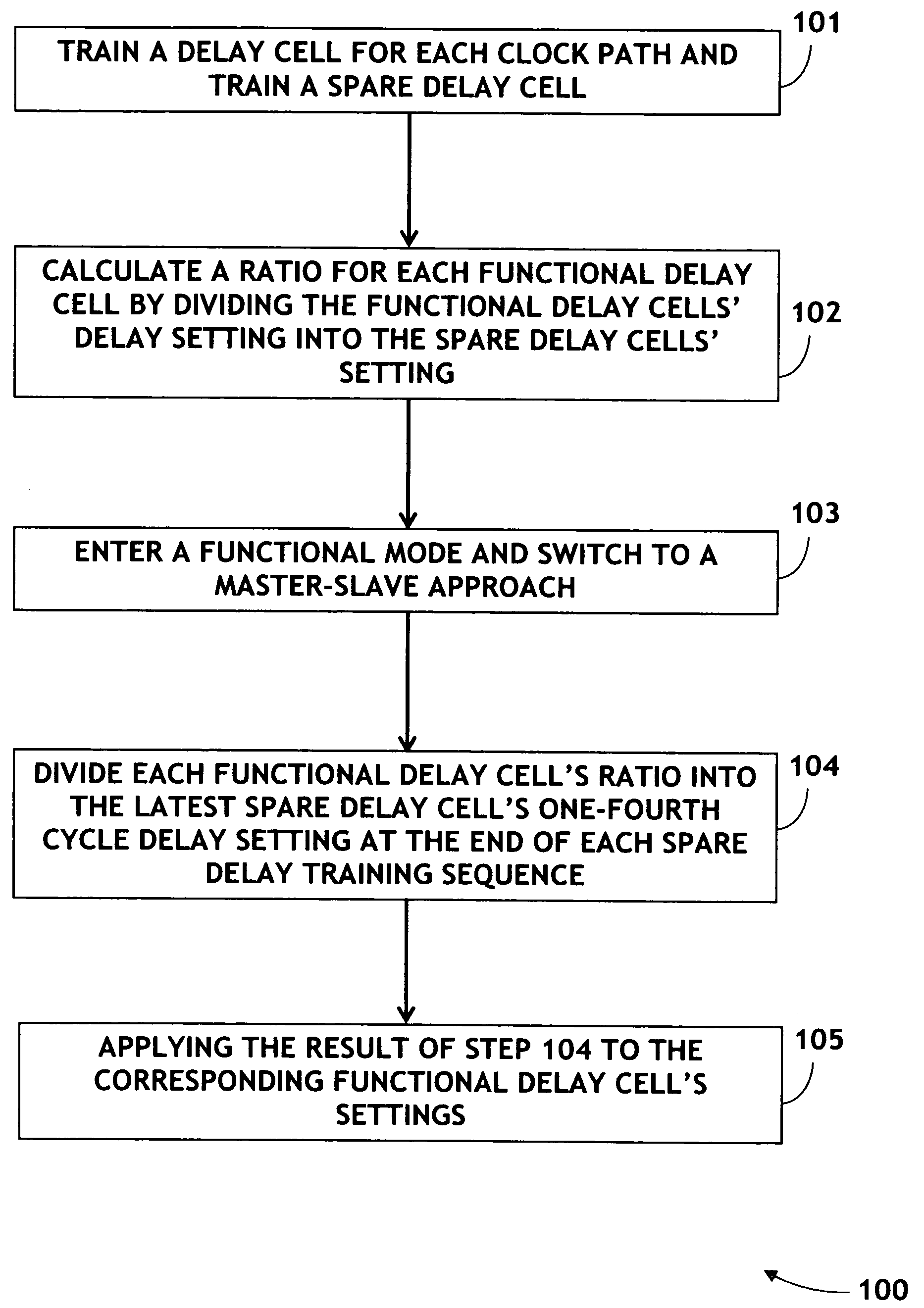
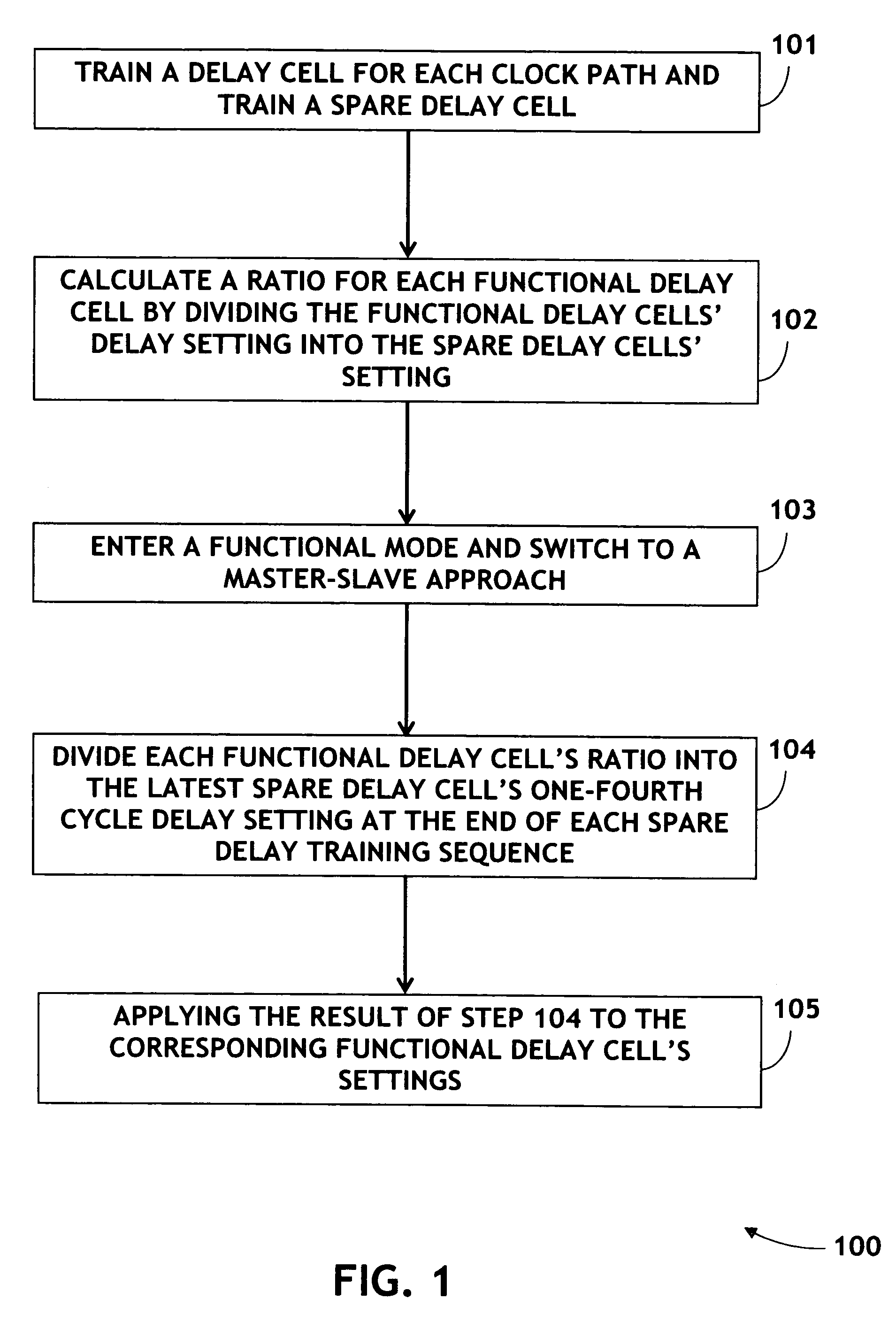
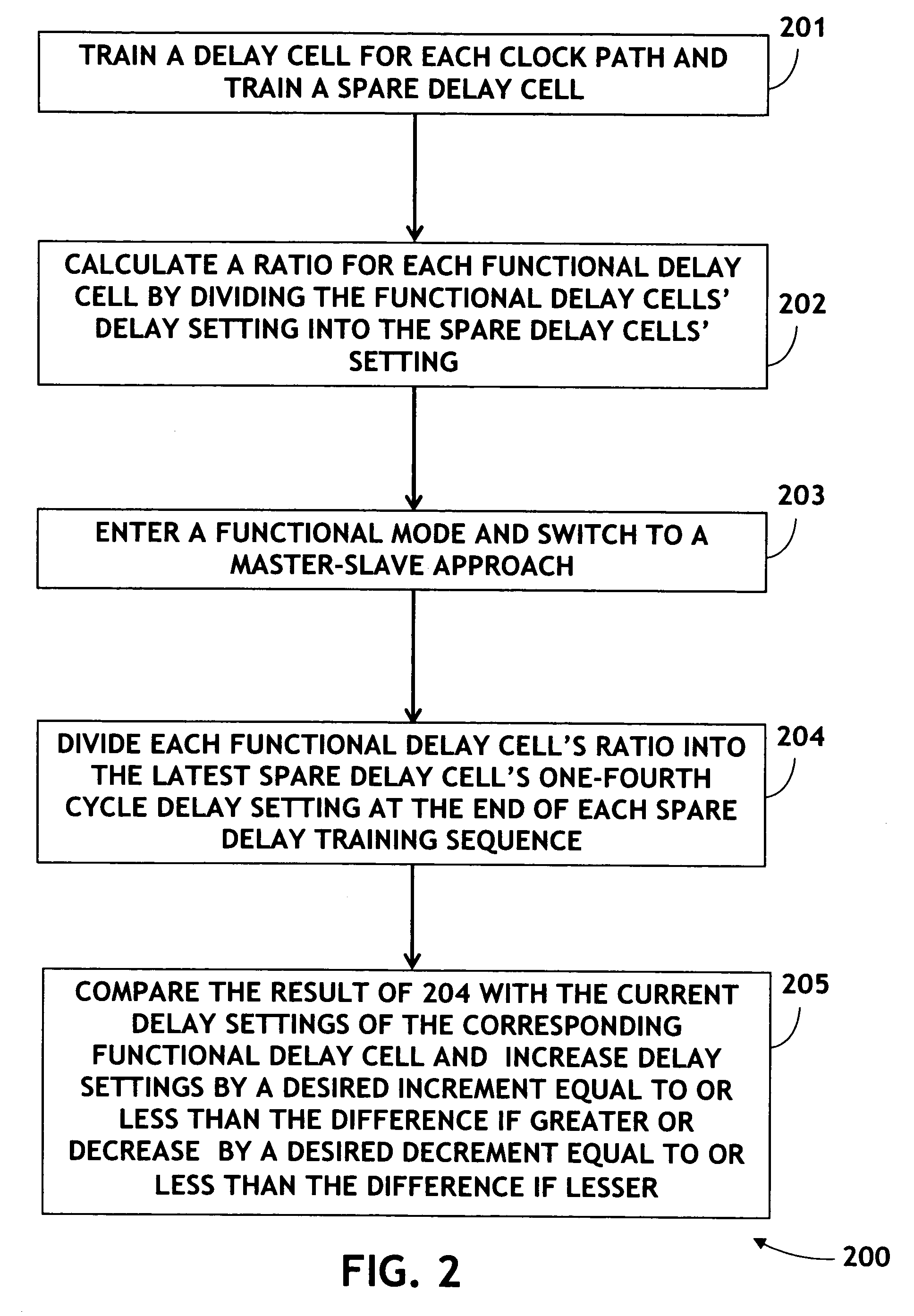
[0014]Referring to FIG. 1, a method 100 for process, voltage, and temperature compensation in accordance with an exemplary embodiment of the present invention is shown. The method 100 includes the step 101 of training a delay cell for each clock path (namely a Functional delay) and training a spare delay cell in similar method to the training described in patent application Ser. No. 11 / 523,139. The method includes training each delay cell in parallel. Training a delay cell may include adding an offset delay to the determined aligned or ¼ delay settings The method 100 further includes the step 102 of calculating a ratio for each Functional delay cell by dividing the Functional delay cells' delay setting into the spare delay cells' one-fourth cycle setting. A ratio value other than 1.0 reflects any difference between each delay cell and the spare delay ce...
PUM
 Login to View More
 Abstract
Description
Claims
Application Information
 Login to View More