

Silicon solar cell and production method thereof
a solar cell and photovoltaic technology, applied in the direction of solid-state devices, pv power plants, semiconductor devices, etc., can solve the problems of contaminated fe not, difficult to secure sufficient cell performance, and reduce the bulk effective life time to around 10 s, so as to reduce the effect of life time and reduce the bulk effective life tim
- Summary
- Abstract
- Description
- Claims
- Application Information
AI Technical Summary
Benefits of technology
Problems solved by technology
Method used
Image

Examples
example 1
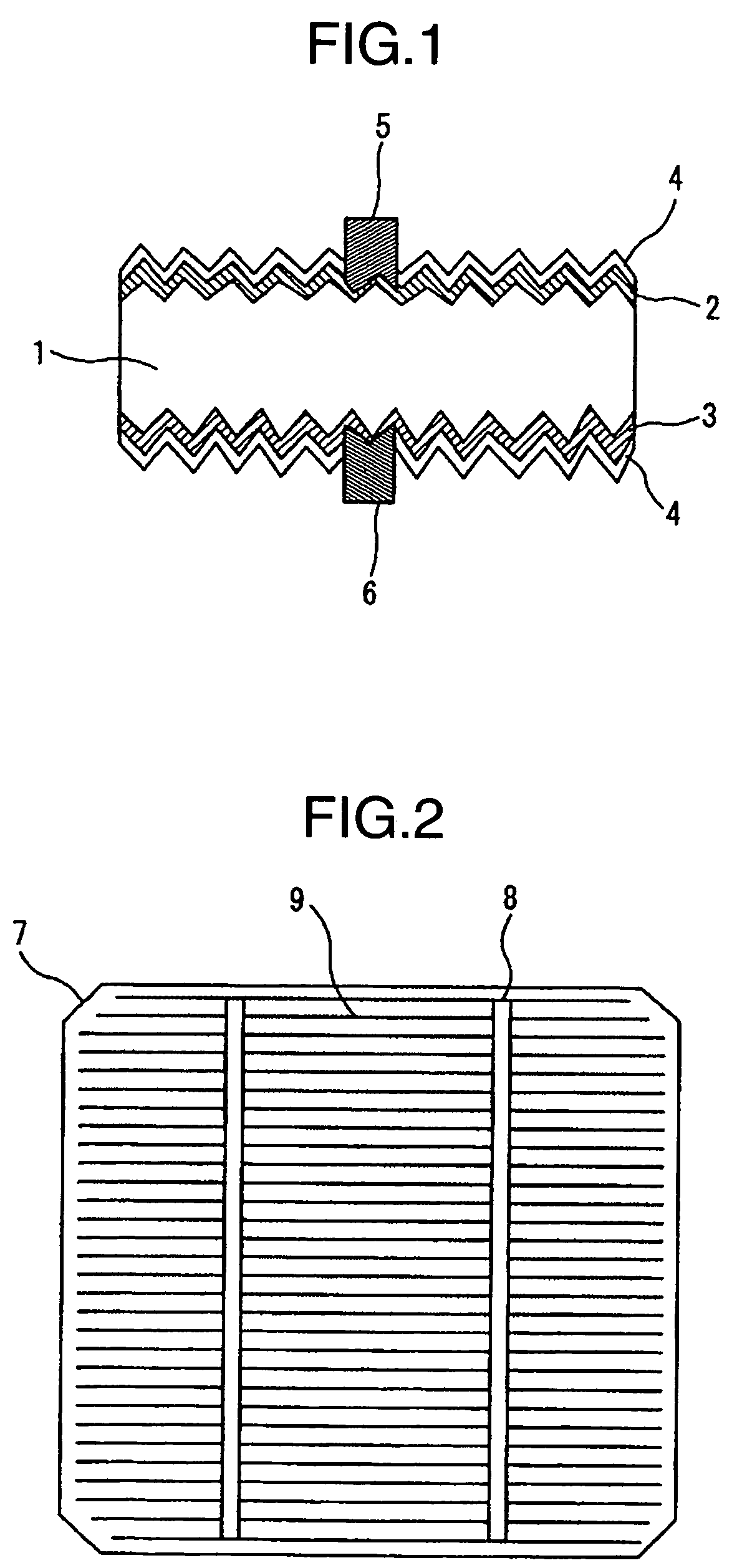
[0034]FIG. 1 illustrates a cross-sectional structure of the solar cell produced in Example 1, where the silicon substrate 1 may be of p- or n-type. The solar cell is described here taking a p-type substrate as an example.
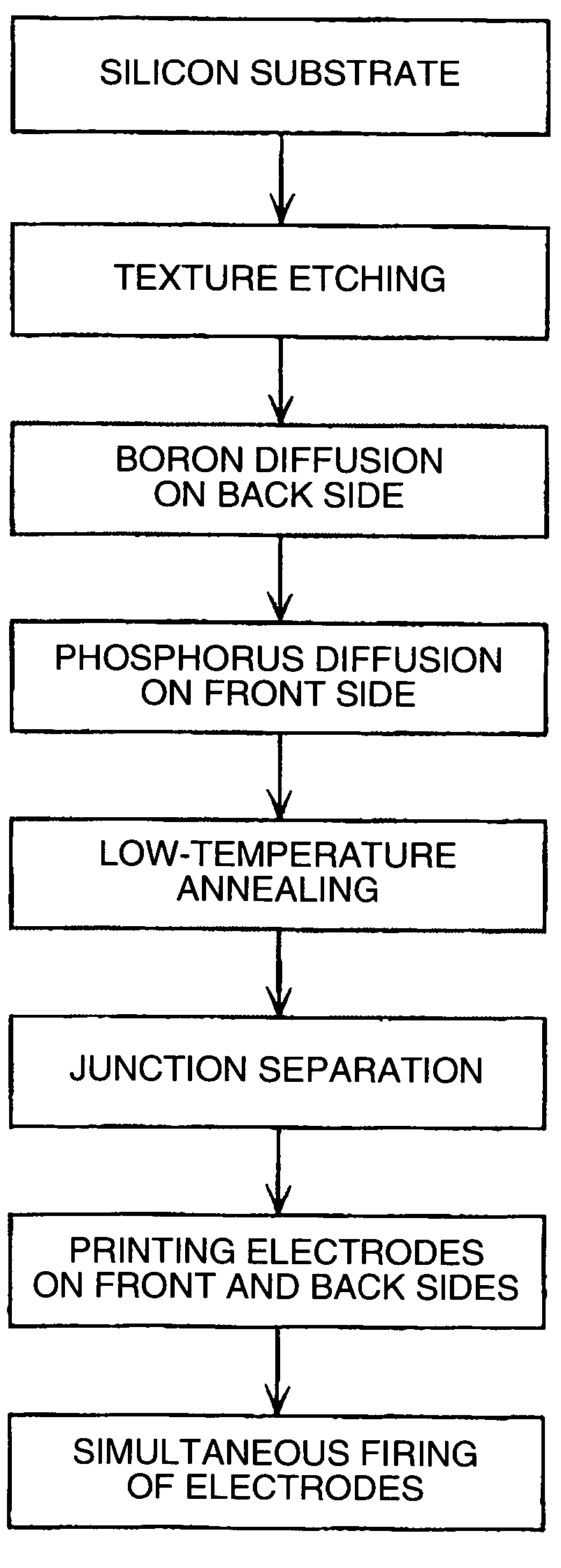
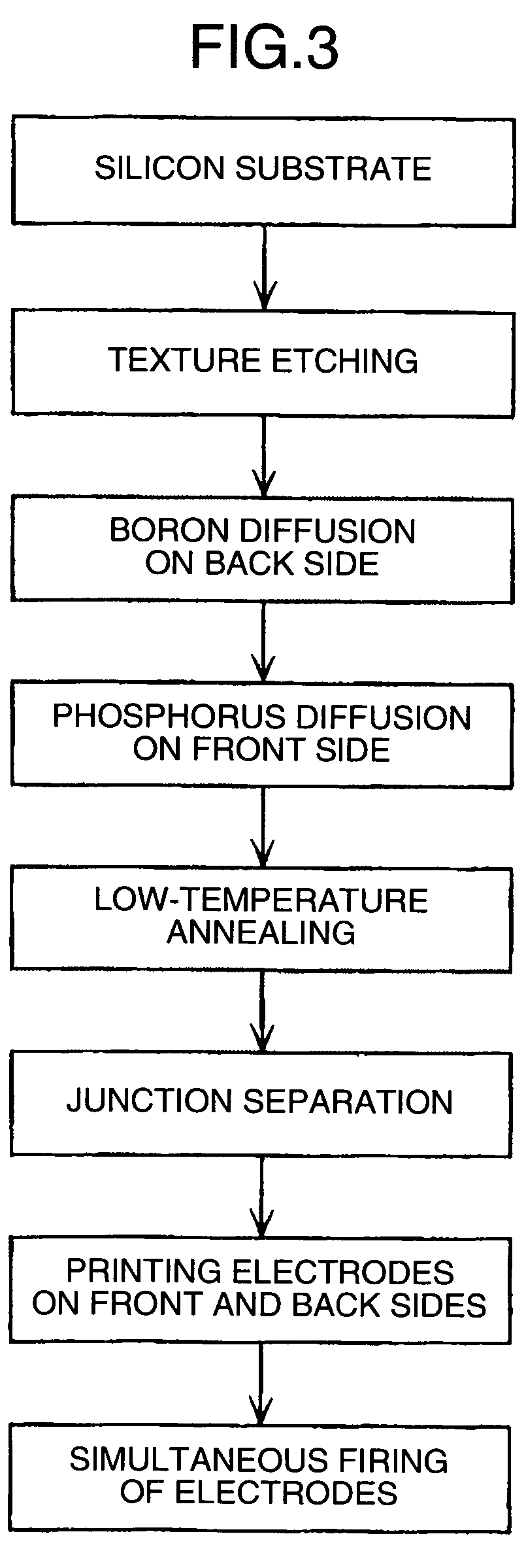
[0035]The solar cell of Example 1 comprises the silicon substrate 1 coated with the n+ layer 2 on the front side and p+ layer 3 on the back side, the former being formed by phosphorus diffusion and the latter by boron diffusion, where the n+ layer 2 and p layer of the silicon substrate 1 form the p-n junction while the p+ layer 3 forms a BSF. Each of the n+ layer 2 and p+ layer 3 is coated with the silicon oxide (SiO2) film 4.
[0036]The n+pp+-diffused substrate of BSF structure is coated with the respective front electrode 5 as the cathode on the front side and back electrode 6 as the anode on the back side. The grid-shape electrode for the silicon solar cell of Example 1 is composed of the busbar electrodes 8 and finger electrodes 9, as illustrated in FIG. 2, where ...
example 2
[0048]The solar cell with n+pp+ BSF structure was produced in Example 2 in the same manner as in Example 1, except that it was coated with the grid-shape electrode, as illustrated in FIG. 2, on the front side, not expecting positive photosensitivity on the back side. Therefore, it differs from the cell produced in Example 2 only in that the electrode accounts for a larger area and is arranged more finely and tightly as shown at FIG. 5. In other words, area ratio of the grid-shape electrode on the front side to the front side surface is smaller than that of the grid-shape electrode on the back side to the back side surface.
[0049]A mono-facial cell by conventional technique, illustrated in FIG. 6, comprises the n+p-diffused substrate 12 coated with the aluminum electrode 13 of uneven brownish red color over the entire back side. By contrast, the mono-facial cell of Example 2, illustrated in FIG. 5, comprises the n+pp+-diffused substrate 7 coated with the busbar electrodes 8 and finger...
example 3
[0051]The solar cell was produced in the same manner as in Example 1 or 2, except that the fine finger electrodes 9 (width: 100 μm or less) were made thicker at the bases 11 on the busbar electrode 8, as illustrated in FIG. 7. The width of the busbar electrode 8 in the cell of Example 3 is at least 10 times wider than that of the finger electrode 9 and is 1 to 3 mm. The wider base 11 is rectangular (FIG. 7 (A)) or triangular (FIG. 7(B)), and the finger electrodes 9 are made 2 to 4 times wider in width at a portion around 1 mm from the base 11. The width of the finger electrode 9 may be made wider in the section from the base 11 to 0.3 to 2 times of the busbar electrode width. The solar cell of Example 3 has improved cell performance, because the finger electrodes 9 for the grid-shape electrode are made finer to increase number of the finger electrodes 9 and thereby to reduce series resistance of the cell.
[0052]As discussed above, Example 3 realizes a solar cell of high efficiency by...
PUM
| Property | Measurement | Unit |
|---|---|---|
| width | aaaaa | aaaaa |
| peak temperature | aaaaa | aaaaa |
| temperature | aaaaa | aaaaa |
Abstract
Description
Claims
Application Information
 Login to View More