Epoxy resin curing agent produced by heating anhydride and polyester in presence of hydrogen and hydrogenation catalyst
a technology of hydrogen and catalyst, which is applied in the field of acid anhydridebased epoxy resin curing agent, epoxy resin composition, etc., can solve the problems of product unusability, achieve excellent crack resistance and transparency, and produce with relative ease. , the effect of minimal coloring
- Summary
- Abstract
- Description
- Claims
- Application Information
AI Technical Summary
Benefits of technology
Problems solved by technology
Method used
Image

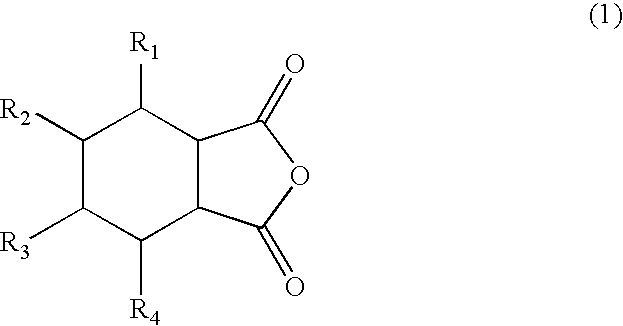
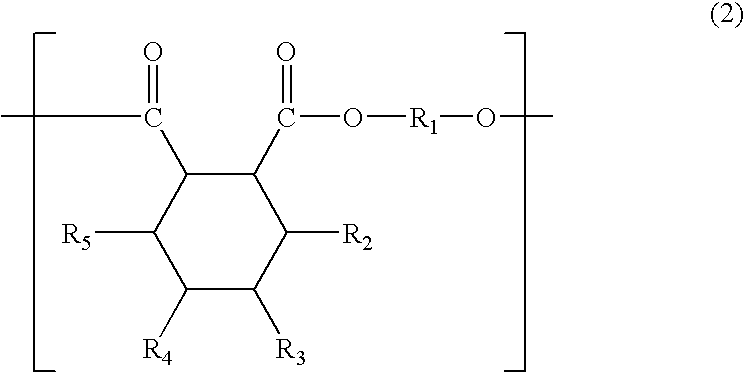

Examples
example 1
[0058]A reaction vessel fitted with a stirrer, a thermometer and a reflux condenser was charged with 172 parts by weight of 1,4-cyclohexanedicarboxylic acid, 208 parts by weight of neopentyl glycol and 0.1 parts by weight of tetrabutyl titanate, the resulting mixture was heated to 160° C., and the temperature was then raised from 160° C. to 250° C. over a period of 4 hours. Subsequently, the pressure was reduced to 5 mmHg over a period of one hour, and following a further pressure reduction to 0.3 mmHg, the mixture was reacted for one hour at 250° C., thus yielding a polyester resin (I).
[0059]A reaction vessel fitted with a stirrer, a thermometer and a gas inlet tube was charged with 20 parts by weight of the polyester resin (I) and 80 parts by weight of 4-methylhexahydrophthalic anhydride (HN-7000, manufactured by Hitachi Chemical Co., Ltd.) as the polyvalent carboxylic acid anhydride, and the mixture was stirred at 110° C. for 45 minutes under a stream of nitrogen gas, thereby ach...
example 2
[0063]Synthesis was conducted in the same manner as the example 1, using 101 parts by weight of 4-methylhexahydrophthalic anhydride (HN-7000, manufactured by Hitachi Chemical Co., Ltd.), 61 parts by weight of tetrahydrophthalic anhydride, 120 parts by weight of neopentyl glycol, 19 parts by weight of ethylene glycol, and 0.06 parts by weight of tetrabutyl titanate, thereby yielding a polyester resin (II).
[0064]A reaction vessel fitted with a stirrer, a thermometer and a gas inlet tube was charged with 30 parts by weight of the polyester resin (II) and 70 parts by weight of methylhexahydrophthalic anhydride (HN-5500, manufactured by Hitachi Chemical Co., Ltd.) as the polyvalent carboxylic acid anhydride, and the mixture was stirred at 110° C. for one hour under a stream of nitrogen gas, thereby achieving completely uniform dissolution and yielding a mixture (II).
[0065]An induction stirring autoclave was charged with 100 parts by weight of the mixture (II) and 0.3 parts by weight of a...
example 3
[0067]Synthesis was conducted in the same manner as the example 1, using 52 parts by weight of 1,2-cyclohexanedicarboxylic acid, 83 parts by weight of isophthalic acid, 40 parts by weight of sebacic acid, 120 parts by weight of neopentyl glycol, 12 parts by weight of 1,6-hexanediol, and 0.06 parts by weight of tetrabutyl titanate, thereby yielding a polyester resin (III).
[0068]A reaction vessel fitted with a stirrer, a thermometer and a gas inlet tube was charged with 30 parts by weight of the polyester resin (III) and 70 parts by weight of methylhexahydrophthalic anhydride (HN-5500, manufactured by Hitachi Chemical Co., Ltd.) as the polyvalent carboxylic acid anhydride, and the mixture was stirred at 110° C. for 40 minutes under a stream of nitrogen gas, thereby achieving completely uniform dissolution and yielding a mixture (III).
[0069]An induction stirring autoclave was charged with 100 parts by weight of the mixture (III) and 0.5 parts by weight of a 5% by weight rhodium / carbon ...
PUM
| Property | Measurement | Unit |
|---|---|---|
| mol % | aaaaa | aaaaa |
| temperature | aaaaa | aaaaa |
| temperature | aaaaa | aaaaa |
Abstract
Description
Claims
Application Information
 Login to View More
 - R&D
- Intellectual Property
- Life Sciences
- Materials
- Tech Scout
- Unparalleled Data Quality
- Higher Quality Content
- 60% Fewer Hallucinations
Browse by: Latest US Patents, China's latest patents, Technical Efficacy Thesaurus, Application Domain, Technology Topic, Popular Technical Reports.
© 2025 PatSnap. All rights reserved.Legal|Privacy policy|Modern Slavery Act Transparency Statement|Sitemap|About US| Contact US: help@patsnap.com