Production of biofuels and biolubricants from a common feedstock

a technology of biolubricants and biofuels, which is applied in the direction of fuels, fatty acid oxidation, organic chemistry, etc., can solve the problems of affecting the use affecting the cold flow of conventional biodiesel fuels, and destroying carbon deposits on engines

a technology of biolubricants and biofuels, which is applied in the direction of fuels, fatty acid oxidation, organic chemistry, etc., can solve the problems of affecting the use affecting the cold flow of conventional biodiesel fuels, and destroying carbon deposits on engines

US7815694B2Inactive Publication Date: 2010-10-19CHEVROU USA INC

Image

Smart Image Click on the blue labels to locate them in the text.
Viewing Examples
Smart Image
  • Production of biofuels and biolubricants from a common feedstock
  • Production of biofuels and biolubricants from a common feedstock
  • Production of biofuels and biolubricants from a common feedstock

Examples

Experimental program
Comparison scheme
Effect test

example

[0075]This Example serves to illustrate how fractional crystallization can be utilized to separate fatty acids according to their degree of separation, in accordance with some embodiments of the present invention. Such separations are known in the art, as this Example is based on a procedure described by J. Singh et al., “The Component Fatty Acids of Penicillium Lilacium Fat,” Biochem. J., vol. 62, p. 222 (1956). Accordingly, it is the integration of such separations with the methods and systems of the present invention that is novel.

[0076]A mixture of fatty acids is prepared comprising: 46.89 g of oleic acid (a monounsaturated fatty acid), 16.23 g of linoleic acid (a polyunsaturated fatty acid), and 58.52 g of saturated fatty acid (total weight of mixture is 121.64 g). The composition of the mixture (by weight %) is: 38.56% oleic acid, 13.3% linoleic acid, and 48.12% saturated acid.

[0077]The above mixture is crystallized at −65° C. with 10 volumes of acetone (˜1.5 L). The first fil...

the structure of the environmentally friendly knitted fabric provided by the present invention; figure 2 Flow chart of the yarn wrapping machine for environmentally friendly knitted fabrics and storage devices; image 3 Is the parameter map of the yarn covering machine
Login to View More

PUM

PropertyMeasurementUnit
operating pressureaaaaaaaaaa
temperatureaaaaaaaaaa
Login to View More

Abstract

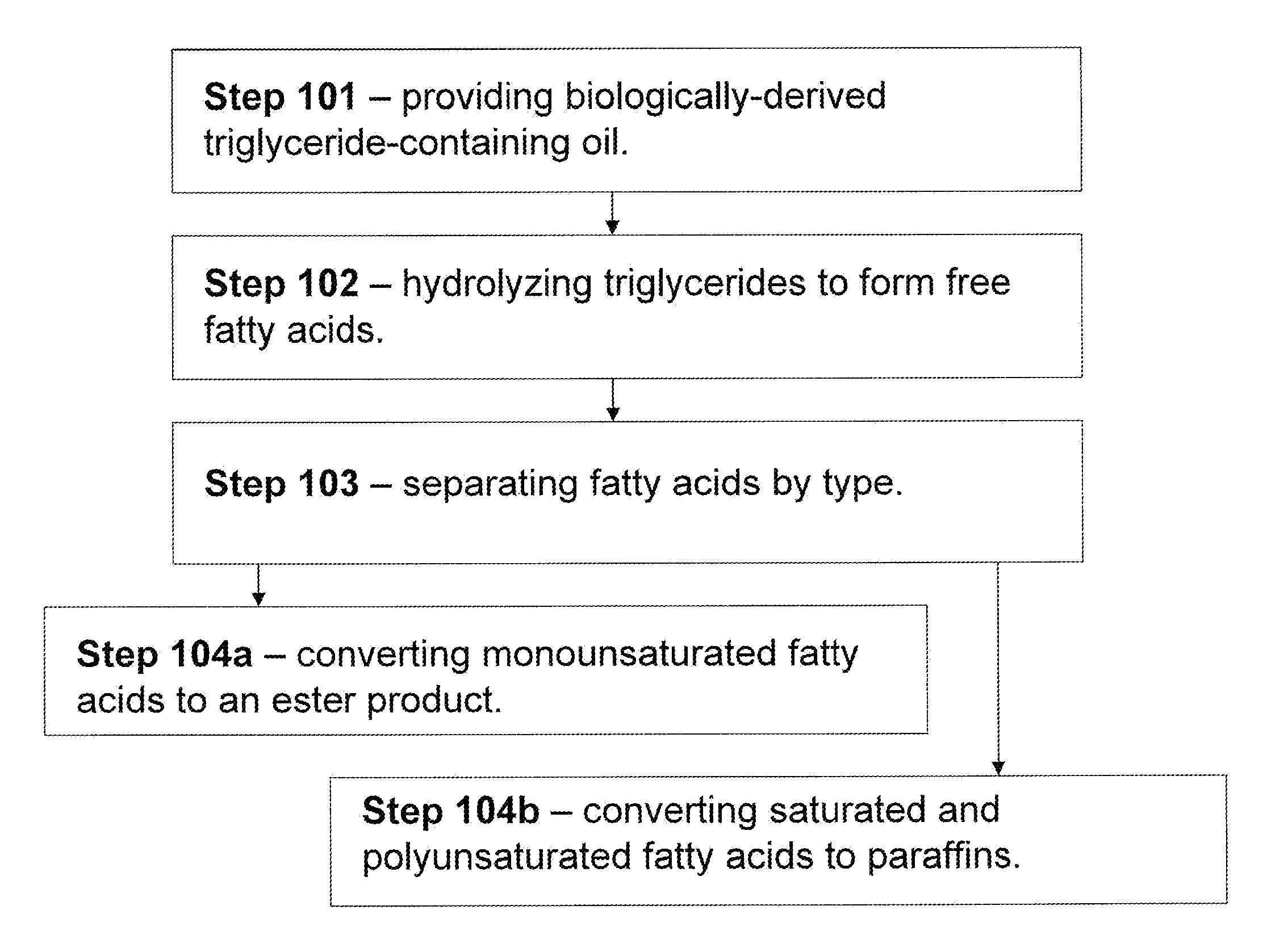
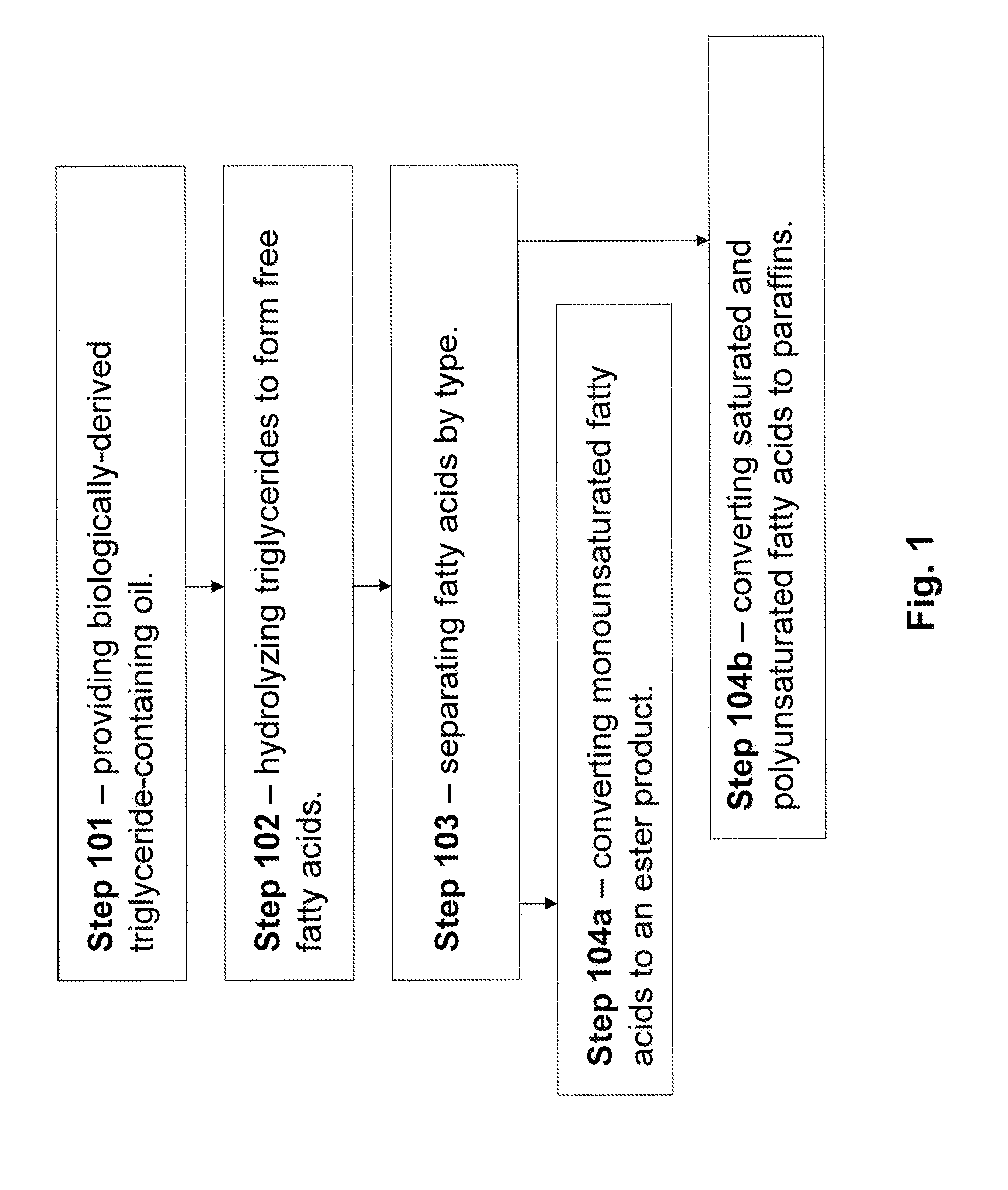
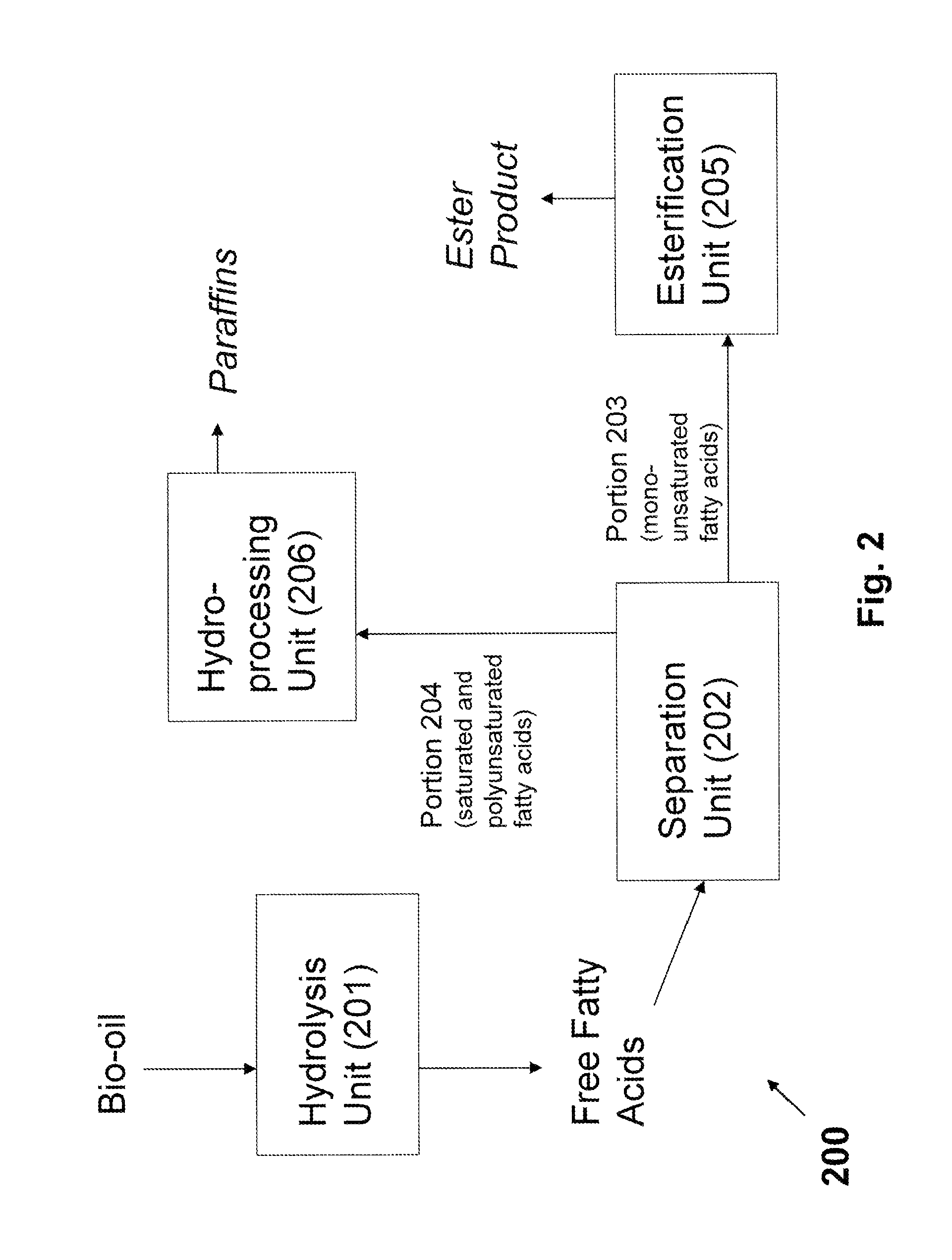
The present invention is directed to methods and systems for processing triglyceride-containing, biologically-derived oils, wherein such processing comprises conversion of triglycerides to free fatty acids and the separation of these fatty acids by saturation type. Such separation by type enables the efficient preparation of both lubricants and transportation fuels from a common source using a single integrated method and / or system.

Description

FIELD OF THE INVENTION[0001]This invention relates generally to lubricants and fuels derived from biomass, and specifically to methods and systems for efficiently making biolubricants and biofuels from vegetable or crop oils.BACKGROUND[0002]Biofuels are of increasing interest for a number of reasons including: (1) they are a renewable resource, (2) their production is less dependent on geopolitical considerations, (3) they provide the possibility of a direct replacement of petroleum-based fuels in existing vehicles, and (4) the net greenhouse gas emissions can be substantially reduced by virtue of CO2 uptake by biofuel precursors-particularly in the case of cellulose feedstocks. See Pearce, “Fuels Gold,” New Scientist, 23 Sep. 2006 pp. 36-41.[0003]An easily-obtainable biofuel is vegetable oil, which largely comprises triglycerides and some free fatty acids. The properties of vegetable oil, however, make it generally inappropriate for use as a direct replacement for petroleum diesel ...

Claims

the structure of the environmentally friendly knitted fabric provided by the present invention; figure 2 Flow chart of the yarn wrapping machine for environmentally friendly knitted fabrics and storage devices; image 3 Is the parameter map of the yarn covering machine
Login to View More

Application Information

Patent Timeline
19 Oct 2010
Publication
US7815694B2
IPC
B01J8/00; C07C1/00; C10L1/18; C10L5/00
CPC
C10G45/58; C11C3/003; C10G3/46; C10G3/50; C11C3/006; C10G2300/1011; Y02P30/20; C10G2300/1014
Inventors
MILLER, STEPHEN JOSEPH