
Electronic circuit, electro-optical device, and electronic apparatus including the same
a technology of electrooptical devices and electronic devices, applied in the direction of static indicating devices, optical radiation measurement, instruments, etc., can solve the problems of a/d conversion potential significantly narrow dynamic range, poor saturation characteristics of polysilicon thin-film transistors, etc., to achieve optimal display quality, increase in cost, and sufficient a/d conversion dynamic range
- Summary
- Abstract
- Description
- Claims
- Application Information
AI Technical Summary
Benefits of technology
Problems solved by technology
Method used
Image

Examples
first embodiment
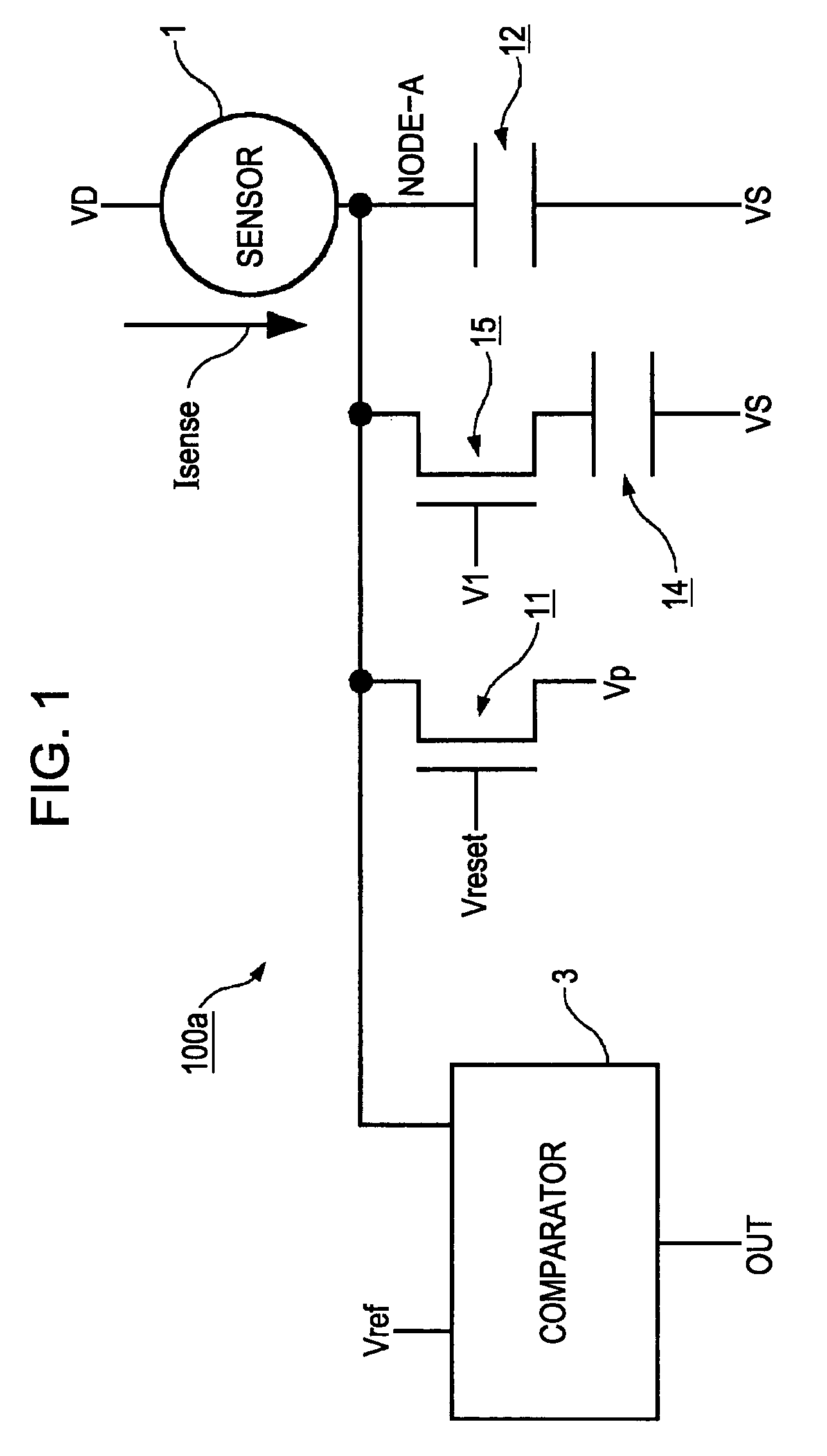
[0061]FIG. 1 is a diagram showing a sensor 1 and an A / D conversion circuit 100a realizing an electronic circuit in accordance with a first embodiment of the present invention. Elements that are the same as those of the known structure shown in FIG. 12 are designated by the same reference numerals, and a description thereof is omitted. In this circuit, a transistor is not used for conversion of the current Isense and the voltage VA, and a capacitor 12 serving as a first capacitive element and a capacitor 14 serving as a second capacitive element are placed. A transistor 15 serving as a range-switching circuit, a transistor 11 serving as a first switching element, and transistors constituting a comparator circuit 3 serving as a voltage detection circuit are field-effect transistors each including an active layer made of thin-film polysilicon disposed on a glass substrate serving as a substrate.
[0062]The capacitor 12, the capacitor 14, the transistor 15 and the transistor 11 constitute...
second embodiment
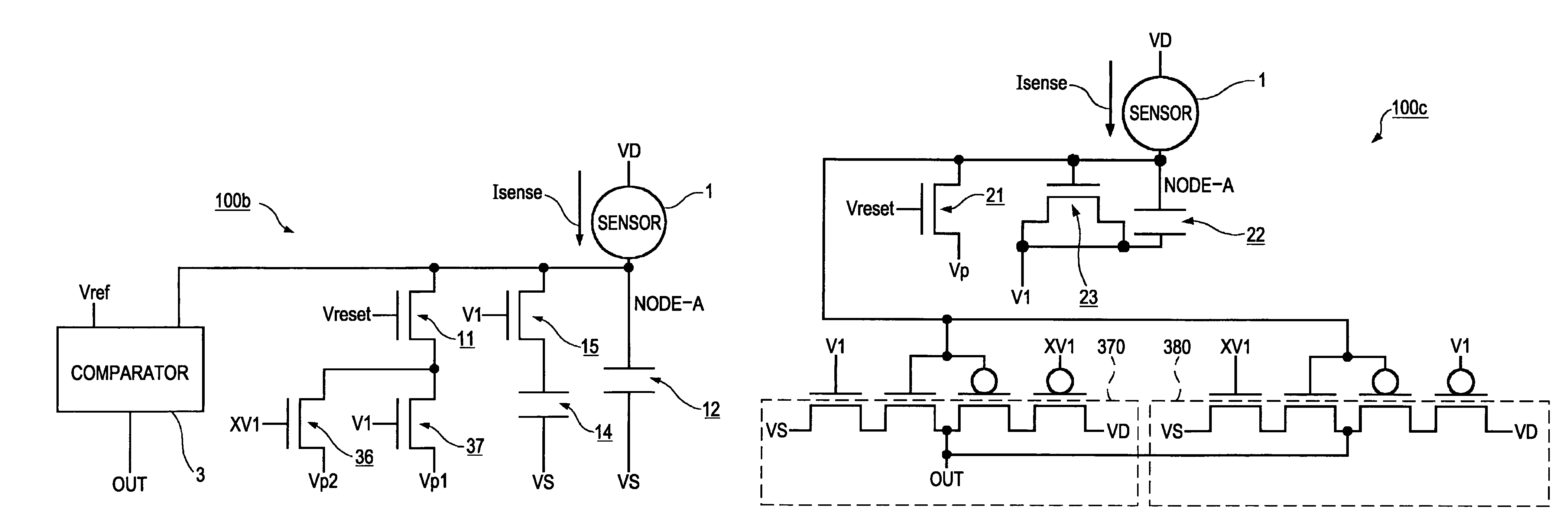
[0093]FIG. 9 is a circuit diagram showing a sensor 1 and an A / D conversion circuit 100b according to a second embodiment of the invention. A transistor 11 as a first switching element, a capacitor 12 as a first capacitive element, a capacitor 14 as a second capacitive element, and a transistor 15 as a range-switching circuit have the same structures and operate in the same manner as the elements represented by the same reference numerals in the first embodiment. The total capacitance C1 of the Node-A is 100 fF when V1=VS and 10 pF when V1=VD as in the first embodiment. The channel length and the channel width of each of transistors 36 and 37 are same as those of the transistor 15.
[0094]One end of the transistors 36 and 37 are connected via the transistor 11 to the Node-A, the other ends thereof are connected to voltages Vp2 and Vp1, respectively, thus constituting a reset voltage switching circuit that switches the reset voltage in response to a range-switching signal V1. A signal X...
third embodiment
[0098]FIG. 10 is a circuit diagram showing a sensor 1 and an A / D conversion circuit 100c according to a third embodiment of the invention. As a capacitance switching unit which is a range-switching circuit of the Node-A, instead of the structure including the capacitor and the switch shown in the first embodiment or the second embodiment, a field-effect capacitor in which source and drain electrodes of a transistor 23 are short-circuited with each other is used. The source and drain electrodes of the field-effect transistor 23 are connected to a range-switching signal V1. The voltage VA of the Node-A is between an initial voltage Vp and a reference voltage Vref, and VS+Vth23. A transistor 21 has a channel width W of 20 μm and a channel length L of 6 μm. The transistor 23 has a channel width W of 2,770 μm and a channel length L of 10 μm. A capacitor 22 has a capacitance of 100 fF.
[0099]When V1=VS, Vgs=Vp−VS>Vth, where Vgs is the voltage between the gate and the source of the transist...
PUM
 Login to View More
 Abstract
Description
Claims
Application Information
 Login to View More