
Feedback enhanced plasma spray tool
a plasma spray tool and plasma technology, applied in the field of plasma spraying devices, can solve the problems of not being able to provide enough, not being able to reliably design parts with tightly specified engineered coating structures, and no tool has been available to improve the control of these coating parameters, so as to achieve more tightly controlled coating thickness, maintain control over other variables, and increase coating deposition rate
- Summary
- Abstract
- Description
- Claims
- Application Information
AI Technical Summary
Benefits of technology
Problems solved by technology
Method used
Image

Examples
Embodiment Construction
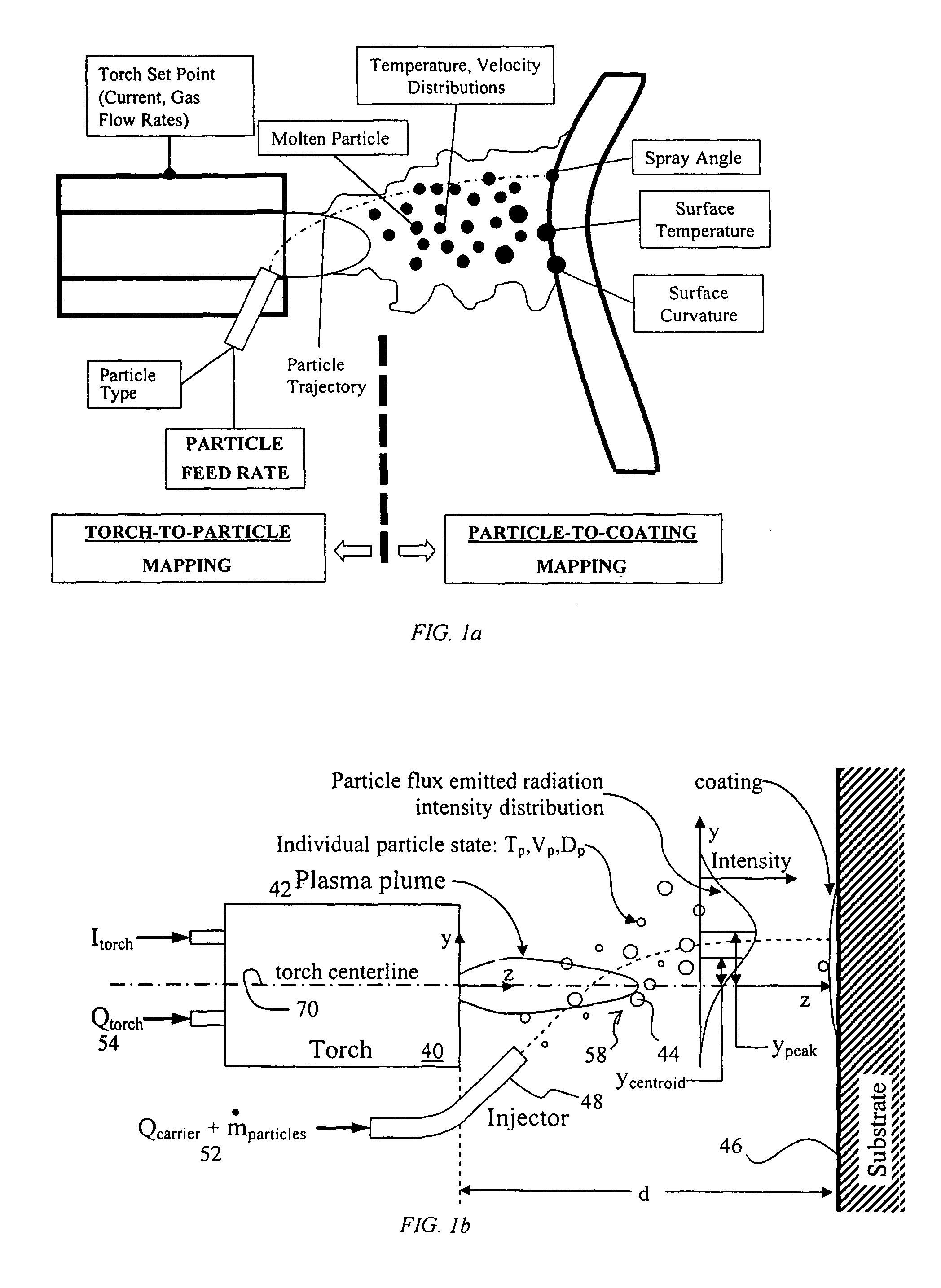
Important input and output process variables of a plasma spray process are schematically illustrated in FIGS. 1a, 1b, showing torch 40, plasma jet or plume 42, and particles 44 traveling from torch 40 to surface 46. Particles 44 are introduced into torch 40 as a powder through injector tube 48 along side 50 of torch 40. Carrier gas 52 carriers particles 44 of the powder through tube 48 and into torch 40. Alternatively, wire, liquid or suspension can be used for introducing feed material. Particles 44 are accelerated when they enter plasma jet 42 that passes through torch 44. Particles 44 are heated as they cross through plasma jet 42. Some of the particles are heated enough to melt, to provide that a substantial fraction of particles 44 are molten particles 56. Spatial distribution of particles 58 varies with distance from torch 40. Spatial distribution of particles 58 is affected by flow rate of carrier gas 52 among other conditions of the plasma jet 42.
Torch 40 includes several to...
PUM
| Property | Measurement | Unit |
|---|---|---|
| particle size | aaaaa | aaaaa |
| temperature | aaaaa | aaaaa |
| temperature | aaaaa | aaaaa |
Abstract
Description
Claims
Application Information
 Login to View More