Supercharge Your Innovation With Domain-Expert AI Agents!

PAPR reduction in multi-carrier-carrier transmission

a multi-carrier, transmission technology, applied in the direction of digital transmission, secret communication, electrical equipment, etc., to achieve the effect of saving receiver complexity, easy and reliable differentiation, and avoiding waste of useful transmission resources

Active Publication Date: 2014-01-07
TELECOM ITALIA SPA
View PDF7 Cites 0 Cited by
  • Summary
  • Abstract
  • Description
  • Claims
  • Application Information

AI Technical Summary

Benefits of technology

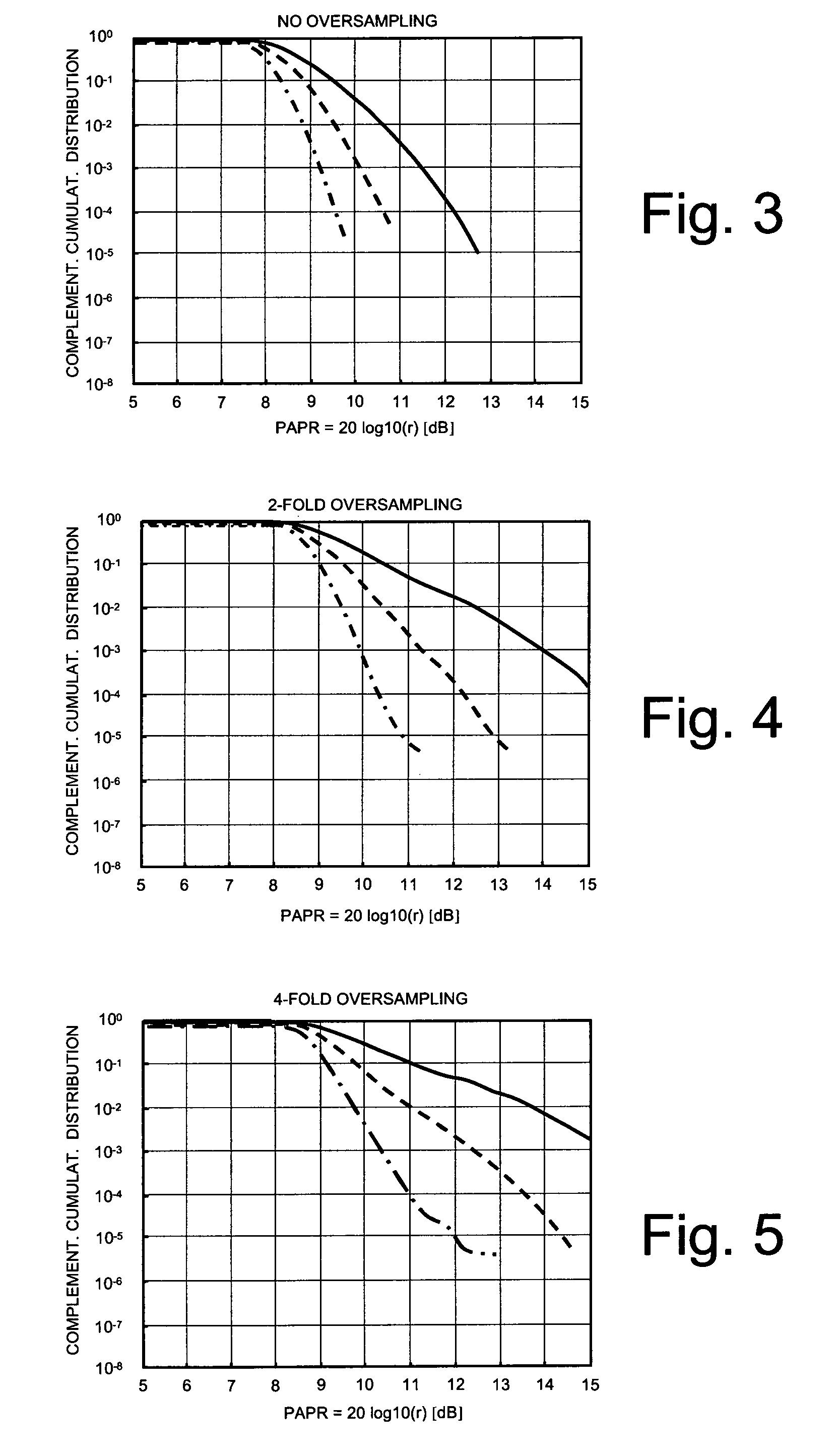
This approach achieves a significant 3 dB PAPR reduction with 99% reliability in a 4-times oversampled 256-subcarrier SISO-OFDM system, with improved results for higher-order constellations, while maintaining low complexity and spectral efficiency.

Problems solved by technology

A water-filling process is instead hardly applicable to SC transmission systems, especially for what concerns bit allocation.
All of these advantages come to the expense of one IFFT and one FFT computation per data block, and a slight drop in frequency efficiency due to the insertion of a cyclic prefix (CP) before each symbol or a zero padding (ZP) after each symbol, which result in differently structured communication signals.
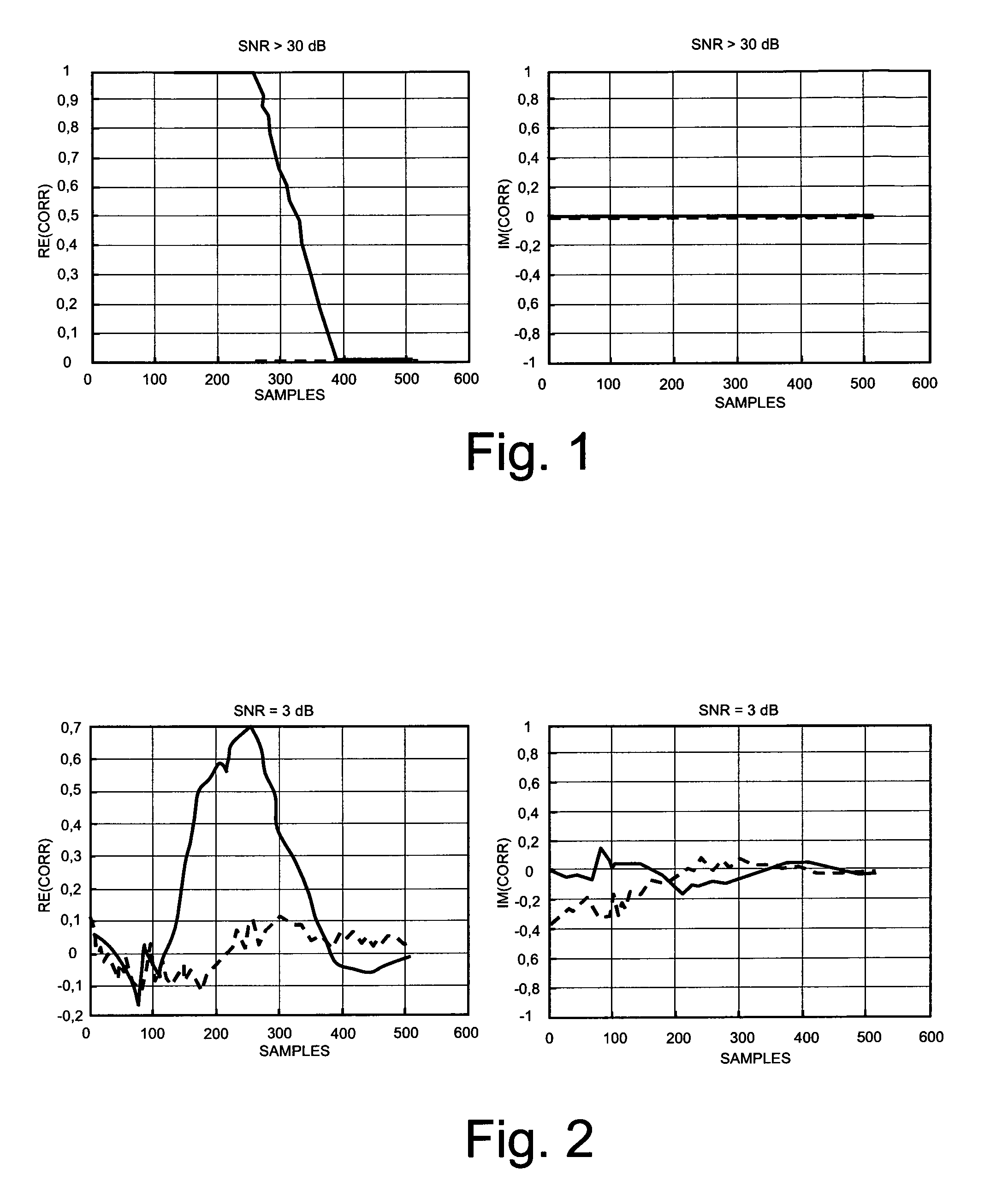
However, if data is cyclically shifted, timing errors will simply result in a phase shift after FFT, which can typically be included and corrected in channel estimation and compensation.
Can be used for simple synchronization processing but is essentially useless when the system frame structure includes synchonization-specific information blocks (training and synchronization sequences); andin certain cases, it might diminish the requirements on signal windowing to limit spectral re-growth at the transmitter.
Disadvantages of the CP method are:the average radiated power and possible battery consumption are higher than in the ZP method.
Disadvantages of the ZP method are:it is not applicable if the receiver expects a received signal with auto-correlation peaks in coincidence of the CP (which might be the case for some OFDM systems); andit needs processing at the receiver, although very simple, before FFT.
Unluckily, as different subcarriers carry uncorrelated signals, there is always a non-zero probability that different subcarriers sum up coherently in a certain time instant.
Real world PA devices have a limited range of input signals they can amplify with high linearity.
Above a certain input amplitude, the PA is driven outside its linear region, causing distortion.
However, this means higher hardware cost, and is usually not acceptable for consumer products.
a) clipping: in this case the signal is hard-limited below a certain threshold. Depending on the value of the threshold and on the PAPR value of the original signal, this process brings a certain degree of degradation in the link performance (typically an error floor). Moreover, clipping can cause signal re-growth outside the spectral mask, which is often unacceptable. A description of this technique may for example be found in US 2008 / 0101502, wherein an optimized clipping for peak-to-average power ratio reduction is disclosed. An optimized clipping pulse is generated which meets certain requirements, such as a spectral mask target or an error vector magnitude (EVM) target (expected standard deviation between signal constellation points before and after PAPR reduction), when applied to a signal;
b) using a certain fraction of the total subcarriers not to carry information data but to reduce the PAPR. This kind of solution inherently reduces spectral efficiency; in fact, it has been reported in the literature that the fraction of unusable subcarriers needed to appreciably lower PAPR is not negligible, e.g. 5 to 10% or more. Moreover, to guarantee a substantial reduction of PAPR, complicated iterative algorithms are necessary at the transmitter, having a computational load and / or delay that is unacceptable in most practical applications. A description of this technique may for example be found in Kamran Haider, “Peak to Average Ratio Reduction in Wireless OFDM Communication Systems”, Degree of Master of Science in Electrical Engineering, Blekinge Institute of Technology, Department of Telecommunications and signal processing, January 2006;
c) phase rotation at the transmitter. In this case the phase of the subcarriers is rotated before IFFT according to a set of pre-determined sequences. IFFT processing is applied to all of the candidate OFDM symbols, and the one with lowest PAPR value is transmitted. The receiver tries to decode the possible OFDM symbols corresponding to all the sequences in a blind way, and can verify the correctness of a certain sequence when channel decoding of CRC-check is error free (blind detection). This technique produces a sustainable increase in the complexity of the transmitter due to multiple IFFTs that are to be performed in parallel, in contrast to the technique previously described in item b), but in general multiplies the complexity of the receiver by the number of sequences, which is not acceptable. Some variants of this technique try to signal what sequence has been used, but this reduces the number of subcarriers available for payload data. A description of this technique may for example be found either in the above-referenced “Peak to Average Ratio Reduction in Wireless OFDM Communication Systems” or in WO 2004 / 054193, wherein a scrambling-based peak-to-average power ratio reduction without side information is disclosed. One of a set of scrambling sequences is used at the transmitter which results in either a minimum or acceptable peak power. Rather than transmitting side information identifying which of the set of scrambling sequences was selected, the scrambling sequence is also applied to the cyclic redundancy check (CRC), and using syndrome detection the receiver is capable of determining which scrambling sequence was used at the transmitter and can proceed with the necessary de-scrambling. This solution, however, can be used only with a specified type of channel coding, that is in general not acceptable;
d) translation of constellation signals inside their decision region. According to this technique, the value of the constellation signals can be varied iteratively, provided that signals do not go outside their decision region, until the IFFT output converges to a solution having limited PAPR. The technique can be applied in particular to the external signals in constellations, bringing them towards an even more external position. However, this technique involves complex iterative computations as well as multiple IFFTs at the transmitter, and in general does not guarantee an appreciable reduction of PAPR. A description of this technique may for example be found in Cristina Ciochina, Fabien Buda and Hikmet Sari, “An Analysis of OFDM Peak Power Reduction Techniques for WiMAX Systems”, IEEE International Conference on Communications, June 2006, vol. 10, pages 4676-4681.


Method used

the structure of the environmentally friendly knitted fabric provided by the present invention; figure 2 Flow chart of the yarn wrapping machine for environmentally friendly knitted fabrics and storage devices; image 3 Is the parameter map of the yarn covering machine
View more

Image

Smart Image Click on the blue labels to locate them in the text.
Viewing Examples
Smart Image
  • PAPR reduction in multi-carrier-carrier transmission
  • PAPR reduction in multi-carrier-carrier transmission
  • PAPR reduction in multi-carrier-carrier transmission

Examples

Experimental program
Comparison scheme
Effect test

first embodiment

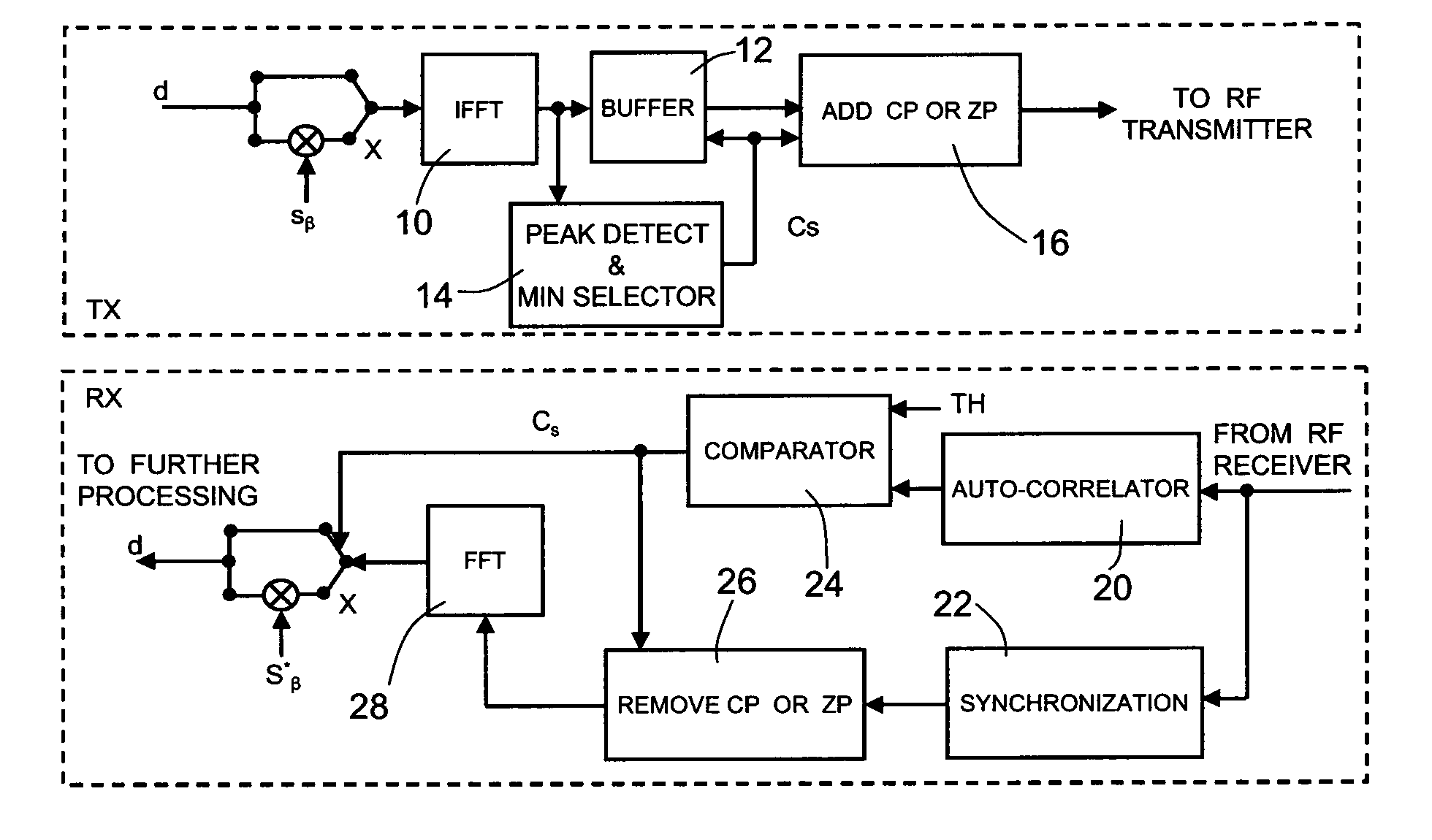
[0059]Let's now consider, as an example, the invention wherein β=2. The elements of the two sequences are pseudo-random numbers with different modules:

sβ(i)=αβ(i)·ejφβ(i), 0≦≦N−1  (11)

where α is a positive number, and φ is a random number uniformly distributed between −π and π. In many practical implementations, α may be set to 1 so as to have a variable phase only. For the sake of simplicity, in the following α will be assumed to be unitary.

[0060]Let PAPR1 be the PAPR value when using scrambling sequence s1 and PAPR2 the PAPR value when using s2. It may be appreciated that one of the two scrambling sequences s1 and s2, but not both, may be unitary, namely made up of unitary scrambling elements (unitary modulus and zero phase), so resulting in a non-descrambling of the modulated data (X(n)=d(n)).

[0061]For the transmission of each OFDM symbol, the scrambling sequence Sβ is then selected such that:

[0062]β=arg⁢⁢minβ⁢(PAPR).(12)

[0063]Moreover, it is chosen to transmit CP when β=1, and Z...

third embodiment

[0086]Therefore, let's finally consider, as a yet further example, the present invention, wherein the inventive principle is applied to a MIMO system with MT transmitting antennas and MR receiving antennas. A MISO system is a particular case of a MIMO system where MR=1.

[0087]Let the data payload transmitted on the p-th transmit antenna be defined, similarly to formula (1′), as:

[0088]xIFFT,p⁡(t)=1N⁢∑n=0N-1⁢dp⁡(n)⁢sβ⁡(n)⁢ⅇj⁢⁢2⁢π⁢⁢n⁢⁢t / N(17)

[0089]In formula (17), it may be immediately appreciated that the same scrambling sequence is used for all the transmitting antennas.

[0090]Let the PAPR value associated with a single antenna defined as:

[0091]PAPRp=max0≤t<Ts⁢xIFFT,p⁡(t)2Potav(18)

then, the maximum PAPR on all antennas is:

[0092]PAPRtot=maxp=0⁢…⁢⁢MT-1⁢(PAPRp)(19)

and the scrambling sequence is chosen based on:

[0093]β=arg⁢⁢minβ⁢(PAPRtot).(20)

[0094]At the receiver, exactly the same processing as for the SISO case can be applied to determine if CP or ZP has been transmitted.

[0095]The ove...

the structure of the environmentally friendly knitted fabric provided by the present invention; figure 2 Flow chart of the yarn wrapping machine for environmentally friendly knitted fabrics and storage devices; image 3 Is the parameter map of the yarn covering machine
Login to View More

PUM

No PUM Login to View More

Abstract

A multi-carrier data communication is selectively operable in one of different communication modes which result in differently structured communication signals, the communication being configured for processing a data item intended to be transmitted to generate different transmission candidate data; selecting one of the transmission candidate data for transmission; selecting one of the communication modes based on the selected data item; and transmitting the selected data item using the selected communication mode.

Description

CROSS REFERENCE TO RELATED APPLICATION[0001]This application is a national phase application based on PCT / IT2008 / 000683, filed Oct. 31, 2008.TECHNICAL FIELD OF THE INVENTION[0002]The present invention relates in general to radio communication systems based on multi-carrier radio transmission, and in particular to peak-to-average power ratio (PAPR) reduction in multi-carrier transmission.BACKGROUND ART[0003]As is known, in recent years a clear tendency to shift radio communications systems from single-carrier (SC) to multi-carrier (MC) transmission can be observed. There are several reasons for this paradigm shift, among which the following are worthy of mention:[0004]the necessity to cover wider bandwidths, which is related to augmented data-rate and improved robustness to multi-path fading, can be dealt with more simply by adopting MC transmission. Especially signal equalization can be performed in a largely more effective way in the frequency domain, subcarrier by subcarrier, than...

Claims

the structure of the environmentally friendly knitted fabric provided by the present invention; figure 2 Flow chart of the yarn wrapping machine for environmentally friendly knitted fabrics and storage devices; image 3 Is the parameter map of the yarn covering machine
Login to View More

Application Information

Patent Timeline
no application Login to View More
Patent Type & Authority Patents(United States)
IPC IPC(8): H04L1/02H04K1/04
CPCH04L27/2621
Inventor PRIOTTI, PAOLO
Owner TELECOM ITALIA SPA
Features
  • R&D
  • Intellectual Property
  • Life Sciences
  • Materials
  • Tech Scout
Why Patsnap Eureka
  • Unparalleled Data Quality
  • Higher Quality Content
  • 60% Fewer Hallucinations
Social media
Patsnap Eureka Blog
Learn More