Supercharge Your Innovation With Domain-Expert AI Agents!

Low cost, fast curing optical fiber coatings

a radiation cureable, optical fiber technology, applied in the direction of cladding optical fibre, glass optical fibre, instruments, etc., can solve the problems of increased coating cost, high cost of coating formulation, and high cost of primary coating, so as to achieve non-radiation cureability, low cost, and high speed

Active Publication Date: 2015-09-08
CORNING INC
View PDF18 Cites 6 Cited by
  • Summary
  • Abstract
  • Description
  • Claims
  • Application Information

AI Technical Summary

Benefits of technology

The use of non-radiation-curable polar polymers in optical fiber coatings achieves faster cure rates and lower production costs, ensuring compatibility with high-speed optical waveguide production without increasing viscosity, thereby enhancing the efficiency and cost-effectiveness of the coating process.

Problems solved by technology

Owing to its low modulus and tensile strength, the primary coating is particularly vulnerable to draw-induced defects.
The cure speed of the coating can be increased by adding higher levels of photoinitiators; however, as the photoinitiators are generally some of the most expensive components, the result is increased coating cost.
Another expensive component of an optical fiber coating formulation is the urethane acrylate oligomer that typically serves as the main component in the coating.
While the use of thermoplastic elastomers resulted in primary coatings with favorable physical properties, the resulting coatings also displayed slow cure speeds which limited the speed at which the draw could be run (thereby increasing the cost to produce optical fiber).
In addition, the high molecular weight of the thermoplastic elastomers limited the level at which they could be added to the coating without increasing viscosity beyond the range preferred for the optical fiber draw process.
While this replacement reduces cost, acrylate monomers are still relatively expensive.
Because conventional oligomeric components are, in general, much more expensive than the monomeric components, the use of oligomers in high concentration has the effect of increasing the cost of producing secondary coating compositions as well as the resulting optical fiber.
The polar polymers are non-radiation-curable and lack acrylate or other groups capable of undergoing UV-induced polymerization.

Method used

the structure of the environmentally friendly knitted fabric provided by the present invention; figure 2 Flow chart of the yarn wrapping machine for environmentally friendly knitted fabrics and storage devices; image 3 Is the parameter map of the yarn covering machine
View more

Image

Smart Image Click on the blue labels to locate them in the text.
Viewing Examples
Smart Image
  • Low cost, fast curing optical fiber coatings
  • Low cost, fast curing optical fiber coatings
  • Low cost, fast curing optical fiber coatings

Examples

Experimental program
Comparison scheme
Effect test

examples

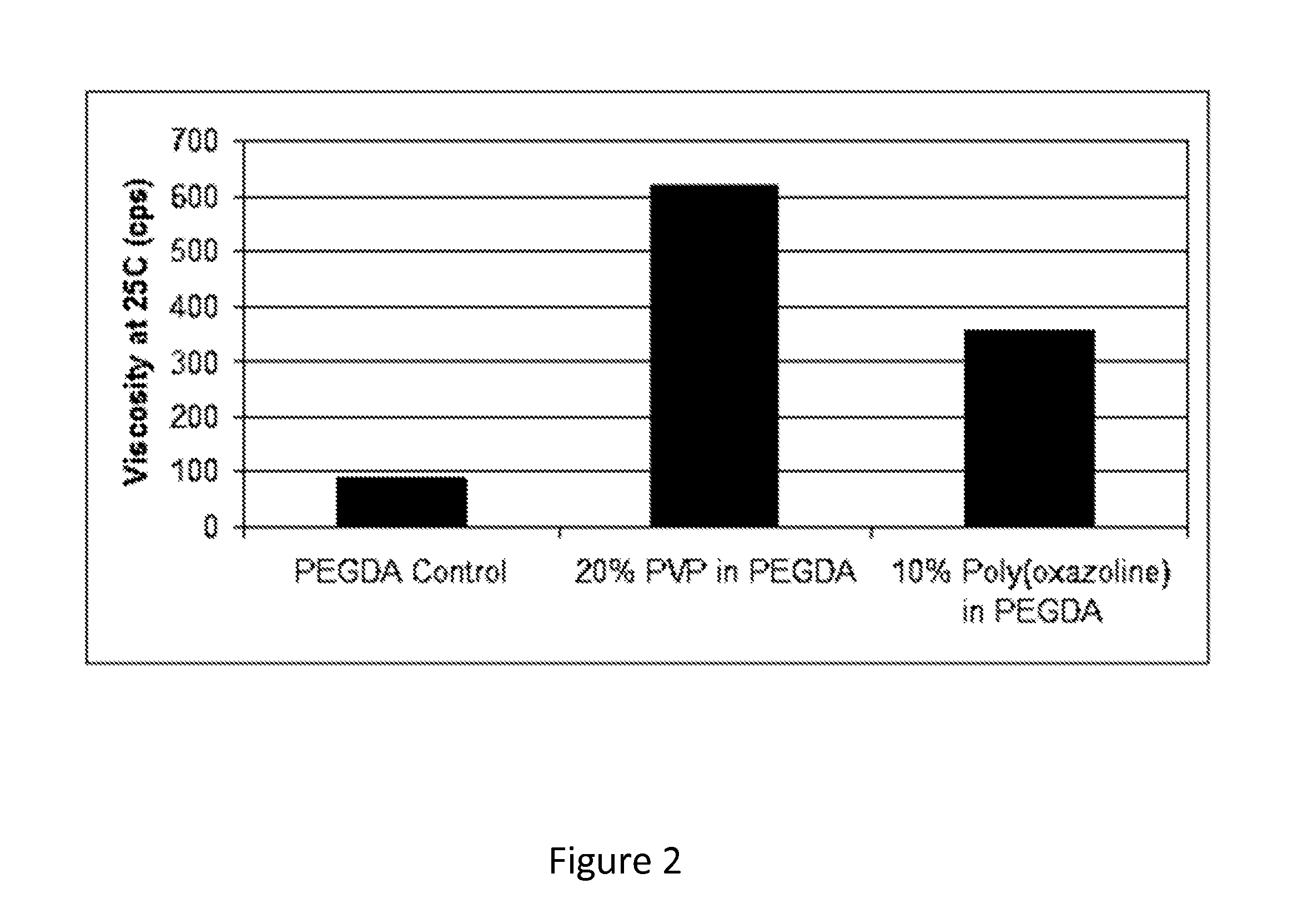
[0092]The following examples illustrate the benefits of including a non-radiation-curable polar polymer in a coating composition. Several coating compositions using PVP or poly(oxazoline) as illustrative non-radiation-curable polar polymers were considered. Specific compositions are described in Tables 1-4 below. The PVP and poly(oxazoline) materials were purchased from commercial suppliers.

[0093]The compositions in Tables 1, 2, 3 and 4 were prepared with the listed components using commercial blending equipment. The monomer, oligomer (where applicable), and polymer components were weighed into a jacketed beaker heated to 60° C.-70° C. Blending was continued until a homogeneous mixture was obtained. The photoinitiators were then weighed and added to the beaker. Blending was then continued until a homogeneous mixture as obtained.

[0094]A Brookfield CAP2000 viscometer was used to measure the viscosity of selected coating compositions. The plate was heated to 25° C. A few (3-4) drops of...

the structure of the environmentally friendly knitted fabric provided by the present invention; figure 2 Flow chart of the yarn wrapping machine for environmentally friendly knitted fabrics and storage devices; image 3 Is the parameter map of the yarn covering machine
Login to View More

PUM

PropertyMeasurementUnit
viscosityaaaaaaaaaa
viscosityaaaaaaaaaa
tensile strengthaaaaaaaaaa
Login to View More

Abstract

A low cost composition that cures rapidly and which is suitable for coating an optical fiber comprises at least one ethylenically unsaturated monomer; at least one photoinitiator; and at least one non-radiation-curable polar polymer having pendent groups that facilitate low energy chemical bonding, hydrogen bonding, dipolar interactions or other interactions with radical compounds formed during polymerization of the monomer. The non-radiation-curable polar polymer(s) are inexpensive and reduce and / or eliminate the need for expensive urethane acrylate oligomers, without sacrificing properties, and while achieving rapid cure speeds.

Description

[0001]This application claims the benefit of priority under 35 U.S.C. §119 of U.S. Provisional Application Ser. No. 61 / 824,479 filed on May 17, 2013 the content of which is relied upon and incorporated herein by reference in its entirety.FIELD[0002]This disclosure pertains to low cost, radiation-curable optical fiber coating compositions that cure relatively quickly to achieve compatibility with high speed optical waveguide production processes.TECHNICAL BACKGROUND[0003]Optical fibers are typically coated with a dual layer coating system, the main purpose of which is to protect the glass fiber from optical, environmental and mechanical failure modes. The coating system consists of a soft inner coating, commonly referred to as the inner or primary coating, and a hard outer coating, commonly referred to as the outer or secondary coating. The properties and dimensions of the coating system are designed to minimize microbend induced attenuation losses while maximizing the mechanical pro...

Claims

the structure of the environmentally friendly knitted fabric provided by the present invention; figure 2 Flow chart of the yarn wrapping machine for environmentally friendly knitted fabrics and storage devices; image 3 Is the parameter map of the yarn covering machine
Login to View More

Application Information

Patent Timeline
no application Login to View More
Patent Type & Authority Patents(United States)
IPC IPC(8): G02B6/02C09D4/06C03C25/10G02B1/12G02B6/245
CPCG02B6/245C03C25/1065C09D4/06G02B1/12G02B6/02395
Inventor FABIAN, MICHELLE DAWNMCCARTHY, KEVIN ROBERTNIU, WEIJUNSCHISSEL, DAVID NEALWINNINGHAM, MICHAEL JAMES
Owner CORNING INC
Features
  • R&D
  • Intellectual Property
  • Life Sciences
  • Materials
  • Tech Scout
Why Patsnap Eureka
  • Unparalleled Data Quality
  • Higher Quality Content
  • 60% Fewer Hallucinations
Social media
Patsnap Eureka Blog
Learn More