
Piezoelectric material, piezoelectric element, and electronic apparatus
a piezoelectric element and piezoelectric material technology, applied in the field of piezoelectric materials, can solve the problems of piezoelectric properties, piezoelectric materials, and the effect of lead components on the environment has been regarded as a problem, and achieve good mechanical quality factor, good piezoelectric constant, good mechanical quality factor
- Summary
- Abstract
- Description
- Claims
- Application Information
AI Technical Summary
Benefits of technology
Problems solved by technology
Method used
Image

Examples
example 1
[0188]Raw materials corresponding to a composition (Ba0.870Ca0.080Sn0.050)0.994(Ti0.930Zr0.070)O3 that is represented by a general formula (Ba1−x−yCaxSny)α(Ti1−zZrz) O3 where x=0.080, y=0.050, z=0.070, and α=0.994 were weighed in accordance with procedures described below.
[0189]A commercially available tin(II) oxide powder (average particle size of 600 nm, purity of 99.5% or more) was used as a Sn raw material. A barium titanate powder (average particle size of 100 nm, purity of 99.999% or more) having a perovskite structure produced by a solid-phase method, a perovskite-type calcium titanate powder (average particle size of 300 nm, purity of 99.999% or more), and a perovskite-type calcium zirconate powder (average particle size of 300 nm, purity of 99.999% or more) were used as raw materials of Ba, Ca, Ti, and Zr. These powders were weighed such that the ratio of Ba, Ca, Sn, Ti, and Zr satisfied the composition (Ba0.870Ca0.080Sn0.050)0.994(Ti0.930Zr0.070)O3. Barium oxalate and tita...
examples 2 to 23
[0197]Piezoelectric materials and piezoelectric elements of Examples 2 to 23 were prepared as in Example 1. However, the weighing ratio of each of the components used as raw materials of the piezoelectric materials was changed to the ratio shown in Table 1. The maximum temperatures (Tmax) at which compacts were fired were set to the temperatures shown in Table 1. For piezoelectric materials having a Zr ratio (z) higher than a Ca ratio (x), a perovskite-type barium zirconate (average particle size of 300 nm, purity of 99.999% or more) produced by a solid-phase method was used instead of the perovskite-type calcium zirconate powder. A commercially available lithium carbonate powder (purity of 99%) was used as a Li raw material and was mixed with the main component together with bismuth oxide. In Examples 20 to 23, in order to adjust the Mg content, 0.0049 parts by weight (Example 20), 0.0499 parts by weight (Example 21), 0.0999 parts by weight (Example 22), and 0.1199 parts by weight ...
example 24
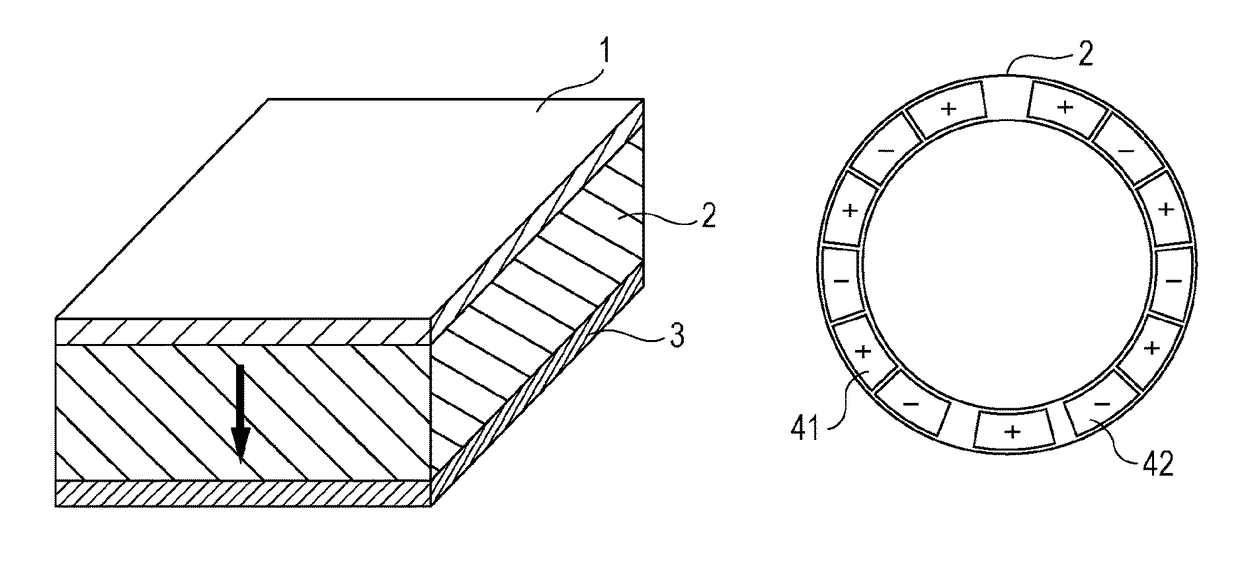
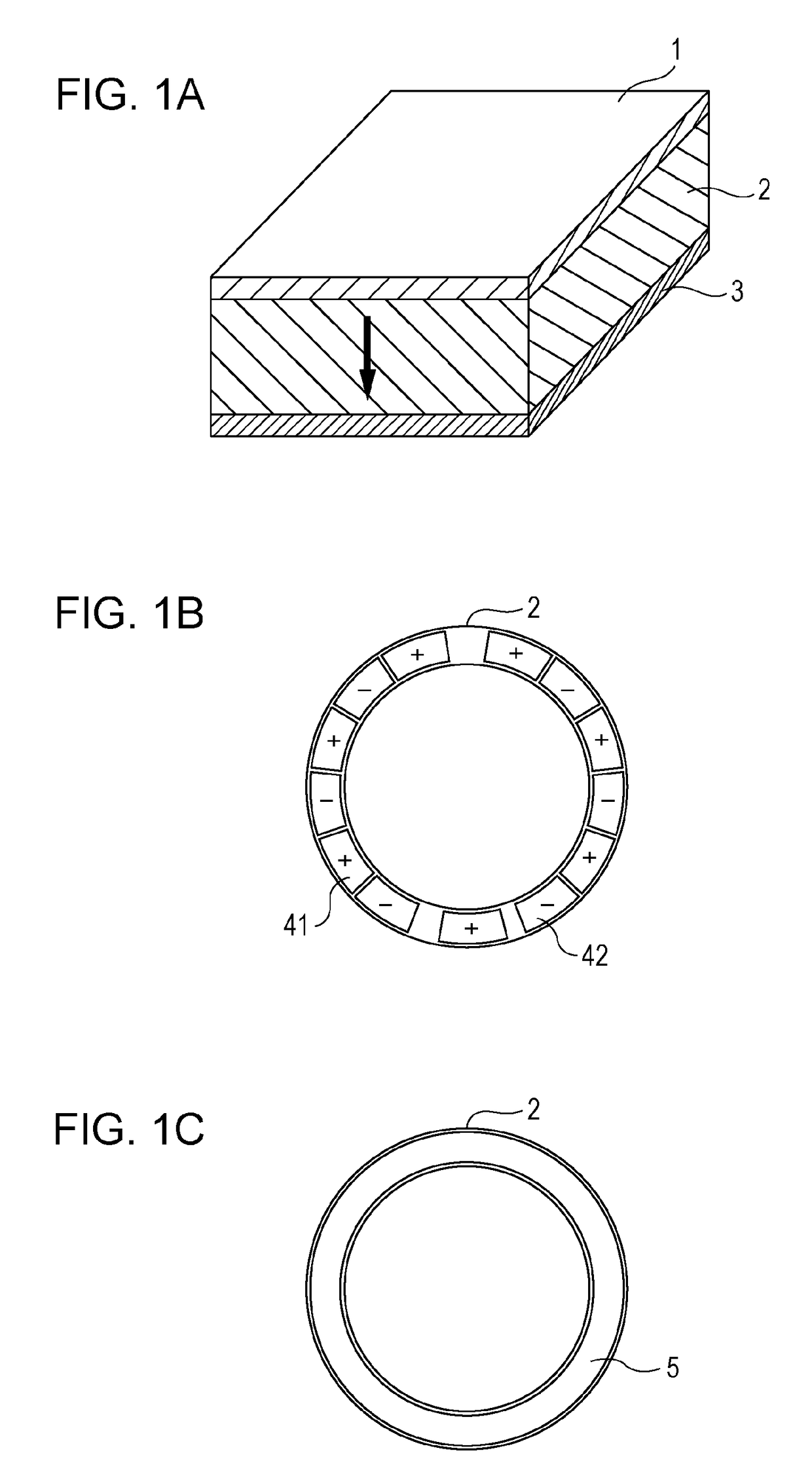
[0222]The piezoelectric element shown in FIGS. 1B and 10 was prepared by using the same piezoelectric material as that used in Example 1. The piezoelectric material contains a metal oxide that can be represented by a chemical formula (Ba0.870Ca0.080Sn0.050)0.994(Ti0.930Zr0.070) O3 as a main component, 0.180 parts by weight of Mn serving as a first sub-component, 0.260 parts by weight of Bi serving as a second sub-component, 0.0001 parts by weight of Mg serving as a third sub-component, 0.033 parts by weight of Si, and 0.017 parts by weight of B, the Si and B serving as a fourth sub-component, relative to 100 parts by weight of the main component. The piezoelectric material was processed so as to have a doughnut disk shape having an outer diameter of 70 mm, an inner diameter of 55 mm, and a thickness of 0.5 mm. Gold electrodes having a thickness of 400 nm were formed on the front and back surfaces of the piezoelectric material by a DC sputtering method. A titanium film having a thick...
PUM
| Property | Measurement | Unit |
|---|---|---|
| frequency | aaaaa | aaaaa |
| equivalent circle diameter | aaaaa | aaaaa |
| equivalent circle diameter | aaaaa | aaaaa |
Abstract
Description
Claims
Application Information
 Login to View More