

Porous biomaterial-filler composite and a method for making the same
A technology of biomaterials and composites, applied in the field of inorganic collagen scaffolds
- Summary
- Abstract
- Description
- Claims
- Application Information
AI Technical Summary
Problems solved by technology
Method used
Image

Examples
Embodiment A
[0140] The following examples describe the preparation of hydroxyapatite that can be used in the present invention. The hydroxyapatite in this method is prepared by a sol-gel method.
[0141] Use the following raw materials:
[0142] Ca(NO 3 ) 2 .4H 2 O mw = 236.15
[0143] (NH 4 ) 2 HPO 4 mw=132.06
[0144] Add 0.05M~0.5M calcium nitrate Ca(NO 3 ) 2 .4H 2 O dissolves in dH 2 Prepare the first solution in O (heavy water). In addition, 0.05M~0.5M ammonium phosphate (NH 4 ) 2 HPO 4 Soluble in dH 2 O Prepare a second solution and add aqueous ammonia NH to it 4 OH, adjust the pH of the solution to 10. Then add the first solution dropwise to the second solution. The solution was then aged at room temperature for 100 hours, and a precipitate was obtained by centrifugation. Then use three parts of reduced concentration ammonia water NH 4 OH and dH 2 O rinse, followed by a second rinse with ethanol.
[0145] The resulting gel was air-dried on a watch glas...
Embodiment B
[0147] The following examples describe the preparation method of carbonate apatite used in the present invention. The mesocarbonate apatite in this method is prepared by the following sol-gel method.
[0148] Use the following raw materials:
[0149] Ca(NO 3 ) 2 .4H 2 O mw = 236.15
[0150] (NH 4 ) 2 HPO 4 mw=132.06
[0151] (NH 4 )HCO 3 mw=79.06
[0152] Add 0.05M~0.5M calcium nitrate Ca(NO 3 ) 2 .4H 2 O dissolves in dH 2 Prepare the first solution in O (heavy water). In addition, 0.05M~0.5M ammonium phosphate (NH 4 ) 2 HPO 4 , 0.05M~0.5M ammonium carbonate (NH 4 )HCO 3 and an appropriate surfactant dissolved in dH 2 O Prepare a second solution. Add ammonia NH to the solution 4 OH and adjust the pH of the solution to 10. The first solution was then added dropwise to the second solution. The solution was aged at room temperature for 100 hours and the precipitate was obtained by centrifugal filtration. Then use three parts of reduced con...
Embodiment 1
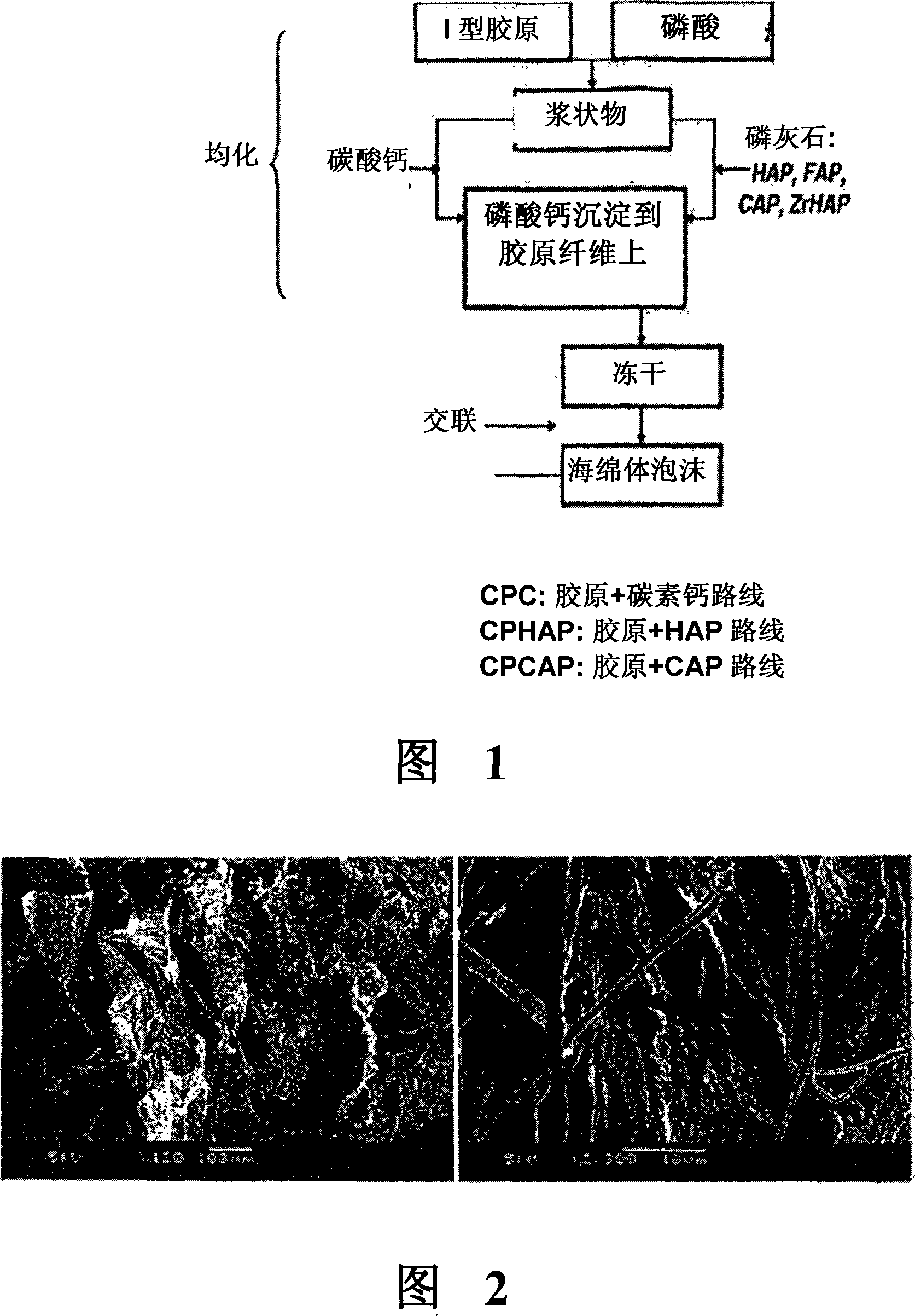
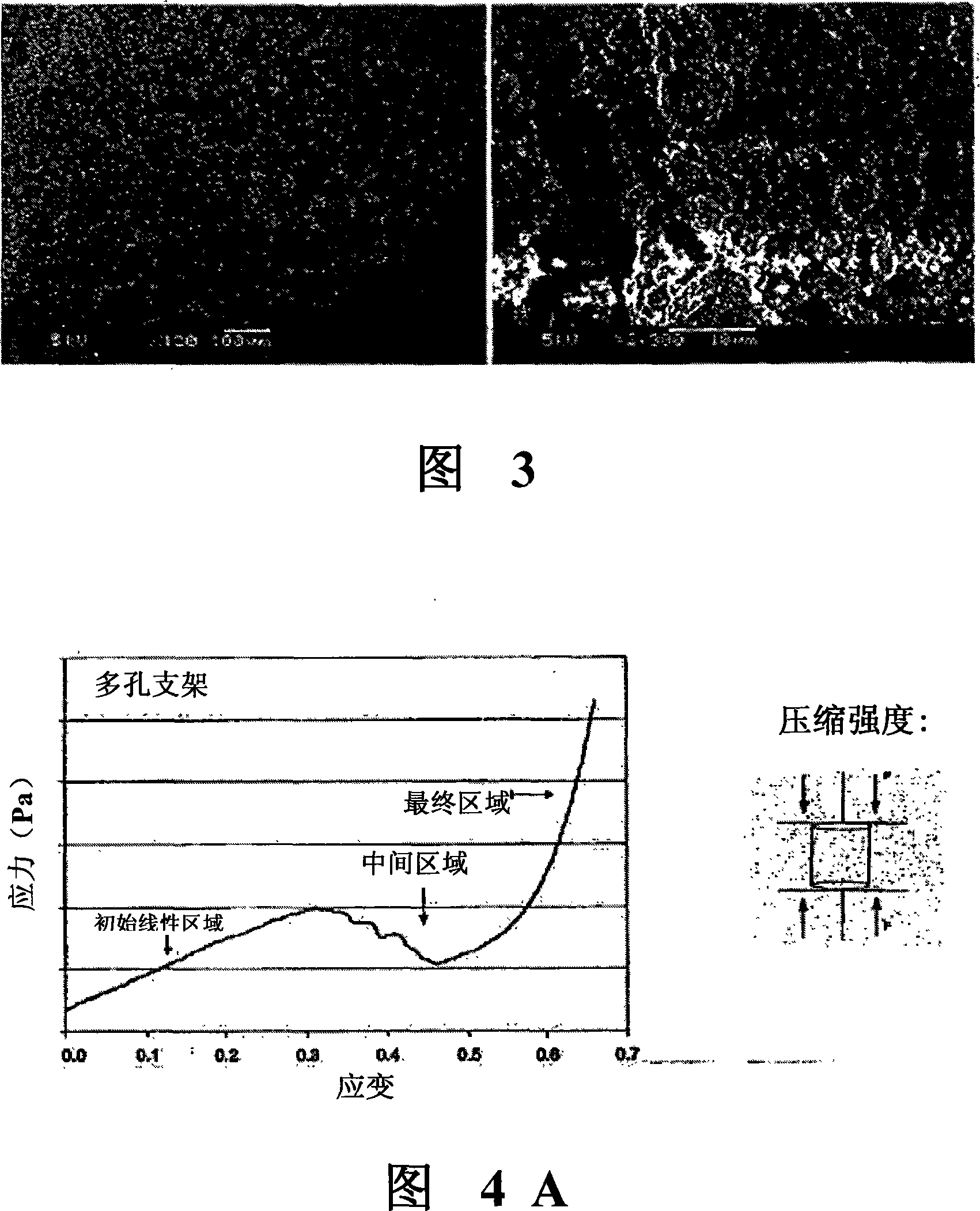
[0155] Figure 1 shows a schematic diagram of the preparation of a scaffold according to one embodiment of the present invention. In this embodiment, type 1 collagen is used, as shown in FIG. 2 . Figure 2 is a set of scanning electron micrographs of dried collagen used in the present invention, shown at x120 and x2.3 resolution. The microstructure shows small fibers of about 1.5-2 microns in diameter mixed with the flakes.
[0156] As shown in FIG. 1 , collagen type 1 and phosphoric acid are mixed into a slurry and homogenized, and then calcium carbonate and / or apatite (such as HAP, FAP, CAP, or ZrCAP) are added to the slurry. The slurry is then homogenized so that the calcium phosphate and / or apatite are dispersed and deposited on the collagen fibers.
[0157] The slurry was then lyophilized and crosslinked to form a spongy foam. The lyophilized product can be cross-linked by the following protocol:
[0158] 1-Ethyl-3-(3-dimethylaminopropyl)carbodiimide / N-hydroxysuccinim...
PUM
 Login to View More
 Abstract
Description
Claims
Application Information
 Login to View More