
Method for improving ultralow-power-consumption wireless communication transmission spectral efficiency
A wireless communication and spectrum transmission technology, applied in the field of wireless communication, can solve the problems of increased complexity and cost, low data rate, increased response, etc., and achieve the effect of improving frequency efficiency, sufficient spectrum resources, reducing cost and energy consumption
- Summary
- Abstract
- Description
- Claims
- Application Information
AI Technical Summary
Problems solved by technology
Method used
Image

Examples
Embodiment 1
[0043] This embodiment introduces a method for improving frequency efficiency by using an extended modulation mode, and specifically introduces three modulation technical solutions.
[0044] a) Modulation scheme 1: π / 4DQPSK
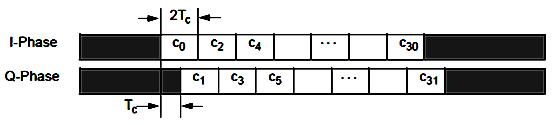
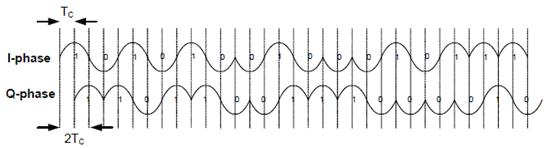
[0045] QPSK-QuadraturePhaseShiftKeying, quadrature phase shift keying, is a digital modulation method. DQPSK-Differential Quadrature Reference Phase Shift Keying, four-phase relative phase shift keying. The constellation diagram of π / 4DQPSK is composed of two QPSK constellation diagrams with a phase difference of π / 4, so the constellation diagram is exactly the same as 8PSK. But the difference between it and the latter is that the possibility of π / 4DQPSK symbols jumping between constellation points is limited. This limitation is that the phase change caused by each symbol jump can only be {π / 4 , -Π / 4, 3π / 4, -3π / 4} four possibilities, relative to O-QPSK, each phase jump is {π / 2, -π / 2} two possibilities, π / 4DQPSK can change the frequency The utilization rate ...
Embodiment 2
[0051] This embodiment introduces a method for improving frequency efficiency in a shortened 16-ary Orthogonal DSSS sequence, and specifically introduces three shortened technical solutions.
[0052] Corresponding to the original 16-ary Orthogonal DSSS sequence with a length of 32 bits, the use of a shorter 16-ary Orthogonal DSSS sequence can correspondingly improve the spectrum utilization.
[0053] 1) 16-ary Orthogonal DSSS with a length of 16 bits
[0054]
[0055] 2) 16-ary Orthogonal DSSS with a length of 8 bits
[0056]
[0057] 3) 16-ary Orthogonal DSSS with a length of 4 bits, since the data symbol is 4 bits, if the length of the DSSS sequence is 4 bits, it is equivalent to not spreading, and the processing gain of spreading is 0dB, which is equivalent Yu directly treats the data symbols as spread spectrum modulation symbol bit groups and sends them to the modulator for modulation to generate a modulated signal.
Embodiment 3
[0059] The modulation method and spread spectrum mentioned in the present invention can be generated by the following methods:
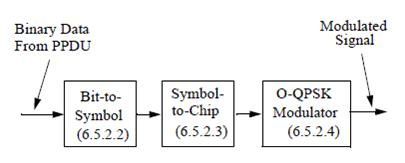
[0060] Picture 10 Describes a block diagram of a modulator using the present invention, which in turn includes four modules: "information bit to information symbol mapping", "information symbol to chip sequence mapping", "chip to modulation symbol bit grouping" and "baseband signal modulator".
[0061] Among them, "information bit to information symbol mapping" divides a group of 4 physical layer frame bit sequences into information symbols; "information symbol to chip sequence mapping" maps an information symbol into one of 16 candidate chip sequences, code The slice sequences s1, s2...s16 are all the same in length, and their length K is equal to the length of the currently selected 16-aryOrthogonal DSSS spreading sequence, such as Picture 11 . "Chip-to-modulation symbol bit grouping" is a serial-to-parallel conversion of a bit sequence. The input chi...
PUM
 Login to View More
 Abstract
Description
Claims
Application Information
 Login to View More