
Brass alloy rod using silicon and aluminum elements to inhibit lead release and preparation method thereof
A technology of brass alloys and elements, applied in the field of alloy rods, can solve the problems of difficult processing, pollution of lead-containing alloy rods, and inability to meet the needs of environmental protection, etc., to achieve the effect of inhibiting lead dissolution and improving cutting performance
- Summary
- Abstract
- Description
- Claims
- Application Information
AI Technical Summary
Problems solved by technology
Method used
Image

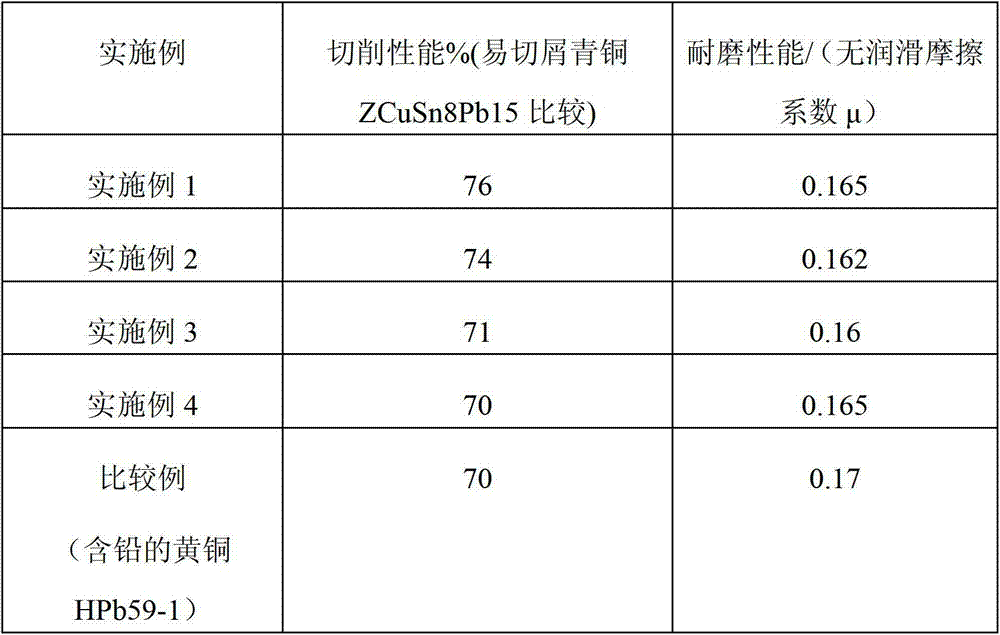
Examples
Embodiment 1
[0021] A brass alloy rod using silicon-aluminum elements to suppress lead dissolution, comprising the following components in weight percentages: 60%-65% copper, 4%-7% silicon, 4-8% aluminum, and the balance zinc. The preparation method is as follows: according to the above ratio, put each component in a power frequency electric furnace, heat it to 1150-1220 degrees and completely melt it, then keep it warm to 1100-1150 degrees; use a graphite rod to fully stir the completely melted alloy liquid , covered with high-purity flaky graphite powder to prevent its oxidation, the thickness is about 10-15cm; after the holding time of 1-2h, use the German imported Spike direct reading spectrometer to test the sample taken out of the furnace 3-6 times Sub-component inspection to ensure that the alloy composition is within the specified range; after further heat preservation for 50-60 minutes, the temperature is raised to 1200 degrees again, and the vibration device of the power frequency...
Embodiment 2
[0024] A brass alloy rod using silicon and aluminum elements to suppress the dissolution of lead is composed of the following components in weight percentage: 62.3% copper, 5.4% silicon, 6.2% aluminum, and the balance zinc. The preparation method is as follows: according to the above ratio, put each component in a power frequency electric furnace, heat it to 1150-1220 degrees and completely melt it, then keep it warm to 1100-1150 degrees; use a graphite rod to fully stir the completely melted alloy liquid , covered with high-purity flaky graphite powder to prevent its oxidation, the thickness is about 10-15cm; after the holding time of 1-2h, use the German imported Spike direct reading spectrometer to test the sample taken out of the furnace 3-6 times Sub-component inspection to ensure that the alloy composition is within the specified range; after further heat preservation for 50-60 minutes, the temperature is raised to 1200 degrees again, and the vibration device of the power...
Embodiment 3
[0027] A brass alloy rod using silicon-aluminum elements to suppress lead dissolution, consisting of the following components in weight percentages: 60%-65% copper, 4%-7% silicon, 4-8% aluminum, 1-3% iron, Balance Zinc. The preparation method is as follows: put each component in a power frequency electric furnace according to the above ratio, heat it to 1150-1220 degrees and completely melt it, then keep it warm to 1100-1150 degrees; stir the completely melted alloy liquid with a graphite rod , covered with high-purity flaky graphite powder to prevent its oxidation, the thickness is about 10-15cm; after the holding time of 1-2h, use the German imported Spike direct reading spectrometer to test the sample taken out of the furnace 3-6 times Sub-component inspection to ensure that the alloy composition is within the specified range; after further heat preservation for 50-60 minutes, the temperature is raised to 1200 degrees again, and the vibration device of the power frequency e...
PUM
| Property | Measurement | Unit |
|---|---|---|
| thickness | aaaaa | aaaaa |
| diameter | aaaaa | aaaaa |
| length | aaaaa | aaaaa |
Abstract
Description
Claims
Application Information
 Login to View More