
Impregnating method of preparing isostatic pressing graphite product
A technology of graphite products and isostatic pressing, which is applied in the field of preparation of static-pressed graphite products, can solve problems such as uneven release, influence of product impregnation uniformity and surface smoothness, uneven pitch, etc., to avoid thermal expansion and contraction effects , uniform impregnation and smooth surface, improving the overall yield
- Summary
- Abstract
- Description
- Claims
- Application Information
AI Technical Summary
Problems solved by technology
Method used
Image

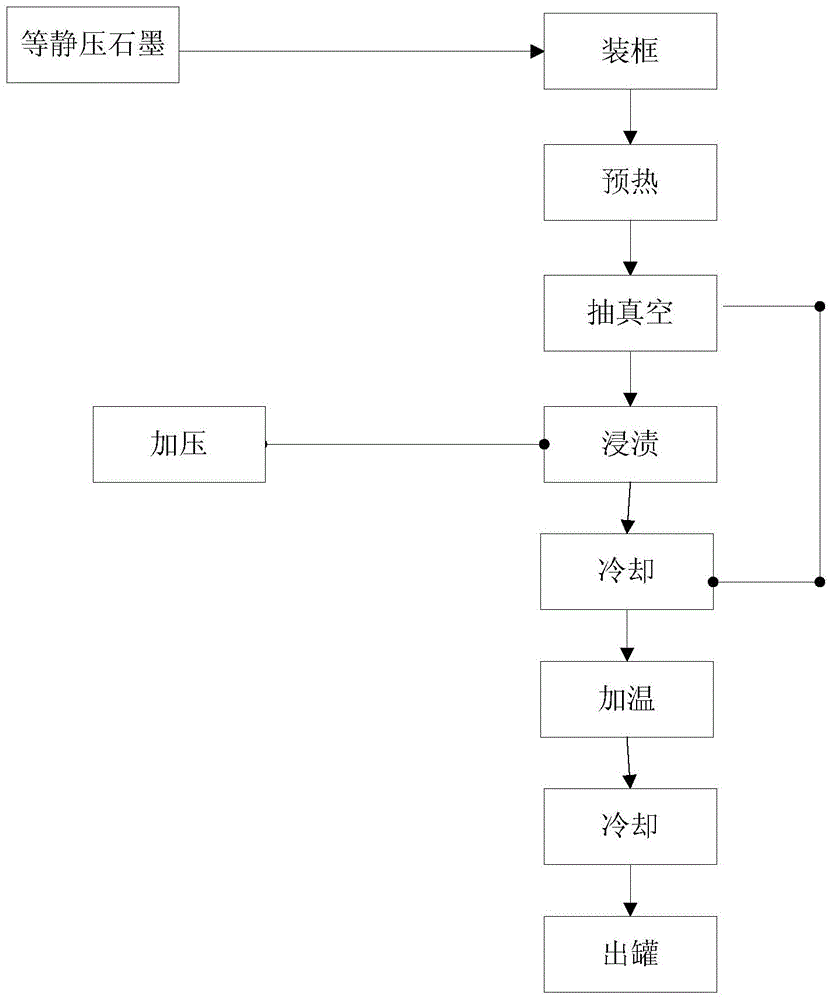
Examples
Embodiment 1
[0035]The isostatic graphite product was heated freely from room temperature to 180°C for 3 hours, then raised to 210°C at a rate of 10°C / h, then to 255°C at a rate of 8°C / h, and then to 255°C at a rate of 5°C / h 330°C, keep warm for 5 hours, and carry out preheating treatment; the preheated isostatic pressed product is placed in the impregnation equipment, vacuumized, and then the impregnation equipment is injected with liquid asphalt at a temperature of 220°C to form an impregnation system, and the pressure applied to the impregnation system is 1.7-1.85Mpa, carry out impregnation treatment; after the applied pressure remains unchanged, cool the impregnation system to 55°C at a cooling rate of 55-65°C / h while maintaining the pressure: the cooled impregnation system Heating until the temperature of the asphalt in the impregnation system is above the softening point and the fluidity is good, and when the surface temperature of the product reaches the asphalt softening point of 90...
Embodiment 2
[0037] The isostatic graphite product is heated freely from room temperature to 180°C for 3 hours, then heated to 200°C at a rate of 15°C / h, then raised to 260°C at a rate of 9°C / h, and then heated to 320°C, keep warm for 4 hours, and carry out preheating treatment; the preheated isostatic pressed product is placed in the impregnation equipment, vacuumized, and then injected into the impregnation equipment with liquid asphalt at a temperature of 200°C to form an impregnation system, and the pressure applied to the impregnation system is 1.7-1.85Mpa, carry out impregnation treatment; after the applied pressure remains unchanged, cool the impregnation system to 60°C at a cooling rate of 55-65°C / h while maintaining the pressure: the cooled impregnation system Heating until the temperature of the asphalt in the impregnation system is above the softening point and the fluidity is good, and when the surface temperature of the product reaches the softening point of 85°C, stop heating....
Embodiment 3
[0039] The isostatic graphite product was heated freely from room temperature to 180°C for 4 hours, then raised to 205°C at a rate of 9°C / h, then to 255°C at a rate of 6°C / h, and then to 330°C, keep warm for 3 hours, and carry out preheating treatment; the preheated isostatic pressed product is placed in the impregnation equipment, vacuumized, and then the impregnation equipment is injected with liquid asphalt at a temperature of 190°C to form an impregnation system, and the pressure applied to the impregnation system is 1.7-1.85Mpa, carry out impregnation treatment; after the applied pressure remains unchanged, cool the impregnation system to 50°C at a cooling rate of 55-65°C / h while maintaining the pressure: the cooled impregnation system Heating until the temperature of the asphalt in the impregnation system is above the softening point and the fluidity is good, and when the surface temperature of the product reaches the softening point of 80°C, stop heating. At the same tim...
PUM
 Login to View More
 Abstract
Description
Claims
Application Information
 Login to View More