Check patentability & draft patents in minutes with Patsnap Eureka AI!

A kind of preparation method of plant bisphenol glycidyl ether

A glycidyl ether and plant technology, which is applied in the field of plant bisphenol to prepare epoxy resin, can solve the problems of brittle performance and poor toughness of the cured product

Active Publication Date: 2017-05-03
SUZHOU BAOLIRUI BIOLOGICAL MATERIAL TECH DEV
View PDF9 Cites 0 Cited by
  • Summary
  • Abstract
  • Description
  • Claims
  • Application Information

AI Technical Summary

Problems solved by technology

[0009] There is no technology for plant bisphenol glycidyl ether in the prior art, and bisphenol A epoxy resin is the main type. After this type of epoxy resin reacts with the curing agent, the cured product is brittle and has poor toughness.

Method used

the structure of the environmentally friendly knitted fabric provided by the present invention; figure 2 Flow chart of the yarn wrapping machine for environmentally friendly knitted fabrics and storage devices; image 3 Is the parameter map of the yarn covering machine
View more

Image

Smart Image Click on the blue labels to locate them in the text.
Viewing Examples
Smart Image
  • A kind of preparation method of plant bisphenol glycidyl ether
  • A kind of preparation method of plant bisphenol glycidyl ether
  • A kind of preparation method of plant bisphenol glycidyl ether

Examples

Experimental program
Comparison scheme
Effect test

Embodiment 1

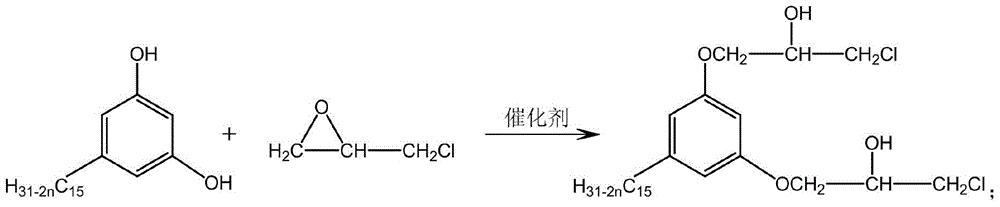
[0034] Pass nitrogen into a 1L four-neck flask equipped with a stirring, thermometer and condensing reflux device to replace the air, add 100g of plant bisphenol, 250g of epichlorohydrin, and 0.5g of tetraethylammonium bromide, stir and heat up to 50°C, and open Cycloaddition etherification reaction 2h. Keeping the temperature constant, 170 g of sodium hydroxide solution with a mass concentration of 30% was added dropwise with a constant pressure funnel for 4 hours, and kept for 2 hours after the dropwise addition to complete the initial ring-closing epoxidative dechlorination reaction. Distill under reduced pressure to recover water and excess epichlorohydrin. The temperature was raised to 60° C., and 20 g of sodium hydroxide solution with a mass concentration of 30% was added at one time to carry out a second ring-closing epoxidative dechlorination reaction for 1 hour. Centrifugal filtration to obtain crude plant bisphenol glycidyl ether; washing, liquid separation, distill...

Embodiment 2

[0036] Pass nitrogen into a 1L four-neck flask equipped with a stirring, thermometer and condensing reflux device to replace the air, add 80g of plant bisphenol, 240g of epichlorohydrin, 0.3g of tetramethylammonium bromide, and 0.3g of tetraethylammonium bromide g, stirring and raising the temperature to 75°C, the ring-opening addition etherification reaction was carried out for 1 h. Keeping the temperature constant, 100 g of sodium hydroxide solution with a mass concentration of 50% was added dropwise with a constant pressure funnel for 3 hours, and kept for 1.5 hours after the dropwise addition to complete the initial ring-closing epoxidative dechlorination reaction. Distill under reduced pressure to recover water and excess epichlorohydrin. The temperature was raised to 70° C., and 25 g of sodium hydroxide solution with a mass concentration of 20% was added at one time to carry out a second ring-closing epoxidative dechlorination reaction for 2 hours. Centrifugal filtratio...

Embodiment 3

[0038] Pass nitrogen into a 1L four-neck flask equipped with a stirring, thermometer and condensing reflux device to replace the air, add 60g of plant bisphenol, 210g of epichlorohydrin, and 0.6g of benzyltriethylammonium bromide and stir to raise the temperature to 80°C. Ring-opening addition etherification reaction 0.5h. Keeping the temperature constant, 50 g of sodium hydroxide solution with a mass concentration of 60% was added dropwise with a constant pressure funnel for 2.5 hours, and kept for 3 hours after the dropwise addition to complete the initial ring-closing epoxidation dechlorination reaction. Distill under reduced pressure to recover water and excess epichlorohydrin. The temperature was raised to 90° C., and 10 g of sodium hydroxide solution with a mass concentration of 30% was added at one time to carry out a second ring-closing epoxidative dechlorination reaction for 1 hour. Centrifugal filtration to obtain crude plant bisphenol glycidyl ether; washing, liqui...

the structure of the environmentally friendly knitted fabric provided by the present invention; figure 2 Flow chart of the yarn wrapping machine for environmentally friendly knitted fabrics and storage devices; image 3 Is the parameter map of the yarn covering machine
Login to View More

PUM

PropertyMeasurementUnit
epoxy equivalentaaaaaaaaaa
Login to View More

Abstract

The invention discloses a method for preparing plant bisphenol glycidyl ether. The synthesis of the plant bisphenol glycidyl ether comprises two steps of ring opening addition etherification and ring closing epoxidization dechlorination, the method is high in yield, and the prepared plant bisphenol glycidyl ether is lower in equivalent weight and better in quality and is conducive to industrial production. The plant bisphenol glycidyl ether prepared in the invention is flexible epoxy resin, which can be independently cured and can also be used for perfecting the toughness of the traditional rigid epoxy resin, so that the application prospect and value are extensive.

Description

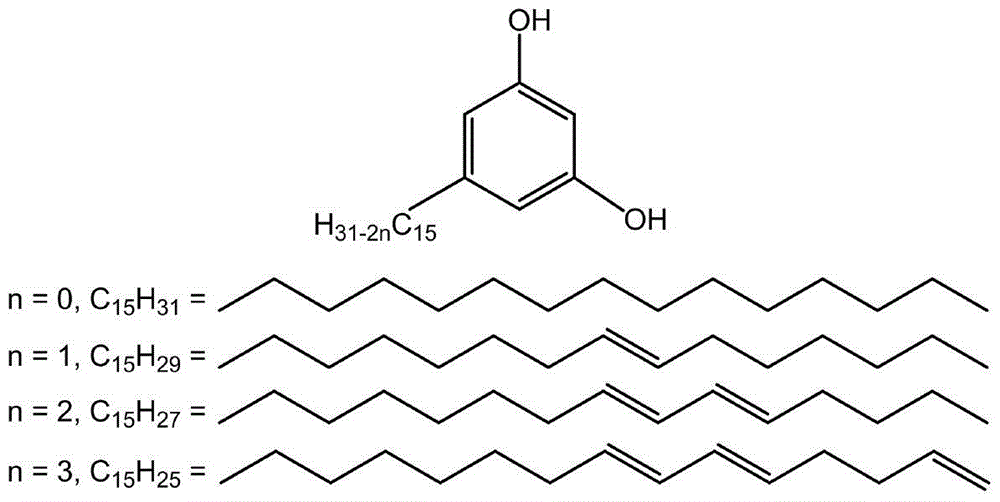
technical field [0001] The invention relates to a method for preparing epoxy resin by using plant bisphenol, in particular to a method for preparing plant bisphenol glycidyl ether. Background technique [0002] Plant bisphenols are refined from industrial vegetable oils through decarboxylation and other processes containing C 15 Unsaturated straight-chain bisphenol compounds are rich in sources, cheap in price, non-toxic and tasteless, and have great application prospects and research and development value. The basic structure of plant bisphenols is as follows: [0003] [0004] Plant bisphenols are a class of resorcinol derivative chemicals containing two hydroxyl groups. They have high phenolic reactivity. Like other alkylated resorcinol monomers, they have good methylene giving properties. The activity of body reaction. In addition, plant bisphenol contains a straight chain of carbon 15 with unsaturated double bonds, which can provide good toughness for the system. ...

Claims

the structure of the environmentally friendly knitted fabric provided by the present invention; figure 2 Flow chart of the yarn wrapping machine for environmentally friendly knitted fabrics and storage devices; image 3 Is the parameter map of the yarn covering machine
Login to View More

Application Information

Patent Timeline
no application Login to View More
Patent Type & Authority Patents(China)
IPC IPC(8): C07D303/27C07D301/26C08G59/24
CPCC07D301/26C07D303/27C08G59/245
Inventor 戴志成
Owner SUZHOU BAOLIRUI BIOLOGICAL MATERIAL TECH DEV
Features
  • R&D
  • Intellectual Property
  • Life Sciences
  • Materials
  • Tech Scout
Why Patsnap Eureka
  • Unparalleled Data Quality
  • Higher Quality Content
  • 60% Fewer Hallucinations
Social media
Patsnap Eureka Blog
Learn More