
Ultrasonic attenuation spectrum based mixed solid particle size and concentration measurement method
A technology of solid particle and attenuation spectrum, applied in particle and sedimentation analysis, measuring device, particle size analysis, etc.
- Summary
- Abstract
- Description
- Claims
- Application Information
AI Technical Summary
Problems solved by technology
Method used
Image

Examples
Embodiment Construction
[0045] The present invention is aimed at the problems existing in the existing methods of ultrasonic measurement of particle concentration. For the known geometric dimensions of ultrasonic transducers, a theoretical model is established by the Monte Carlo method to calculate the ultrasonic attenuation spectrum, thereby realizing an ultrasonic Attenuation spectroscopy is a method for measuring the particle size and concentration of mixed particles in a liquid medium.
[0046] This method is implemented as follows:
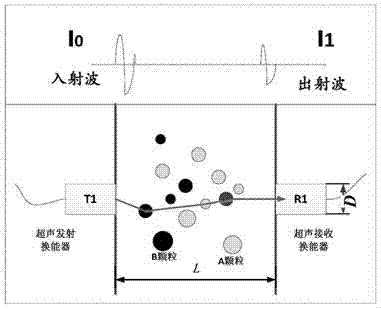
[0047] 1), such as figure 1 As shown, under the action of the excitation circuit, the ultrasonic transmitting transducer T1 emits a beam of pulsed ultrasonic waves, and the ultrasonic receiving transducer R1 is arranged at a distance L, and the area between the ultrasonic transmitting transducer and the receiving transducer is the measurement area. In the case that there are no particles in the measurement area, the sound absorption of the continuum is ignored, and...
PUM
 Login to View More
 Abstract
Description
Claims
Application Information
 Login to View More