
A method for adding sawdust to remove silver from silver-containing tin alloy
A technology of silver-tin alloy and wood chips, applied in the field of non-ferrous metal pyrometallurgy, can solve the problems of inability to handle high lead solder, high capital construction investment cost, hydrometallurgical pollution, etc., to promote secondary nucleation and growth. , The effect of high universality of raw materials and a wide range of silver content
- Summary
- Abstract
- Description
- Claims
- Application Information
AI Technical Summary
Problems solved by technology
Method used
Image

Examples
Embodiment 1
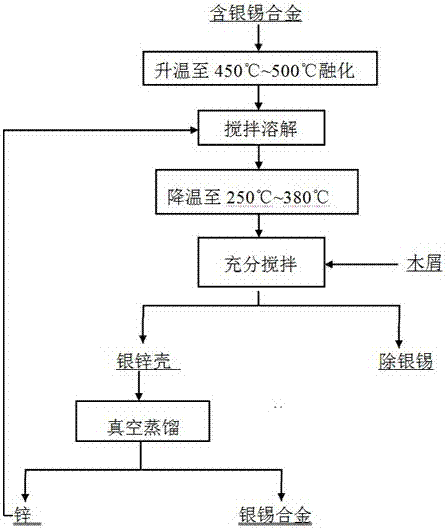
[0018] Such as figure 1 Shown, this adds sawdust to the method for removing silver in silver-containing tin alloy, and its concrete steps are as follows:
[0019] Step 1. First, heat up 10 tons of silver-containing tin alloy (the silver content in the silver-containing tin alloy is 1.5g / t, and the rest is tin) to 450°C and fully melt it. 1:4 add crude zinc, fully stir to dissolve;
[0020] Step 2. Cool the silver-containing tin alloy treated in step 1 to 250°C, add sawdust whose mass is 5 times the silver in the crude zinc, stir well, remove the slag, repeat the operation, and observe that the floating matter is black carbon particles, stop removing the slag operation, and finally obtain liquid tin with low silver content and silver-zinc shell containing carbon particles, and the liquid tin can be desilvered tin after cooling.
[0021] Wherein the silver-zinc shell in step 2 is subjected to vacuum distillation to obtain crude zinc and silver; the crude zinc obtained by vacuu...
Embodiment 2
[0024] Such as figure 1 Shown, this adds sawdust to the method for removing silver in silver-containing tin alloy, and its concrete steps are as follows:
[0025] Step 1. First, heat up 10 tons of silver-containing tin alloy (the silver content in the silver-containing tin alloy is 5000g / t, and the rest is tin) to 500°C and fully melt it, and the molar ratio of silver in the silver-containing tin alloy to zinc in the crude zinc is 1 : 6 Add crude zinc, fully stir and dissolve;
[0026] Step 2. Cool the silver-containing tin alloy treated in step 1 to 300°C, add sawdust whose mass is 5 times the silver in the crude zinc, stir well, remove the slag, repeat the operation, and observe that the floating matter is black carbon particles, stop removing the slag operation, and finally obtain liquid tin with low silver content and silver-zinc shell containing carbon particles, and the liquid tin can be desilvered tin after cooling.
[0027] Wherein the silver-zinc shell in step 2 is ...
Embodiment 3
[0030] Such as figure 1 Shown, this adds sawdust to the method for removing silver in silver-containing tin alloy, and its concrete steps are as follows:
[0031] Step 1. First, heat up 10 tons of silver-containing tin alloy (the silver content in the silver-containing tin alloy is 25000g / t, and the rest is tin) to 550°C and fully melt it, and mix it according to the molar ratio of silver in the silver-containing tin alloy to zinc in the crude zinc: 1 : 9 add thick zinc, fully stir and dissolve;
[0032] Step 2. Cool the silver-containing tin alloy treated in step 1 to 380°C, add wood chips whose mass is 5 times the silver in the crude zinc, stir well, remove the slag, repeat the operation, and observe that the floating matter is black carbon particles, stop removing the slag operation, and finally obtain liquid tin with low silver content and silver-zinc shell containing carbon particles, and the liquid tin can be desilvered tin after cooling.
[0033] Wherein the silver-zi...
PUM
 Login to View More
 Abstract
Description
Claims
Application Information
 Login to View More