
Cavity filter
A cavity filter and metal cavity technology, which is applied to waveguide-type devices, electrical components, circuits, etc., can solve the problems of difficult debugging, low Q value of substrate dielectric loss, and poor batch performance, so as to increase the difficulty of processing and manufacturing. , increase the order, and improve the effect of out-of-band suppression
- Summary
- Abstract
- Description
- Claims
- Application Information
AI Technical Summary
Problems solved by technology
Method used
Image


Examples
Embodiment Construction
[0029] In order to make the object, technical solution and advantages of the present invention clearer, the implementation manner of the present invention will be further described in detail below in conjunction with the accompanying drawings.
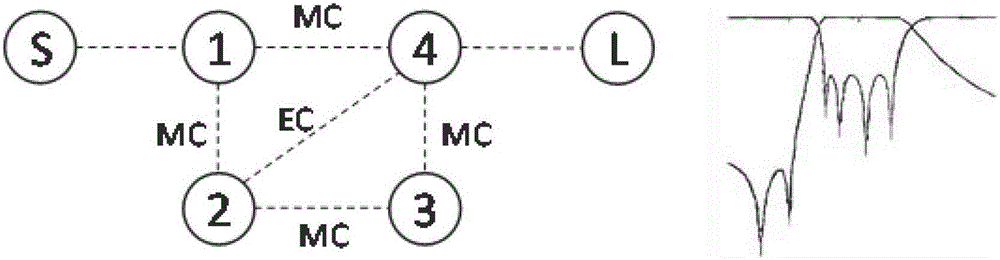
[0030] Such as figure 1 As shown, two transmission zeros are generated on the left side of the passband, and four consecutive cavities generate two cross-couplings, one of which is magnetic coupling, the other is electrical coupling, and the rest are magnetic couplings.
[0031] Among them, EC refers to electrical coupling, MC refers to magnetic coupling, S is the input end, and L is the output end.
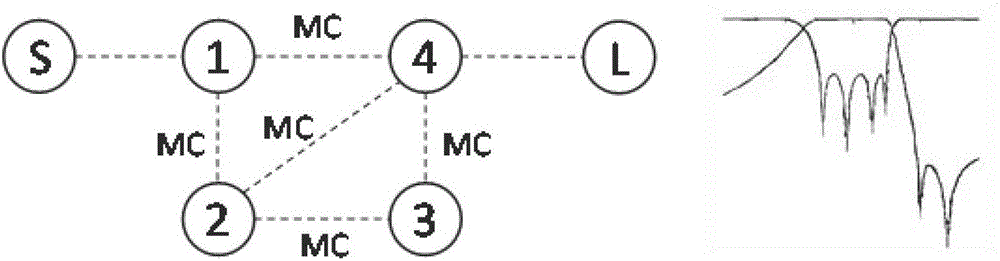
[0032] Such as figure 2 As shown, two transmission zeros are generated on the right side of the passband, and four consecutive cavities generate two cross-couplings, both of which are magnetic couplings, and the rest of the couplings are also magnetic couplings.
[0033] Such as image 3 As shown, two transmission zeros are generated...
PUM
 Login to View More
 Abstract
Description
Claims
Application Information
 Login to View More