
Yellow fever virus detection kit based on RPA technology and applications of yellow fever virus detection kit
A technology of yellow fever virus and reagents, which is applied in the direction of recombinant DNA technology, microbial measurement/inspection, and resistance to vector-borne diseases. It can solve the problems of long detection time, achieve rapid response, wide temperature range, and prevent the spread of infection. Effect
- Summary
- Abstract
- Description
- Claims
- Application Information
AI Technical Summary
Problems solved by technology
Method used
Image


Examples
Embodiment 1
[0066] The RPA detection primer of embodiment 1, yellow fever virus and probe and detection method thereof
[0067] 1. Design and synthesis of primers and probes for RPA detection of yellow fever virus
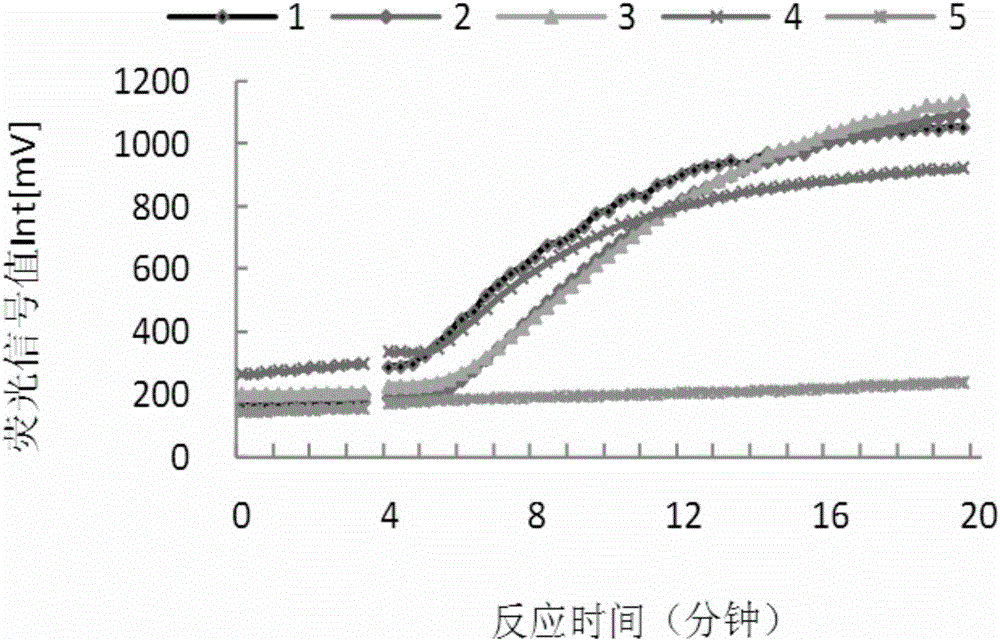
[0068] Download the whole gene sequence of yellow fever virus, use DNASTAR.Lasergene.v7.1 software for sequence comparison analysis, select the nucleoprotein (NP) gene segment (166bp in length) that is conserved within the species and specific among the species as the detection target gene, Design the RPA detection primer and probe of yellow fever virus according to following design requirements: (1) RPA primer length is 30-35 bases, and GC content is between 40-60%, avoids forming secondary structure and hairpin structure; Primer Special sequences such as long strings of polypurine or polypyrimidine should be avoided; the first 3-5 nucleotides at the 5' end should avoid polyguanine, preferably cytosine; (2) The length of the RPA probe is 46- 52 bases, inserting THF (tetrahyd...
Embodiment 2
[0081] The sensitivity comparison of the RPA detection of embodiment 2, yellow fever virus and Real-time PCR detection
[0082] 1. Yellow fever virus RPA detection
[0083] Adopt the RPA detection method of yellow fever virus in the step 2 of embodiment 1, use the yellow fever pseudovirus RNA solution of 10 times gradient dilution as template (the amount of template added is respectively: 10 5 copies / reaction, 10 4 copies / reaction, 10 3 copies / reaction, 10 2 copies / reaction, 10copies / reaction) for RPA amplification.
[0084] 2. Real-time PCR detection of yellow fever virus
[0085] The RNA solution of yellow fever pseudovirus with 10 times gradient dilution is used as template (the amount of template added is respectively: 10 5 copies / reaction, 10 4 copies / reaction, 10 3 copies / reaction, 10 2 copies / reaction, 10copies / reaction), using the primers and probes in Table 1, using the one-step real time RT-PCR kit (Takara, DRR064A) for Real-time PCR, the reaction system in e...
Embodiment 3
[0098] The specific detection of the RPA primer of embodiment 3, yellow fever virus and probe
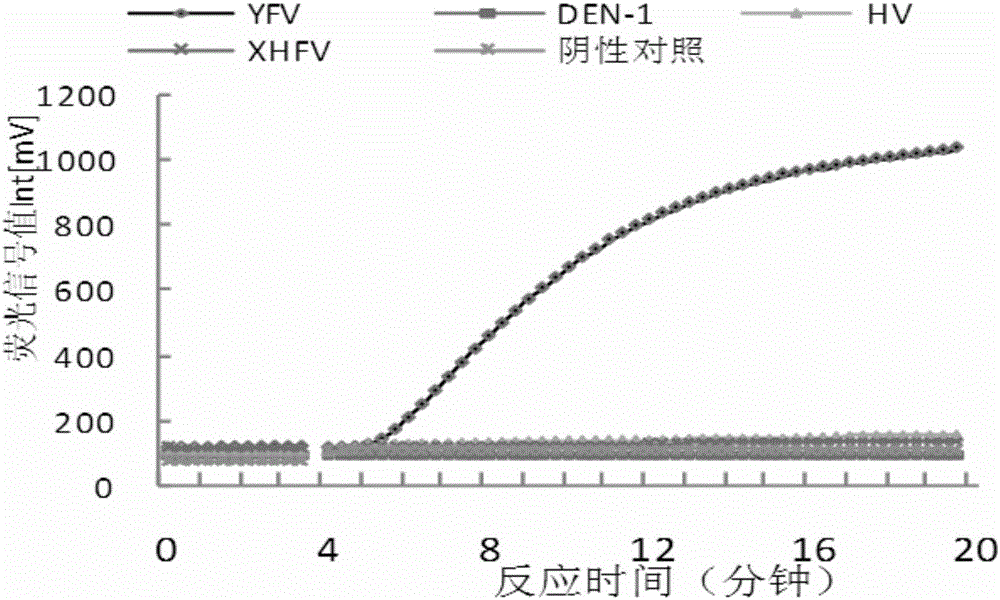
[0099] They belonged to yellow fever virus 17D (YFV-17D, yellow fever pseudovirus), dengue virus type 1 (DEN-1) GZ01 strain, Japanese encephalitis virus (JEV) SA14-14-2 strain, tick-borne encephalitis The viral nucleic acid RNA of the virus (TBEV) Senzhang strain was used as a template, and the RPA detection method of yellow fever virus in step 2 of Example 1 was used to detect the specificity of the RPA primers and probes of the present invention.
[0100] The result is as figure 2 shown. The experimental results show that the RPA primer probes can specifically amplify the target gene and have no cross-reaction with the nucleic acids of three other viruses of the same genus (dengue virus type 1, Japanese encephalitis virus, and tick-borne encephalitis virus), indicating that The RPA primer and probe of the yellow fever virus of the present invention have better specificity.
PUM
| Property | Measurement | Unit |
|---|---|---|
| Titer | aaaaa | aaaaa |
Abstract
Description
Claims
Application Information
 Login to View More