Supercharge Your Innovation With Domain-Expert AI Agents!

A kind of preparation method of pimecrolimus

A technology of pimecrolimus and pyridine, which is applied in the field of medicinal chemistry, can solve the problems of low HPLC purity, decreased yield, and difficulty in removing ascomycin, etc., and achieves improved reaction yield, improved conversion rate and yield, and simplified Effect of Treatment Purification Methods

Active Publication Date: 2020-05-29
BRIGHTGENE BIO MEDICAL TECH (SUZHOU) CO LTD +1
View PDF8 Cites 0 Cited by
  • Summary
  • Abstract
  • Description
  • Claims
  • Application Information

AI Technical Summary

Problems solved by technology

[0012] The contents disclosed in EP1817317B1 all use a single source of chloride ions. The inventors found that using a single source of chlorine according to the method disclosed in EP1817317B1 cannot completely convert activated ascomycin into pimecrolimus, and the remaining activated ascomycin will be recovered later. The treatment process will revert back to ascomycin, resulting in a decrease in yield. In addition, the existence of ascomycin will increase the difficulty and cost of post-processing purification, and it is difficult to remove ascomycin in the subsequent crystallization purification process
The resulting crude product contains both unreacted raw materials and other introduced reagents, and the HPLC purity is also very low

Method used

the structure of the environmentally friendly knitted fabric provided by the present invention; figure 2 Flow chart of the yarn wrapping machine for environmentally friendly knitted fabrics and storage devices; image 3 Is the parameter map of the yarn covering machine
View more

Image

Smart Image Click on the blue labels to locate them in the text.
Viewing Examples
Smart Image
  • A kind of preparation method of pimecrolimus
  • A kind of preparation method of pimecrolimus
  • A kind of preparation method of pimecrolimus

Examples

Experimental program
Comparison scheme
Effect test

Embodiment 1

[0063] Example 1: Comparative example based on Example 1 in EP1817317B1 (only using chloride ion source A)

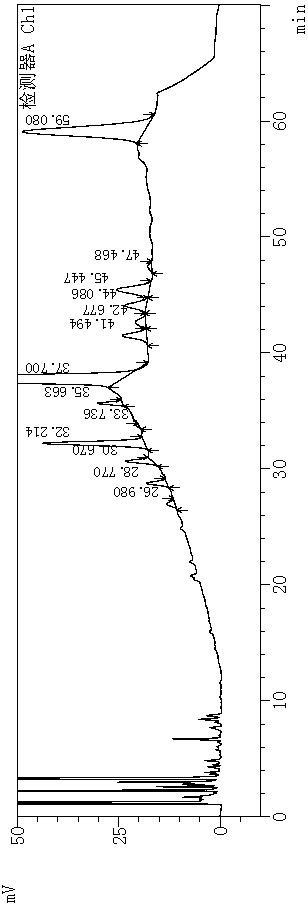
[0064] A solution of 3.0 g (3.79 mmol) of ascomycin in 25 ml of anhydrous dichloromethane was slowly passed through the solution with a stream of dry nitrogen, and cooled to -15°C. Then 24 ml of a 5% by weight solution of trifluoromethanesulfonic anhydride in anhydrous dichloromethane were added to the above solution together with 1.8 g of 2,6-lutidine. After the addition was complete, 28 g of a 10% by weight solution of lithium chloride (66.05 mmol, corresponding to 17.4 molar equivalents of ascomycin) in dichloromethane was added to the above reaction mixture. The reaction mixture was warmed to about 21 °C and stirred at this temperature for 4 days. The reaction mixture was diluted with a mixture of 200ml ethyl acetate and 25ml water, the organic layer was extracted, and then the solvent was evaporated to obtain 3.4g of crude product of pimecrolimus, yield (110.8%), ...

Embodiment 2

[0065] Example 2: Comparative example based on Example 2 in EP1817317B1 (only using chloride ion source B)

[0066]Dissolve 2.9 g (3.66 mmol) of ascomycin in 20 ml of toluene. The solution was concentrated to dryness at 40 °C. Under the protection of nitrogen, the obtained residue was dissolved in 23 ml of anhydrous toluene, and then 28 ml of anhydrous acetonitrile was added. The resulting solution was cooled to -15°C, and 1.13 g of diisopropylethylamine was added to the reaction mixture. 32 ml of anhydrous toluene solution of 1.39 g of trifluoromethanesulfonic anhydride previously cooled to -15°C was added to the above reaction mixture. After the addition was complete, the reaction temperature was raised to 0°C and 30 g of a 12.5% ​​by weight solution of benzyltriethylammonium chloride (16.46 mmol, corresponding to 4.5 molar equivalents of ascomycin) in anhydrous acetonitrile was added. Then the reaction temperature was raised to about 25°C, stirred at 24-25°C for 45min, a...

Embodiment 3

[0067] Embodiment 3: Prepare pimecrolimus according to the method of the present invention

[0068] 2.9 g (3.66 mmol) of ascomycin were dissolved in 20 ml of toluene, and the solution was concentrated to dryness at 40°C. Under the protection of nitrogen, the obtained residue was dissolved in 23 ml of anhydrous toluene, and then 28 ml of anhydrous acetonitrile was added. The resulting solution was cooled to -15°C, and 1.13 g of diisopropylethylamine was added to the reaction mixture. 32 ml of anhydrous toluene solution of 1.39 g of trifluoromethanesulfonic anhydride previously cooled to -15°C was added to the above reaction mixture. After the addition was complete, the reaction temperature was raised to 0°C, and then 1.90 g (8.34 mmol) of benzyltriethylammonium chloride and 0.34 g (8.02 mmol) of LiCl were added (the total amount of chloride ions was 16.36 mmol, equivalent to 4.5 moles equivalent of ascomycin) in anhydrous acetonitrile. Then the reaction temperature was raise...

the structure of the environmentally friendly knitted fabric provided by the present invention; figure 2 Flow chart of the yarn wrapping machine for environmentally friendly knitted fabrics and storage devices; image 3 Is the parameter map of the yarn covering machine
Login to View More

PUM

No PUM Login to View More

Abstract

The invention relates to a method for preparing pimecrolimus from ascomycin. The method is suitable for industrial application. The method provided by the invention is substantially increased in yield and can prepare pimecrolimus through purification via crystallization without column chromatographic purification.

Description

technical field [0001] The invention belongs to the field of medicinal chemistry, and in particular relates to a preparation method of pimecrolimus. Background technique [0002] Pimecrolimus is an anti-inflammatory compound obtained by structural modification of the macrolide natural product ascomycin produced by certain Streptomyces strains. Pimecrolimus is sold in the United States under the brand name ELIDEL ® Sold and approved for the treatment of atopic dermatitis. The systematic designation of pimecrolimus is (1R,9S,12S,13R,14S,17R,18E,21S,23S,24R,25S,27R)-12-[(1E)-2-{(1R,3,R ,4S)-4-chloro-3-methoxycyclohexyl}-1-methylvinyl]-17-ethyl-1,14, dihydroxy-23,25-dimethoxy-13,19, 21,27-Tetramethyl-11,28-dioxa-4-aza-tricyclo[22.3.1.0 4,9 ] Octac-18-ene-2,3,10,16-tetraone. Pimecrolimus is a 32-epichlorinated derivative of ascomycin. Its empirical formula is C 43 h 68 ClNO 11 , its molecular weight is 810.47, and its structural formula is as follows: [0003] , [0...

Claims

the structure of the environmentally friendly knitted fabric provided by the present invention; figure 2 Flow chart of the yarn wrapping machine for environmentally friendly knitted fabrics and storage devices; image 3 Is the parameter map of the yarn covering machine
Login to View More

Application Information

Patent Timeline
no application Login to View More
Patent Type & Authority Patents(China)
IPC IPC(8): C07H19/01C07H1/00C07D498/18
CPCC07D498/18C07H1/00C07H19/01
Inventor 袁建栋黄仰青池建文马萨·康德瑞斯乔迪·普施
Owner BRIGHTGENE BIO MEDICAL TECH (SUZHOU) CO LTD
Features
  • R&D
  • Intellectual Property
  • Life Sciences
  • Materials
  • Tech Scout
Why Patsnap Eureka
  • Unparalleled Data Quality
  • Higher Quality Content
  • 60% Fewer Hallucinations
Social media
Patsnap Eureka Blog
Learn More