Fiberboard prepared through seaweed waste and preparing method of fiberboard
What is AI technical title?
AI technical title is built by Patsnap AI team. It summarizes the technical point description of the patent document.
A technology of seaweed waste and fiberboard, applied in the direction of pretreatment of molding materials, applications, household components, etc., to achieve low formaldehyde emission, energy saving, and low temperature effects
Inactive Publication Date: 2018-05-08
DALIAN OCEAN UNIV
View PDF5 Cites 0 Cited by
Summary
Abstract
Description
Claims
Application Information
AI Technical Summary
This helps you quickly interpret patents by identifying the three key elements:
Problems solved by technology
Method used
Benefits of technology
Problems solved by technology
After searching the literature, there is no relevant report on the use of seaweed waste as raw material for the production of fiberboard
Method used
the structure of the environmentally friendly knitted fabric provided by the present invention; figure 2 Flow chart of the yarn wrapping machine for environmentally friendly knitted fabrics and storage devices; image 3 Is the parameter map of the yarn covering machine
View more
Image
Smart Image Click on the blue labels to locate them in the text.
Viewing Examples
Smart Image
Click on the blue label to locate the original text in one second.
Reading with bidirectional positioning of images and text.
Smart Image
Examples
Experimental program
Comparison scheme
Effect test
Embodiment 1
[0032] The composition of the fiberboard is calculated by weight percentage of dry matter, seaweed solid waste accounts for 90%, urea-formaldehyde resin glue accounts for 7%, and gelatin accounts for 3%.
[0033] The preparation method comprises: drying, crushing, sieving, sizing and stirring, paving, pre-pressing, hot pressing, drying, sawing and classifying packaging of seaweed and algae residues;
[0034] In the steps of drying, crushing and sieving the seaweed residue, the seaweed residue is dried to a moisture content of 4±0.5%, and after crushing, 8-12 mesh particles are taken;
[0035] In the sizing and stirring step, take water with a mass ratio of 7:10 to seaweed algae residue, dissolve urea-formaldehyde resin glue and gelatin in water, add them to the prepared algae residue, stir thoroughly, and keep warm at 60°C for later use;
[0036] Then the seaweed residue is paved and pre-pressed;
[0044] The composition of the fiberboard is calculated by weight percentage of dry matter, seaweed solid waste accounts for 88%, urea-formaldehyde resin glue accounts for 9.6%, and gelatin accounts for 2.4%.
[0045] The preparation method comprises: drying, crushing, sieving, sizing and stirring, paving, pre-pressing, hot pressing, drying, sawing and classifying packaging of seaweed and algae residues;
[0046] In the steps of drying, crushing and sieving the seaweed residue, the seaweed residue is dried to a moisture content of 5±0.5%, and after crushing, 10-12 mesh particles are taken;
[0047] In the sizing and stirring step, take water with a mass ratio of 7:10 to seaweed algae residue, dissolve urea-formaldehyde resin glue and gelatin in water, add them to the prepared algae residue, stir thoroughly, and keep warm at 50°C for later use;
[0048] Then the seaweed residue is paved and pre-pressed;
[0049] In the hot pressing step, the hot pressing temperature is controll...
the structure of the environmentally friendly knitted fabric provided by the present invention; figure 2 Flow chart of the yarn wrapping machine for environmentally friendly knitted fabrics and storage devices; image 3 Is the parameter map of the yarn covering machine
Login to View More
PUM
Login to View More
Abstract
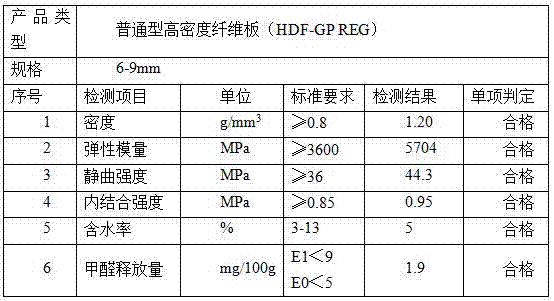
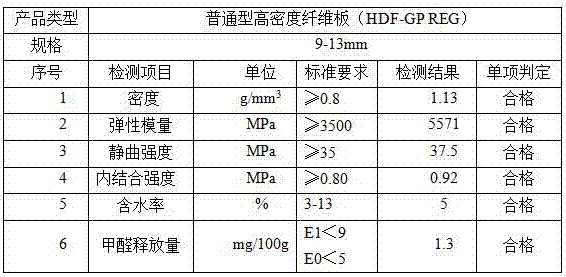
The invention discloses a fiberboard and a preparing method of the fiberboard. For the current situation that the seaweed resource in China is rich while the wood resource is in shortage, the high-density fiberboard is prepared with production waste of the seaweed industry and agriculture as raw materials, the seaweed waste is sufficiently utilized, land resource occupation caused by traditional burying treatment is avoided, meanwhile, the wood raw materials are saved, and the forest resource is protected. Specific limitation is made for the seaweed waste drying degree and particle granularity, seaweed slag particles and a bonding agent are bonded under the condition, and the load bearing capability can be effectively improved. Limitation is made for the proportion relation between a urea-formaldehyderesin adhesive and gelatin and the proportion relation between the total mass of the urea-formaldehyderesin adhesive and the gelatin and the mass of seaweed slag, and the fiberboard obtained under the proportion relation can reach the national high-density fiberboard performance standard and has ultralow formaldehyde emission.
Description
technical field [0001] The invention relates to the field of industrial reuse of seaweed waste, in particular to a fiberboard prepared from seaweed waste and a preparation method thereof. Background technique [0002] my country's annual wood consumption is about 560 million m 3 , since the annual output cannot meet such a huge market demand, the degree of dependence on foreign countries has reached 50%. In recent years, the consumption of forest resources has been serious, ecological problems have occurred frequently, and the supply of logs in the African log market is in short supply. Russia, ASEAN and other log markets have issued "export ban orders" one after another. Since 2015, after the commercial logging of natural forests in key state-owned forest areas of Heilongjiang Province has ceased, my country mainly relies on imports of large-diameter high-quality timber, which is bound to aggravate the current tight supply of timber. Therefore, it is necessary to find alte...
Claims
the structure of the environmentally friendly knitted fabric provided by the present invention; figure 2 Flow chart of the yarn wrapping machine for environmentally friendly knitted fabrics and storage devices; image 3 Is the parameter map of the yarn covering machine
Login to View More
Application Information
Patent Timeline
Application Date:The date an application was filed.
Publication Date:The date a patent or application was officially published.
First Publication Date:The earliest publication date of a patent with the same application number.
Issue Date:Publication date of the patent grant document.
PCT Entry Date:The Entry date of PCT National Phase.
Estimated Expiry Date:The statutory expiry date of a patent right according to the Patent Law, and it is the longest term of protection that the patent right can achieve without the termination of the patent right due to other reasons(Term extension factor has been taken into account ).
Invalid Date:Actual expiry date is based on effective date or publication date of legal transaction data of invalid patent.


 Login to View More
  Login to View More