Supercharge Your Innovation With Domain-Expert AI Agents!

Mapping of qtl, SNP molecular markers and related genes related to fiber strength on chromosome 24 of 70 population of China Cotton Research Institute

A technology of molecular markers and cotton fibers, which is applied in the determination/inspection of microorganisms, recombinant DNA technology, DNA/RNA fragments, etc., and can solve problems such as large distances, inability to locate genes, and inaccurate physical locations

Active Publication Date: 2021-07-13
INST OF COTTON RES CHINESE ACAD OF AGRI SCI
View PDF1 Cites 0 Cited by
  • Summary
  • Abstract
  • Description
  • Claims
  • Application Information

AI Technical Summary

Problems solved by technology

However, due to the low polymorphism of cotton SSR markers, especially in the intraspecific population, the linkage map presents low density and large gaps, and even more than two linkage populations are constructed within one chromosome (Zhang, Ge et al, 2017)
In addition, the distance between the QTL and the confidence interval of the nearest marker is too large to obtain an accurate physical location, resulting in an inaccurate physical location of the QTL, and it is impossible to map the genes related to the trait

Method used

the structure of the environmentally friendly knitted fabric provided by the present invention; figure 2 Flow chart of the yarn wrapping machine for environmentally friendly knitted fabrics and storage devices; image 3 Is the parameter map of the yarn covering machine
View more

Image

Smart Image Click on the blue labels to locate them in the text.
Viewing Examples
Smart Image
  • Mapping of qtl, SNP molecular markers and related genes related to fiber strength on chromosome 24 of 70 population of China Cotton Research Institute
  • Mapping of qtl, SNP molecular markers and related genes related to fiber strength on chromosome 24 of 70 population of China Cotton Research Institute

Examples

Experimental program
Comparison scheme
Effect test

Embodiment 1

[0022] 1. Obtaining recombinant inbred line population

[0023] Using upland cotton lines SGK156 and 901-001 as parents, the parents were planted in the experimental base of the Cotton Research Institute of the Chinese Academy of Agricultural Sciences in Anyang City, Henan Province in 2011, and the F 1 , named as the variety Zhongmiansuo 70, F 1 The plants were self-pollinated, and the combination was propagated in the south of Sanya City, Hainan Province in the winter of 2011, and 250 F 2 Single plant F 2:1 , and then in 2012, 250 individual plants were self-planted in a row to obtain F 2:3 , planted 250 rows of F in Anyang in April 2013 2:3 Strains, in September of the same year, select 10 F plants with better performance in each row 2:1 After mixed harvest, go to Hainan Nanfanjiadai to get F 2:5 , and continued to plant F in Anyang in 2013 2 Single plant, continue to plant F in Anyang in 2014 2:5 Plant line. from F 2:3 Starting from the strains, the planting norms ...

the structure of the environmentally friendly knitted fabric provided by the present invention; figure 2 Flow chart of the yarn wrapping machine for environmentally friendly knitted fabrics and storage devices; image 3 Is the parameter map of the yarn covering machine
Login to View More

PUM

PropertyMeasurementUnit
hardnessaaaaaaaaaa
Login to View More

Abstract

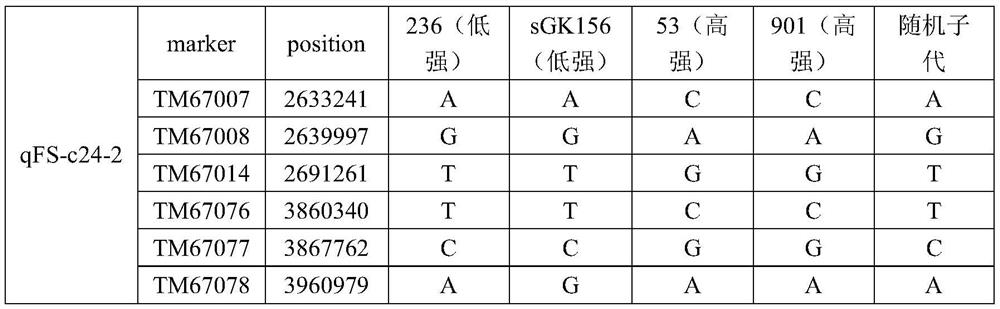
The invention belongs to the field of biotechnology, and discloses a QTL related to cotton fiber strength in 70 populations of China Cotton Research Institute, which is located on chromosome 24 of Upland Cotton, locates 6 SNP molecular markers, locates 116 genes and analyzes some of the genes Expression patterns were analyzed. The invention also discloses the application of a QTL related to cotton. The QTL and SNP molecular markers can be used for molecular marker-assisted selection breeding, which can significantly improve the selection efficiency of strength fiber strains and provide the most economical and effective method for further improving fiber quality. A new approach to molecular breeding.

Description

technical field [0001] The invention belongs to the field of biotechnology, and specifically relates to the positioning and application of QTLs related to cotton fiber strength, SNP molecular markers and related candidate genes. Background technique [0002] Cotton is one of the most important agricultural crops in the world as a natural fiber that provides a renewable resource for the textile industry. The genus Gossypium includes 45 diploid and 5 tetraploid species (Percival, 1999), including four cultivated species, Gossypium hirsutum, Gossypium spp., Gossypium spp., and Gossypium raymondi. Among these species, upland cotton is the most widely planted, covering more than 95% of all high-yield cotton fields, while the fiber quality of upland cotton needs to be improved. As people's demand for high-quality fiber is getting higher and higher, for cotton breeders, it is a clear goal to breed high-quality fiber varieties. However, both fiber quality and yield are quantitativ...

Claims

the structure of the environmentally friendly knitted fabric provided by the present invention; figure 2 Flow chart of the yarn wrapping machine for environmentally friendly knitted fabrics and storage devices; image 3 Is the parameter map of the yarn covering machine
Login to View More

Application Information

Patent Timeline
no application Login to View More
Patent Type & Authority Patents(China)
IPC IPC(8): C12Q1/6895C12N15/11
CPCC12Q1/6895C12Q2600/13C12Q2600/156
Inventor 范森淼商海红邹先炎龚举武刘爱英段丽石玉真张震巩万奎范李强张敏葛群李俊文袁有禄
Owner INST OF COTTON RES CHINESE ACAD OF AGRI SCI
Features
  • R&D
  • Intellectual Property
  • Life Sciences
  • Materials
  • Tech Scout
Why Patsnap Eureka
  • Unparalleled Data Quality
  • Higher Quality Content
  • 60% Fewer Hallucinations
Social media
Patsnap Eureka Blog
Learn More