Check patentability & draft patents in minutes with Patsnap Eureka AI!

Saccharomyces cerevisiae capable of effectively decomposing and converting cellulose and straw fermentation method

A technology of Saccharomyces cerevisiae and cellulose, applied in the field of cellulose bioconversion, can solve the problems of application limitation, increase the difficulty of fermentation process control, etc., and achieve the effect of efficient fermentation

Inactive Publication Date: 2018-08-17
HUBEI UNIV
View PDF6 Cites 2 Cited by
  • Summary
  • Abstract
  • Description
  • Claims
  • Application Information

AI Technical Summary

Problems solved by technology

Although the fermentation of mixed bacteria improves the degradation and conversion efficiency of natural cellulose, it also increases the difficulty of fermentation process control, and its application also has great limitations.

Method used

the structure of the environmentally friendly knitted fabric provided by the present invention; figure 2 Flow chart of the yarn wrapping machine for environmentally friendly knitted fabrics and storage devices; image 3 Is the parameter map of the yarn covering machine
View more

Image

Smart Image Click on the blue labels to locate them in the text.
Viewing Examples
Smart Image
  • Saccharomyces cerevisiae capable of effectively decomposing and converting cellulose and straw fermentation method
  • Saccharomyces cerevisiae capable of effectively decomposing and converting cellulose and straw fermentation method
  • Saccharomyces cerevisiae capable of effectively decomposing and converting cellulose and straw fermentation method

Examples

Experimental program
Comparison scheme
Effect test

Embodiment Construction

[0026] The principles and features of the present invention are described below in conjunction with examples, which are only used to explain the present invention and are not intended to limit the scope of the present invention.

[0027] 1. Co-expression strain construction

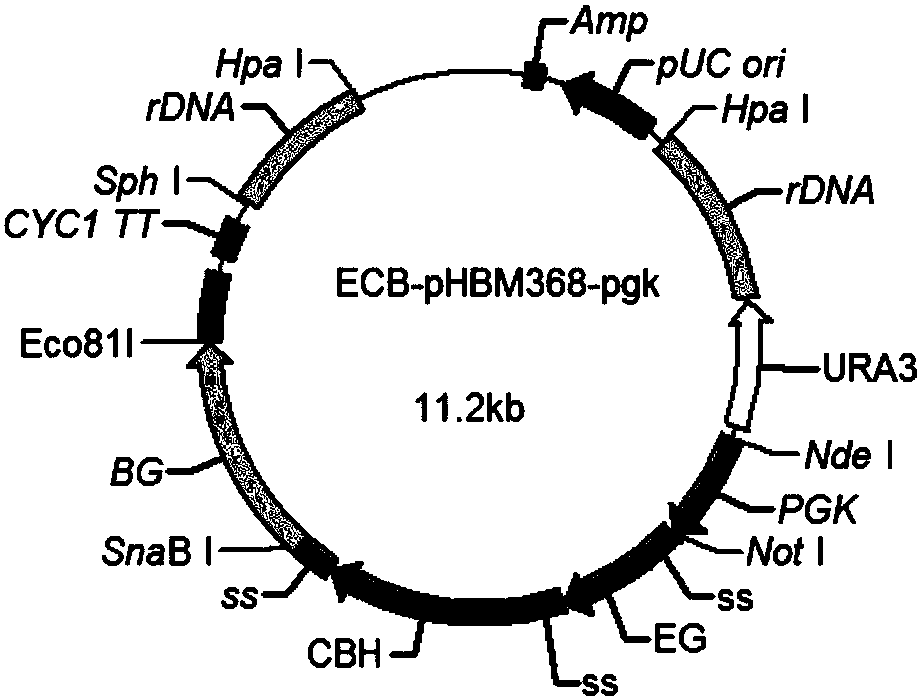
[0028] The following genes were synthesized: eg2 from Staphylocera papillosa (GenBank Accession: AM180511), cbh2 from D. chrysalis (GenBank Accession: KC751534) and bg2 from Sphingomonas (GenBank Accession: JF308485). These three genes were respectively cloned into the pHBM368-pgk plasmid in our laboratory to construct three recombinant strains pHBM368-pgk-EG2, pHBM368-pgk-CBH2 and pHBM368-pgk-BG2. Using these three plasmids as templates, the three cellulase genes were cloned by PCR and introduced into Xba I and EcoR I restriction sites, and the co-expression recombinant plasmid pHBM368-pgk- ECB (plasmid such as figure 1 shown).

[0029] The plasmid pHBM368-pgk-ECB was electrotransformed into Saccharom...

the structure of the environmentally friendly knitted fabric provided by the present invention; figure 2 Flow chart of the yarn wrapping machine for environmentally friendly knitted fabrics and storage devices; image 3 Is the parameter map of the yarn covering machine
Login to View More

PUM

No PUM Login to View More

Abstract

The invention relates to saccharomyces cerevisiae capable of effectively decomposing and converting cellulose. An endoglucanase gene expression cassette, an exoglucanase gene expression cassette and a[beta]-glucosidase gene expression cassette are transformed to the saccharomyces cerevisiae, so that co-expression of three cellulases in the same saccharomyces cerevisiae is achieved. The inventionalso relates to a method for fermenting cellulose via the saccharomyces cerevisiae, wherein the method comprises the following steps: inoculating a YPD liquid medium with the saccharomyces cerevisiae,implementing cultivation at 28 DEG C for a whole night so as to promote activation; transferring the activated saccharomyces cerevisiae into the YPD liquid medium, and implementing cultivation at 28DEG C to a proper concentration, so that a fermentation seed solution is obtained; and fermenting the fermentation seed solution in a fermentation container which is filled with biomass containing cellulose at 25 DEG C. According to the yeast strain (saccharomyces cerevisiae) and the fermentation method, ethanol and high-protein feed additives can be obtained through efficient fermentation of thecellulose.

Description

technical field [0001] The invention relates to the field of cellulose biotransformation, more particularly, to a Saccharomyces cerevisiae capable of efficiently decomposing and transforming cellulose, and a method for fermenting cellulose biomass. Background technique [0002] Cellulose is a renewable organic resource, which is widely distributed and easy to obtain. It can be obtained from wood, weeds, agricultural residues and municipal solid waste, among others. At present, fossil fuels are widely used as the main energy source in real life and production. With the increase of population, the demand for fuel is increasing day by day, and the depletion of fossil resources is becoming more and more serious. In addition, the combustion of fossil resources produces CO 2 The impact of GHG and other greenhouse gases on global climate change has made people pay more and more attention to clean and renewable energy. Due to its wide distribution and low cost, cellulose is rega...

Claims

the structure of the environmentally friendly knitted fabric provided by the present invention; figure 2 Flow chart of the yarn wrapping machine for environmentally friendly knitted fabrics and storage devices; image 3 Is the parameter map of the yarn covering machine
Login to View More

Application Information

Patent Timeline
no application Login to View More
IPC IPC(8): C12N1/19C12P7/10A23K10/12C12R1/865
CPCA23K10/12C12N9/2437C12N9/2445C12P7/10C12Y302/01004C12Y302/01021C12Y302/01091Y02E50/10
Inventor 江正兵肖文静宋慧婷李华南杨溢民戴余军
Owner HUBEI UNIV
Features
  • R&D
  • Intellectual Property
  • Life Sciences
  • Materials
  • Tech Scout
Why Patsnap Eureka
  • Unparalleled Data Quality
  • Higher Quality Content
  • 60% Fewer Hallucinations
Social media
Patsnap Eureka Blog
Learn More