Preparing method of 2-substituted-1,3-dithiane derivative
What is AI technical title?
AI technical title is built by PatSnap AI team. It summarizes the technical point description of the patent document.
A technology of derivatives and dithianes, which is applied in the field of preparation of 2-substituted-1,3-dithiane derivatives, achieves the effects of high substrate conversion rate, simple and easy post-treatment, and high yield
Inactive Publication Date: 2018-09-14
LANZHOU UNIVERSITY
View PDF2 Cites 1 Cited by
Summary
Abstract
Description
Claims
Application Information
AI Technical Summary
This helps you quickly interpret patents by identifying the three key elements:
Problems solved by technology
Method used
Benefits of technology
Problems solved by technology
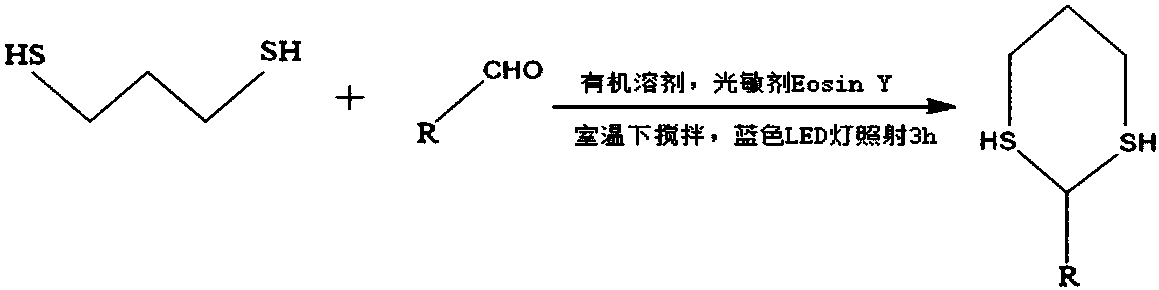
No reports have been found on the use of visible light activation to prepare 2-substituted-1,3-dithiane derivatives
Method used
the structure of the environmentally friendly knitted fabric provided by the present invention; figure 2 Flow chart of the yarn wrapping machine for environmentally friendly knitted fabrics and storage devices; image 3 Is the parameter map of the yarn covering machine
View more
Image
Smart Image Click on the blue labels to locate them in the text.
Viewing Examples
Smart Image
Click on the blue label to locate the original text in one second.
Reading with bidirectional positioning of images and text.
Smart Image
Examples
Experimental program
Comparison scheme
Effect test
Embodiment 1
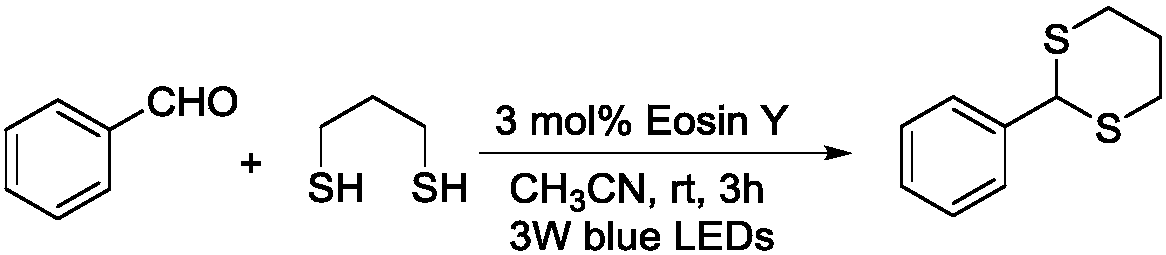
[0021] The synthetic method of 2-phenyl substituted-1,3-dithiane comprises the following steps:
[0022] (1) Add 0.55mmol of 1,3-propanedithiol, 0.5mmol of benzaldehyde and 0.015mmol of Eosin Y to a 10mL colorless transparent glass test tube, add 1.5mL of MeCN to dissolve, and stir the system at room temperature 30°C , with a 3w blue LED light for 3h.
[0023] (2) After the reaction was completed, MeCN was removed by rotary evaporation under reduced pressure and the resulting mixture was separated by silica gelcolumn chromatography to obtain the product.
[0024] The specific synthetic reaction formula is:
[0025]
[0026] After detection, the characterization result of the obtained 2-phenyl substituted-1,3-dithiane is: the yield is 98%, white solid. 1 H NMR (400MHz, CDCl 3 )δ7.53–7.41(m,2H),7.40–7.28(m,3H),5.17(s,1H),3.16–2.98(m,2H),3.00–2.83(m,2H),2.27–2.08( m,1H),2.05–1.82(m,1H); 13 C NMR (101MHz, CDCl 3 )δ 139.0, 128.7, 128.4, 127.7, 51.4, 32.1, 25.0.
Embodiment 2
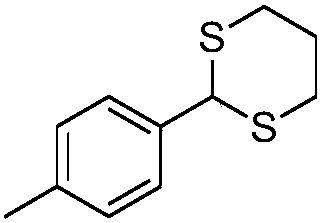
[0028]
[0029] The product is as shown above, and the reaction conditions and steps are the same as in Example 1. After testing, the characterization result of the obtained product is: the yield is 99%, white solid. 1 H NMR (400MHz, CDCl3) δ7.33 (d, J = 8.0Hz, 2H), 7.13 (d, J = 8.0Hz, 2H), 5.13 (s, 1H), 3.05–2.98 (m, 2H), 2.88 –2.83(m,2H),2.31(s,3H),2.14–2.09(m,1H),1.86–1.82(m,1H); 13 C NMR (101 MHz, CDCl3) δ 138.1, 136.0, 129.2, 127.4, 51.0, 32.0, 24.9, 21.1.
Embodiment 3
[0031]
[0032] The product is as shown above, and the reaction conditions and steps are the same as in Example 1. After detection, the characterization result of the obtained product is: the yield is 74%, white solid. 1 H NMR (400MHz, CDCl3) δ7.47 (d, J = 8.4Hz, 2H), 7.35 (d, J = 8.4Hz, 2H), 5.11 (s, 1H), 3.15–2.97 (m, 2H), 2.93 –2.88(m,2H),2.20–2.14(m,1H),1.96–1.87(m,1H); 13 CNMR (101MHz, CDCl3) δ138.0, 131.9, 129.5, 122.3, 50.6, 31.9, 24.9.
the structure of the environmentally friendly knitted fabric provided by the present invention; figure 2 Flow chart of the yarn wrapping machine for environmentally friendly knitted fabrics and storage devices; image 3 Is the parameter map of the yarn covering machine
Login to View More
PUM
Login to View More
Abstract
The invention belongs to the technical field of organic synthesis, and particularly discloses a preparing method of a 2-substituted-1,3-dithiane derivative. The preparing method comprises the following steps of adding substrate aldehyde, 1,3-dimercaptopropane and catalytic amount Eosin Y into a proper amount of acetonitrile, continuously stirring the mixture, using a blue LED to irradiate the mixture for 3 h at a room-temperature open system, after the reaction is finished, removing organic solvents through rotary evaporation, and then obtaining a product through recrystallization and chromatography. According to the preparing method of the 2-substituted-1,3-dithiane derivative, the yield of the product is high, the conversion rate of the substrate is high, the reaction operation conditions are mild and environmentally friendly, demanding water and oxygen removal operations and devices are not needed, and the reaction can be conducted at the room temperature.
Description
technical field [0001] The invention belongs to the technical field of organic synthesis, and in particular relates to a preparation method of 2-substituted-1,3-dithiane derivatives. Background technique [0002] The 2-position monosubstituted 1,3-dithiane is widely used as a synthetic building block in the synthesis of natural products and drug molecules with good physiological activities. It is a preferred starting point for synthetic and medicinal chemists to construct carbonyl compounds. original thing. The traditional method for preparing dithiane is to use the activation of Lewis acid or protonic acid to dehydrate and condense the carbonyl of aldehyde or ketone compound with 1,3-propanedithiol. Because this traditional preparation method needs to add a large amount of acidic substances, and most of them need to be heated to reflux, the tolerance of the substrate is not good, and the post-reaction treatment and product purification are cumbersome, which restricts its w...
Claims
the structure of the environmentally friendly knitted fabric provided by the present invention; figure 2 Flow chart of the yarn wrapping machine for environmentally friendly knitted fabrics and storage devices; image 3 Is the parameter map of the yarn covering machine
Login to View More
Application Information
Patent Timeline
Application Date:The date an application was filed.
Publication Date:The date a patent or application was officially published.
First Publication Date:The earliest publication date of a patent with the same application number.
Issue Date:Publication date of the patent grant document.
PCT Entry Date:The Entry date of PCT National Phase.
Estimated Expiry Date:The statutory expiry date of a patent right according to the Patent Law, and it is the longest term of protection that the patent right can achieve without the termination of the patent right due to other reasons(Term extension factor has been taken into account ).
Invalid Date:Actual expiry date is based on effective date or publication date of legal transaction data of invalid patent.



 Login to View More
  Login to View More