Check patentability & draft patents in minutes with Patsnap Eureka AI!

Method for preparing cross-linked polyamide in body one-pot method

A technology of cross-linking polyamide and body, applied in the field of polyamide, can solve problems such as complicated preparation process, and achieve the effect of simple process and excellent performance

Inactive Publication Date: 2019-02-19
BEIJING UNIV OF CHEM TECH
View PDF4 Cites 2 Cited by
  • Summary
  • Abstract
  • Description
  • Claims
  • Application Information

AI Technical Summary

Problems solved by technology

Cross-linked polyamides are mainly synthesized by two methods at present: (1) ring-opening polymerization-cross-linking method, utilizing anionic ring-opening polymerization of caprolactam or laurolactam to synthesize linear polyamides, and then combining with polyacyl caprolactam (JP 02032128 A ) or caprolactam-terminated polyisocyanate (US 20130079465 A1) is prepared by cross-linking; this method needs to be carried out at high temperature, and the preparation process is complicated

Method used

the structure of the environmentally friendly knitted fabric provided by the present invention; figure 2 Flow chart of the yarn wrapping machine for environmentally friendly knitted fabrics and storage devices; image 3 Is the parameter map of the yarn covering machine
View more

Image

Smart Image Click on the blue labels to locate them in the text.
Viewing Examples
Smart Image
  • Method for preparing cross-linked polyamide in body one-pot method
  • Method for preparing cross-linked polyamide in body one-pot method
  • Method for preparing cross-linked polyamide in body one-pot method

Examples

Experimental program
Comparison scheme
Effect test

Embodiment 1

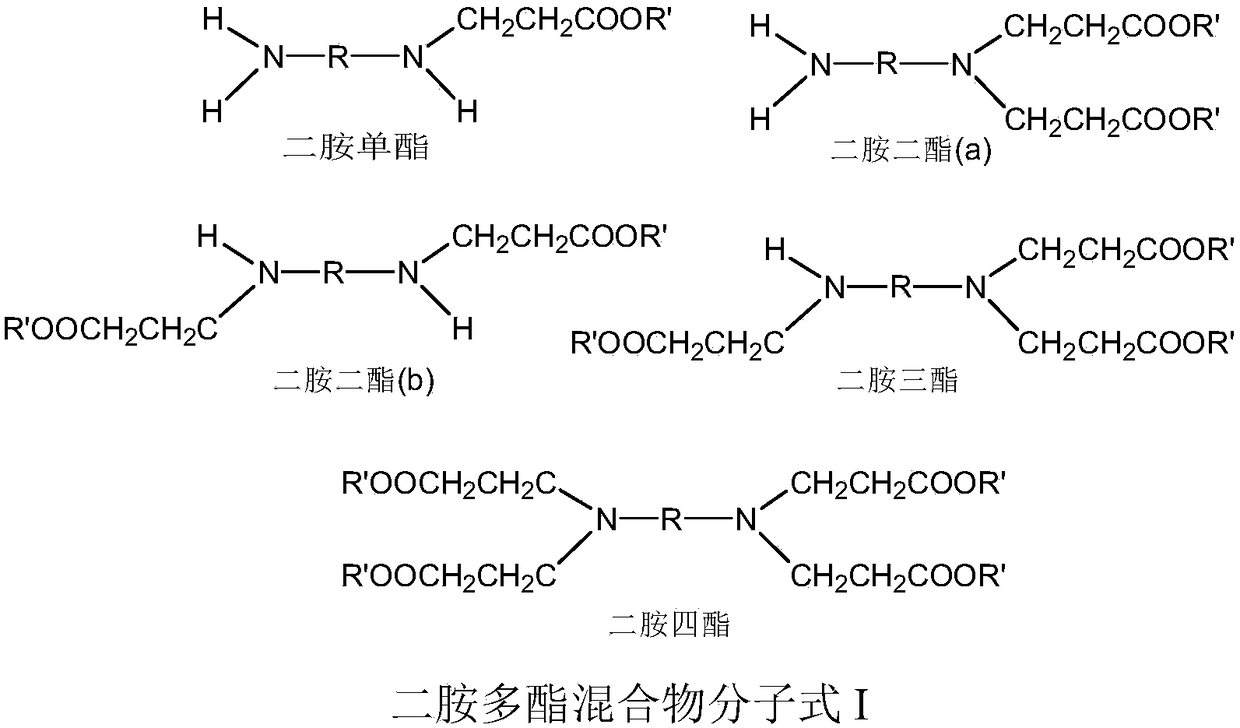
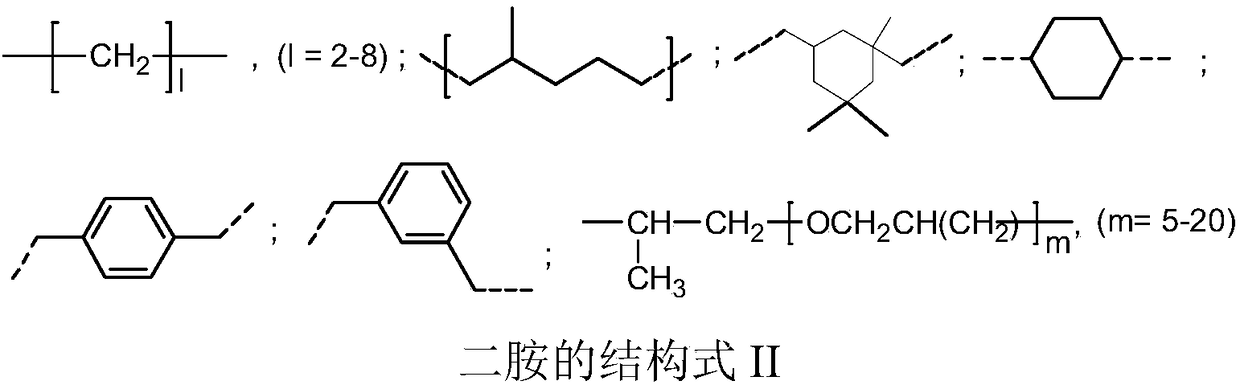
[0030] 1) Michael addition reaction: 116 parts of hexamethylenediamine and 344 parts of methyl acrylate were weighed by weight fraction, and reacted at 50°C for 3 hours to obtain a diamine polyester mixture.

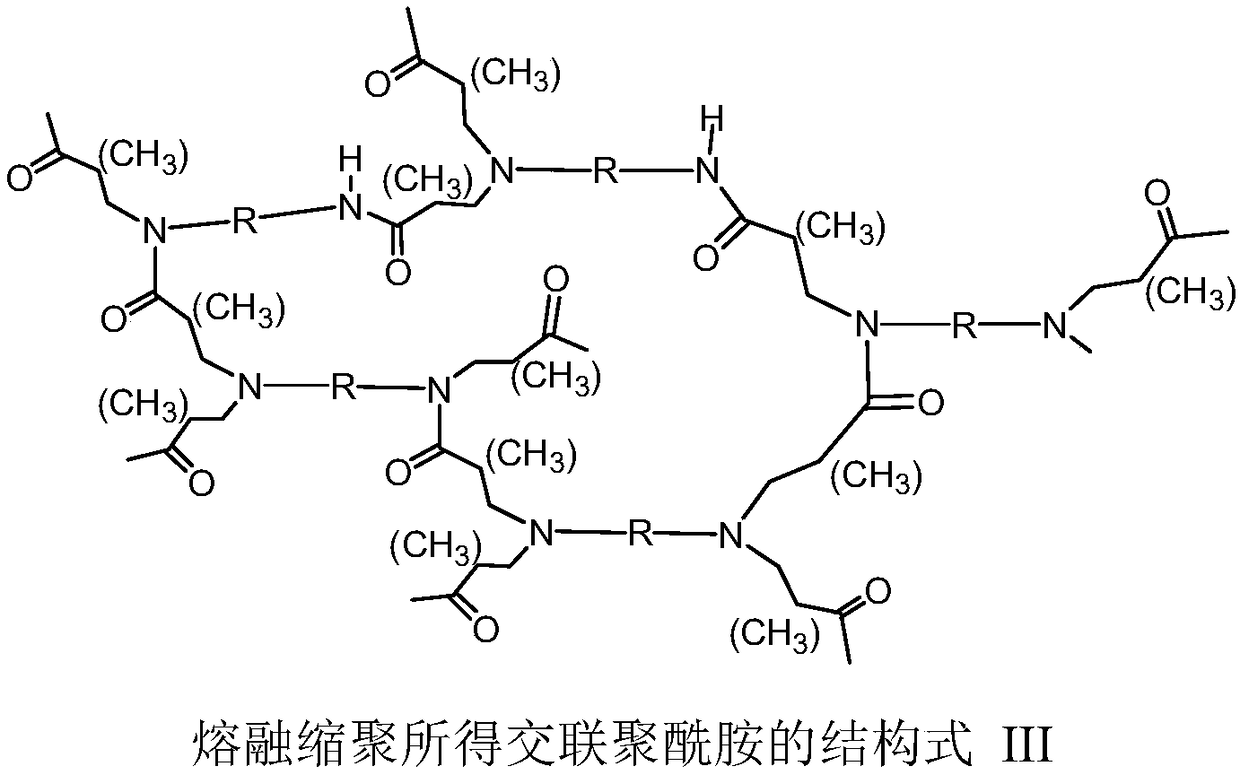
[0031] 2) Preparation of cross-linked polyamide: heat up the diamine polyester mixture obtained in step 1) to 170°C and react at normal pressure for 2 hours under the protection of nitrogen. -25mmHg) for 9 hours to obtain a cross-linked polyamide with a tensile strength of 38 MPa and an elongation at break of 25%.

Embodiment 2

[0033] 1) Michael addition reaction: 116 parts of hexamethylenediamine and 129 parts of methyl acrylate were weighed by weight fraction, and reacted at 50° C. for 3 hours to obtain a mixture of diamine polyesters.

[0034] 2) Preparation of cross-linked polyamide: heat up the diamine polyester mixture obtained in step 1) in Example 2 to 170°C and react under normal pressure for 40 minutes under nitrogen protection. React in a vacuum oven (25-30 mmHg) for 9 hours to obtain a cross-linked polyamide with a tensile strength of 45 MPa and an elongation at break of 21%.

Embodiment 3

[0036] 1) Michael addition reaction: 116 parts of hexamethylenediamine and 86 parts of methyl acrylate were weighed by weight fraction, and reacted at 60° C. for 3 hours to obtain a mixture of diamine polyesters.

[0037] 2) Preparation of cross-linked polyamide: heat up the diamine polyester mixture obtained in step 1) in Example 3 to 150°C and react under normal pressure for 20 minutes under nitrogen protection. React in a vacuum oven for 9 hours to obtain a cross-linked polyamide with a tensile strength of 3 MPa and an elongation at break of 69%.

the structure of the environmentally friendly knitted fabric provided by the present invention; figure 2 Flow chart of the yarn wrapping machine for environmentally friendly knitted fabrics and storage devices; image 3 Is the parameter map of the yarn covering machine
Login to View More

PUM

PropertyMeasurementUnit
Tensile strengthaaaaaaaaaa
Login to View More

Abstract

The invention relates to a method for preparing cross-linked polyamide in a body one-pot method, which belongs to the technical field of polyamide. Diamine and (methyl) acrylate have the body Michaeladdition to generate a diamine polyester mixture, and the diamine polyester is heated, molten and polycondensated to obtain the cross-linked polyamide. The method is mild in reaction conditions, easyin obtaining raw materials, simple in procedures and environment-friendly in process, and the obtained cross-linked polyamide is excellent in mechanical performance.

Description

technical field [0001] The invention establishes a method for preparing cross-linked polyamide by utilizing diamine and (meth)acrylic acid ester in one pot. The specific method is to generate a diamine polyester mixture through bulk Michael addition reaction of diamine and (meth)acrylic acid ester, and to prepare cross-linked polyamide through melting and polycondensation at elevated temperature, which belongs to the technical field of polyamide. technical background [0002] Polyamide is a kind of polymer material with excellent comprehensive properties. It has superior mechanical properties, high strength, good toughness, and has the characteristics of oil resistance and corrosion resistance. It can meet the needs of industries and has great room for development. Nowadays, ordinary polyamides are mainly linear structures, and the synthesis processes of linear polyamides are generally divided into two categories: (1) polycondensation of dibasic acids and diamines; (2) ring-...

Claims

the structure of the environmentally friendly knitted fabric provided by the present invention; figure 2 Flow chart of the yarn wrapping machine for environmentally friendly knitted fabrics and storage devices; image 3 Is the parameter map of the yarn covering machine
Login to View More

Application Information

Patent Timeline
no application Login to View More
IPC IPC(8): C08G73/02C08J5/18C08L79/02
CPCC08G73/028C08J5/18C08J2379/02
Inventor 赵京波杨胜青张军营
Owner BEIJING UNIV OF CHEM TECH
Features
  • R&D
  • Intellectual Property
  • Life Sciences
  • Materials
  • Tech Scout
Why Patsnap Eureka
  • Unparalleled Data Quality
  • Higher Quality Content
  • 60% Fewer Hallucinations
Social media
Patsnap Eureka Blog
Learn More