Aromatic amine compound and organic light-emitting device thereof

An electroluminescent device and compound technology, applied in the direction of electro-solid devices, electrical components, light-emitting materials, etc., can solve problems such as changing the internal carrier transport performance, the light-extraction efficiency of the device is only 20%, and affecting the stability of organic materials. , to achieve good hole transport ability, reduce total emission and waveguide effect, and not easy to crystallize

CN109400485AInactive Publication Date: 2019-03-01CHANGCHUN HYPERIONS TECH CO LTD
1 Cites 7 Cited by

Patent Information

Authority / Receiving Office
CN · China
Patent Type
Applications(China)
Current Assignee / Owner
Publication Date
2019-03-01
Estimated Expiration
Not applicable · inactive patent

Smart Images

  • Figure 1
    Figure 1
  • Figure 2
    Figure 2
  • Figure 3
    Figure 3
Patent Text Reader

Abstract

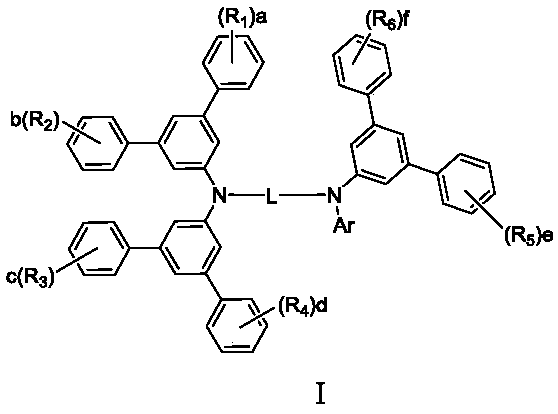
The invention provides an aromatic amine compound and an organic light-emitting device thereof, and relates to the technical field of organic photoelectric materials. An aromatic amine main body structure is connected with three substituted or non-substituted 3,5-diphenylbenzene group to obtain the aromatic amine compound, the aromatic amine compound has good hole transport ability, and is high inreflectivity, good in film-forming property and good in thermal stability, synthesis is simple and is easy to operate, the aromatic amine compound can be applied to the organic light-emitting deviceand serves as a hole transport layer and / or a covering layer, the problems that the organic light-emitting device is severe in light loss and low in light emitting efficiency, heat of the device is accumulated, the efficiency of the device is severe in roll-off, and the service life is short are solved, and the organic light-emitting device has the advantages of high light-emitting efficiency andlong service life.
Need to check novelty before this filing date? Find Prior Art

Description

technical field

[0001] The invention relates to the technical field of organic photoelectric materials, in particular to an aromatic amine compound and an organic electroluminescence device thereof. Background technique

[0002] Organic electroluminescent devices apply voltage across the cathode and anode, inject current, and after electrons and holes pass through the organic functional layers, they combine to form excitons in the light-emitting layer, and the excitons return to a stable ground state to produce radiative luminescence. After more than 30 years of development, the efficiency of organic electroluminescent devices has been greatly improved, and because of its self-illumination, wide viewing angle, full curing, full color, fast response, high brightness, low driving voltage, thin thickness, Due to the characteristics of light weight, large-size and curved panels, organic electroluminescent devices have been more and more used in the display market, and have becom...

Examples

Embodiment 1

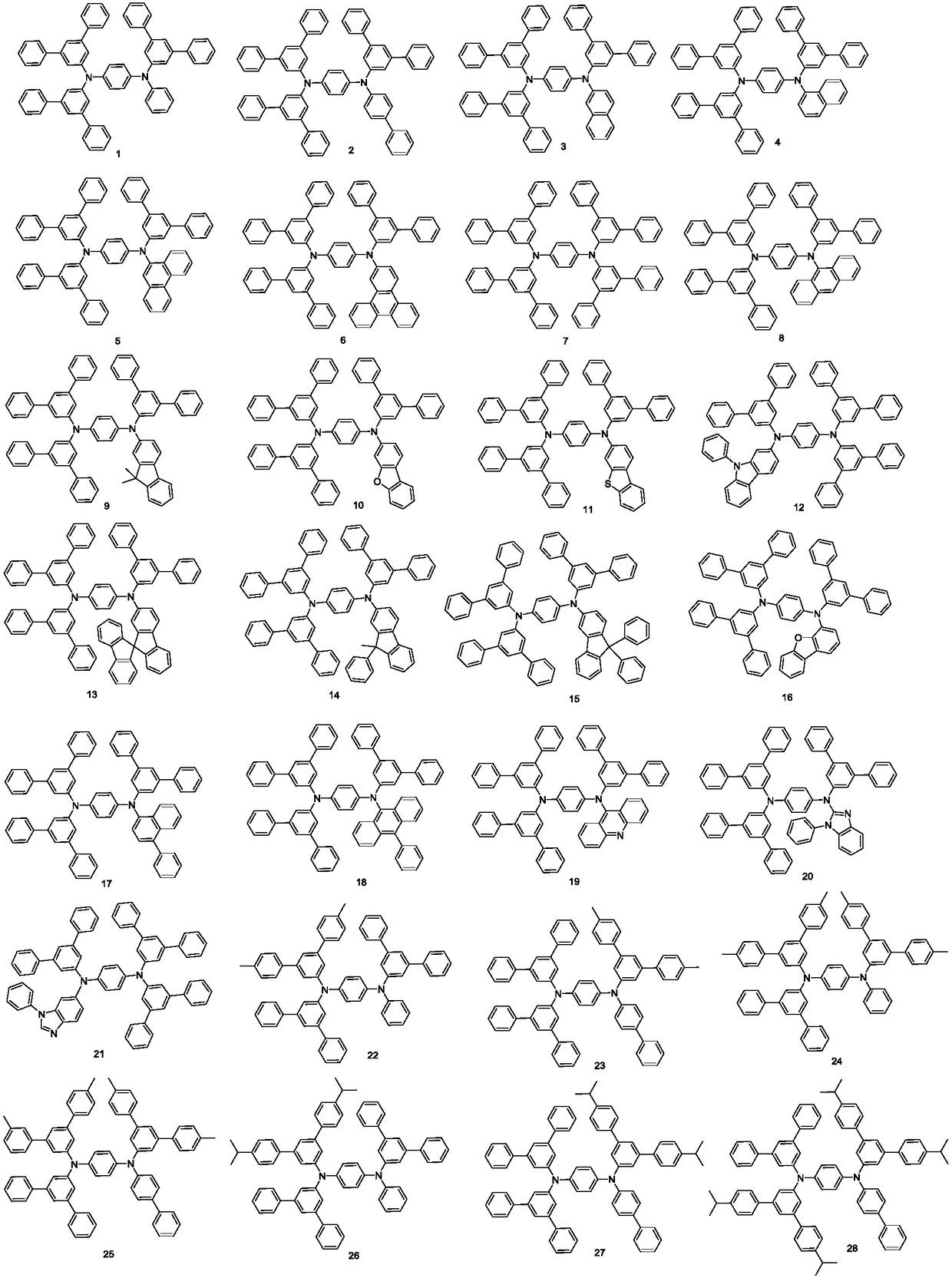
[0078][Example 1] Synthesis of Compound 1

[0079]

[0080] Step1: Add 1,1':3',1"terphenyl-5'-amine (2.45g, 10mmol), 5'-bromo-1,1':3',1"terphenyl-5'-amine (3.09g , 10mmol), Pd 2 (dba) 3 (0.21g, 0.25mmol), P(t-Bu) 3 (0.18g, 0.84mmol), NaOt-Bu (2.8g, 25mmol), 100mL of toluene solution, reacted at 100°C for 24h, extracted the organic phase with diethyl ether and water after the reaction, and washed the organic layer with MgSO 4 Drying, concentration of organic matter, column chromatography and recrystallization gave intermediate 1-1 (3.88g, 82%).

[0081] Step2: Add 1,1':3',1" terphenyl-5'-amine (2.45, 10mmol), bromobenzene (1.57g, 10mmol), Pd to the reactor 2 (dba) 3 (0.21g, 0.25mmol), P(t-Bu) 3 (0.18g, 0.84mmol), NaOt-Bu (2.8g, 25mmol), 100mL of toluene solution, reacted at 100°C for 24h, extracted the organic phase with diethyl ether and water after the reaction, and washed the organic layer with MgSO 4 Dry, concentrate the organic matter, go through column chromatog...

Embodiment 2

[0084] [Example 2] Synthesis of compound 20

[0085] Compound 20 (7.49 g, 76%) was obtained according to the synthesis method of compound 1 in Example 1.

[0086]

Embodiment 3

[0087] [Example 3] Synthesis of compound 35

[0088] Compound 35 (7.97 g, 77%) was obtained according to the synthesis method of compound 1 in Example 1.

[0089]