Preparation method of a nitrogen-containing porous carbon/manganese dioxide nanowire composite electrode

A manganese dioxide nano-composite electrode technology, which is applied in hybrid capacitor electrodes, hybrid/electric double-layer capacitor manufacturing, etc., to achieve the effect of shortening the diffusion path, rich raw materials, and favorable capacitance performance

A manganese dioxide nano-composite electrode technology, which is applied in hybrid capacitor electrodes, hybrid/electric double-layer capacitor manufacturing, etc., to achieve the effect of shortening the diffusion path, rich raw materials, and favorable capacitance performance

CN109637827BActive Publication Date: 2021-09-28安徽格兰科新材料技术有限公司

Image

Smart Image Click on the blue labels to locate them in the text.
Viewing Examples
Smart Image
  • Preparation method of a nitrogen-containing porous carbon/manganese dioxide nanowire composite electrode
  • Preparation method of a nitrogen-containing porous carbon/manganese dioxide nanowire composite electrode
  • Preparation method of a nitrogen-containing porous carbon/manganese dioxide nanowire composite electrode

Examples

Experimental program
Comparison scheme
Effect test

Embodiment 1

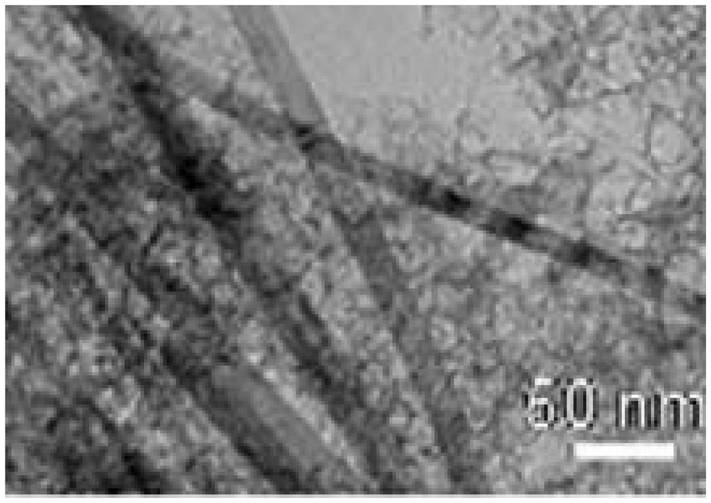
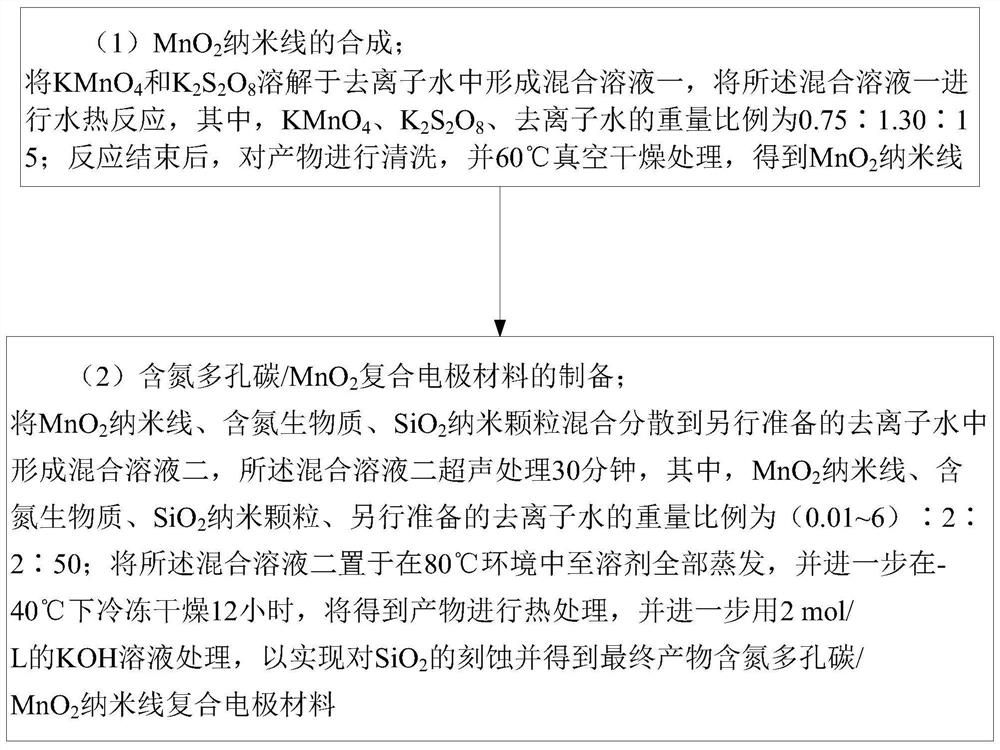
[0040] 0.75 g KMnO 4 and 1.30 g K 2 S 2 o 8 Dissolve in 15 mL deionized water. The above-mentioned mixed solution was placed in a reactor for hydrothermal high-temperature reaction, the temperature was 140°C, and the reaction time was 24 hours. After the reaction, the product was washed with deionized water and alcohol, and dried in a vacuum oven at 60°C to obtain MnO 2 Nanowires, the nanowires have a diameter of about 20-25nm and a length of about 1 μm.

[0041] 0.1 gram of MnO prepared by the above reaction 2 Nanowires with 2 grams of gelatin, 2 grams of SiO 2 Nanoparticles (approximately 50 nm in diameter) were mixed and dispersed in 50 ml of deionized water and sonicated for 30 min. After that, the above mixed solution was placed in an oven at 80°C until the solvent was completely evaporated, and further freeze-dried at -40°C for 12 hours. The obtained product was subjected to heat treatment, and the heat treatment conditions were first treated at 300°C for 2 hours...

Embodiment 2

[0044] 0.75 g KMnO 4 and 1.30 g K 2 S 2 o 8 Dissolve in 15 mL deionized water. The above-mentioned mixed solution was placed in a reactor for hydrothermal high-temperature reaction, the temperature was 140°C, and the reaction time was 24 hours. After the reaction, the product was washed with deionized water and alcohol, and dried in a vacuum oven at 60°C to obtain MnO 2 Nanowires, the nanowires have a diameter of about 20-25nm and a length of about 1 μm.

[0045] 0.3 gram of MnO prepared by the above reaction 2 Nanowires with 2 grams of gelatin, 2 grams of SiO 2 Nanoparticles (approximately 50 nm in diameter) were mixed and dispersed in 50 ml of deionized water and sonicated for 30 min. After that, the above mixed solution was placed in an oven at 80°C until the solvent was completely evaporated, and further freeze-dried at -40°C for 12 hours. The obtained product was subjected to heat treatment, and the heat treatment conditions were first treated at 300°C for 2 hours...

Embodiment 3

[0047] 0.75 g KMnO 4 and 1.30 g K 2 S 2 o 8 Dissolve in 15 mL deionized water. The above-mentioned mixed solution was placed in a reactor for hydrothermal high-temperature reaction, the temperature was 140°C, and the reaction time was 24 hours. After the reaction, the product was washed with deionized water and alcohol, and dried in a vacuum oven at 60°C to obtain MnO 2 Nanowires, the nanowires have a diameter of about 20-25nm and a length of about 1 μm.

[0048] 0.5 gram of MnO prepared by the above reaction 2 Nanowires with 2 grams of gelatin, 2 grams of SiO 2Nanoparticles (approximately 50 nm in diameter) were mixed and dispersed in 50 ml of deionized water and sonicated for 30 min. After that, the above mixed solution was placed in an oven at 80°C until the solvent was completely evaporated, and further freeze-dried at -40°C for 12 hours. The obtained product was subjected to heat treatment, and the heat treatment conditions were first treated at 300°C for 2 hours,...

the structure of the environmentally friendly knitted fabric provided by the present invention; figure 2 Flow chart of the yarn wrapping machine for environmentally friendly knitted fabrics and storage devices; image 3 Is the parameter map of the yarn covering machine
Login to View More

PUM

No PUM Login to View More

Abstract

The invention discloses a method for preparing a nitrogen-containing porous carbon / manganese dioxide nanowire composite electrode for a supercapacitor, which uses nitrogen-containing biomass carbon and manganese dioxide as raw materials to prepare the electrode. First, manganese dioxide nanowires are synthesized by hydrothermal method, and then manganese dioxide nanowires, nitrogen-containing biomass carbon and silicon dioxide are mixed, followed by high-temperature carbonization and alkali etching, and finally a composite electrode material is formed. The prepared composite electrode material has a high specific capacitance value, at 2mol / L Ca(NO 3 ) 2 In the electrolyte, the specific capacity can reach up to 357.5F / g, and it has excellent cycle stability. After 5000 cycles, the specific capacity can still maintain 97.2%. The biomass carbon used in the invention is a renewable resource, and the manganese dioxide is an environment-friendly raw material, both of which have the characteristics of abundant raw materials and low cost. The composite electrode for supercapacitor prepared by the invention has excellent performance and simple operation, and can meet the application requirements of energy storage.

Description

technical field [0001] The invention belongs to the field of supercapacitor electrode material preparation, and in particular relates to a method for preparing a nitrogen-containing porous carbon / manganese dioxide nanowire composite electrode for supercapacitors. Background technique [0002] Supercapacitors have attracted great attention due to their advantages such as high power density, high cycle life, and high stability. According to the energy storage mechanism, supercapacitors can be divided into two categories: electric double layer capacitors and pseudocapacitors. Among them, the electric double layer capacitor relies on the electrostatic double layer formed at the electrode / electrolyte interface to store charges, and the electrode materials used are mainly carbon materials with high specific surface area. Pseudocapacitors store charges through reversible redox reactions on the surface or bulk of electrode materials, and the electrode materials used mainly include ...

Claims

the structure of the environmentally friendly knitted fabric provided by the present invention; figure 2 Flow chart of the yarn wrapping machine for environmentally friendly knitted fabrics and storage devices; image 3 Is the parameter map of the yarn covering machine
Login to View More

Application Information

Patent Timeline
28 Sep 2021
Publication
CN109637827B
IPC
H01G11/24; H01G11/30; H01G11/46; H01G11/34; H01G11/44; H01G11/86
CPC
H01G11/24; H01G11/30; H01G11/34; H01G11/44; H01G11/46; H01G11/86; Y02E60/13
Inventors
王振洋; 张淑东