Double-layer casing structure electric heating waste gas treatment device

An exhaust gas treatment device and a double-layer casing technology are applied in the direction of exhaust devices, noise reduction devices, machines/engines, etc., which can solve the problems of damage to electrical insulation ceramics of heating electrical components, potential safety hazards, unfavorable maintenance in the later period, etc., and achieve increased The effect of service life, reducing serious local aging problems, and avoiding core damage

CN110206622BActive Publication Date: 2021-07-27亿达天地环保技术股份有限公司
16 Cites 0 Cited by

Patent Information

Authority / Receiving Office
CN · China
Patent Type
Patents(China)
Current Assignee / Owner
Publication Date
2021-07-27

Smart Images

  • Figure 1
    Figure 1
  • Figure 2
    Figure 2
  • Figure 3
    Figure 3
Patent Text Reader

Abstract

An electric heating exhaust gas treatment device with a double-layer casing structure is arranged in the exhaust system of an internal combustion engine, and includes an inner layer casing, an outer layer casing and a metal catalyst carrier. The inner layer casing is provided with a metal catalyst carrier, and at least one The heating honeycomb element is located in the inner sleeve and arranged above the metal catalyst carrier. There is an insulating gap between the heating honeycomb element and the metal catalyst carrier. The upper end of the inner sleeve is located on the inner side of the outer sleeve and a The annular U-shaped processing groove separates the upper end of the inner casing into a circular arc, one end of the heating honeycomb element is electrically connected to the circular arc, and a conductive element is electrically connected to the circular arc after penetrating through the outer sleeve. The outer wall of the arc ring; thus, the present invention can effectively reduce or avoid the adverse effects of accelerated oxidation and corrosion in the contact area between the end of the electric conductor and the honeycomb core body, and especially avoid the high torque generated during the actual assembly process so that Damage caused by electrically sensitive parts.
Need to check novelty before this filing date? Find Prior Art

Description

technical field

[0001] The invention relates to the technical field of emission reduction of automobile tail gas pollutants, in particular to an electric heating waste gas treatment device with a double-layer casing structure. Background technique

[0002] In the exhaust system of the internal combustion engine, an electric heating device that can play a catalytic role in advance is installed at the front end of the catalyst carrier. It can ignite the catalytic reaction through the flowing exhaust gas through radiant heat, especially for the rapid and effective heating of the diesel internal combustion engine. The accumulated carbon black particles are thereby burned off.

[0003] The technical construction of this type of electric heating device is to use and only use a single sleeve, and to apply a circuitous current line at its end through equidistant gaps. One end of the current line is in contact with the inner wall of the sleeve, and the other end is in contact with an...

Examples

Embodiment Construction

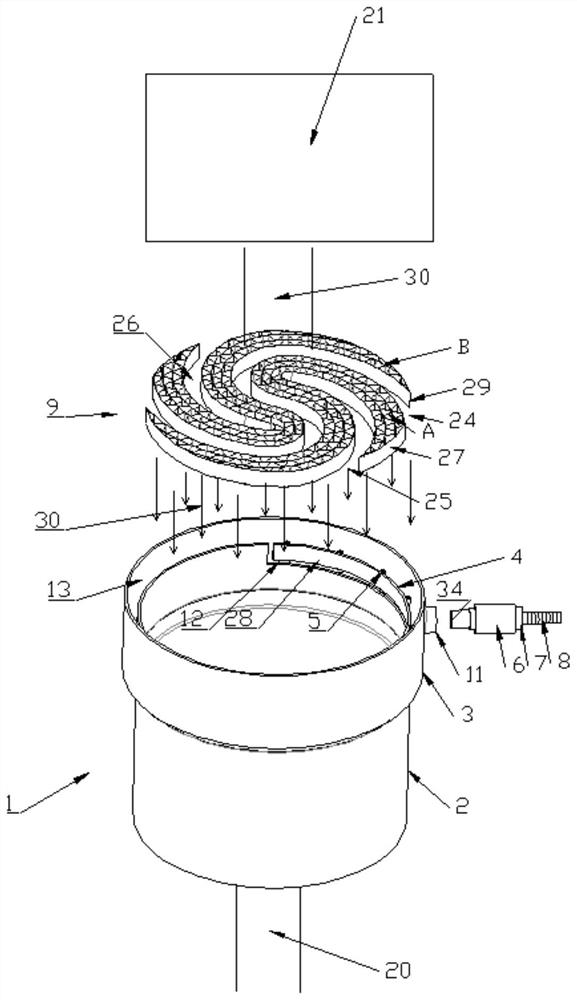
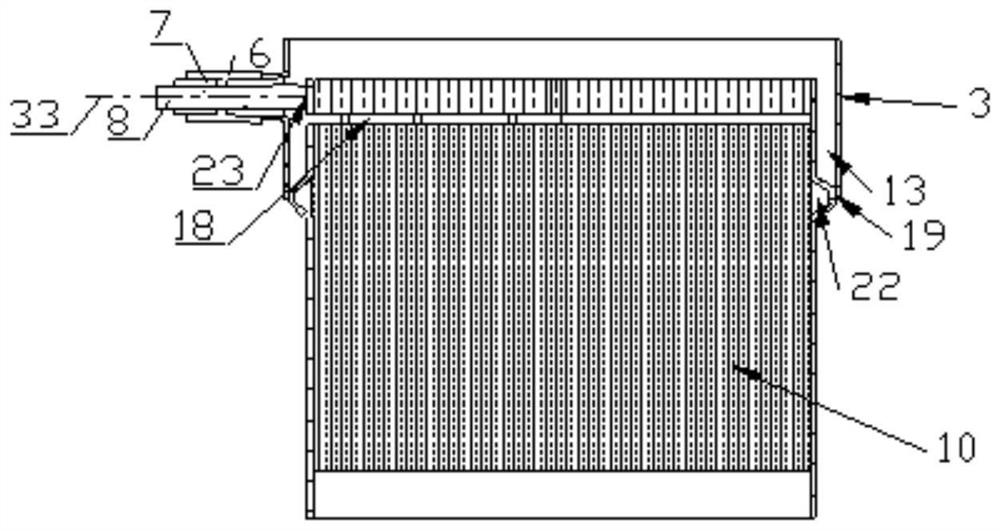
[0032] see figure 1 with 2 , shows the electric heating exhaust gas treatment device with double-layer casing structure of the present invention.

[0033] The electric heating exhaust gas treatment device 1 with a double-layer casing structure is used to purify the exhaust gas of the internal combustion engine 21, which is arranged in the exhaust system 20 of the internal combustion engine 21, and includes an inner casing 2, an outer casing 3 and a metal catalyst carrier 10. The metal catalyst carrier 10 is arranged inside the inner layer casing, and the upper outer edge of the inner layer casing 2 is provided with a trapezoidal reinforcing rib 19 protruding radially outward, and the outer diameter of the trapezoidal reinforcing rib 19 is equal to And the outer side is connected to the lower end inner wall of the outer casing 3, so that a double-layer casing gap 13 is formed between the outer casing 3 and the inner casing 2, and the double-layer casing gap 13 is preferably grea...