

Halomonas YFX-6 and application thereof
A technology of YFX-6 and Halomonas, which is applied in Halomonas and its application fields, can solve the problems such as difficulty in exerting advantages and achieve good removal effect
- Summary
- Abstract
- Description
- Claims
- Application Information
AI Technical Summary
Problems solved by technology
Method used
Image

Examples
Embodiment 1
[0030] Screening to obtain Halomonas sp YFX-6, the screening process is as follows:
[0031] Step 1), take activated sludge from the outlet of the A / A / O treatment process A pool of the leather wastewater treatment plant;
[0032] Step 2), inoculating 5g of activated sludge into an inorganic salt medium with a volume fraction of nitrate nitrogen of 0.5% and a salinity of 10%, at a temperature of 30°C, a salinity of 10%, and a rotating speed of 180 rpm Cultivate on a shaker for 1 minute to obtain the first bacterial liquid;
[0033] Step 3), absorb the first bacterial solution in step 2) and transfer it to an inorganic salt medium with a volume fraction of nitrate nitrogen of 1.5% and a salinity of 10%, at a temperature of 30°C and a rotation speed of 180 rpm Cultivate on a shaker for 3 days to obtain the second bacterial liquid;
[0034] Step 4), absorb the second bacterial solution in step 3) and transfer it to an inorganic salt medium with a volume fraction of nitrate nitro...
Embodiment 2
[0038] The strains screened in Example 1 were identified.
[0039] In Example 1 of the present invention, three strains were screened, which were named HX-1, IL-3, and YFX-6 in the present invention. Among them, YFX-6 was identified as Halomonas sp.
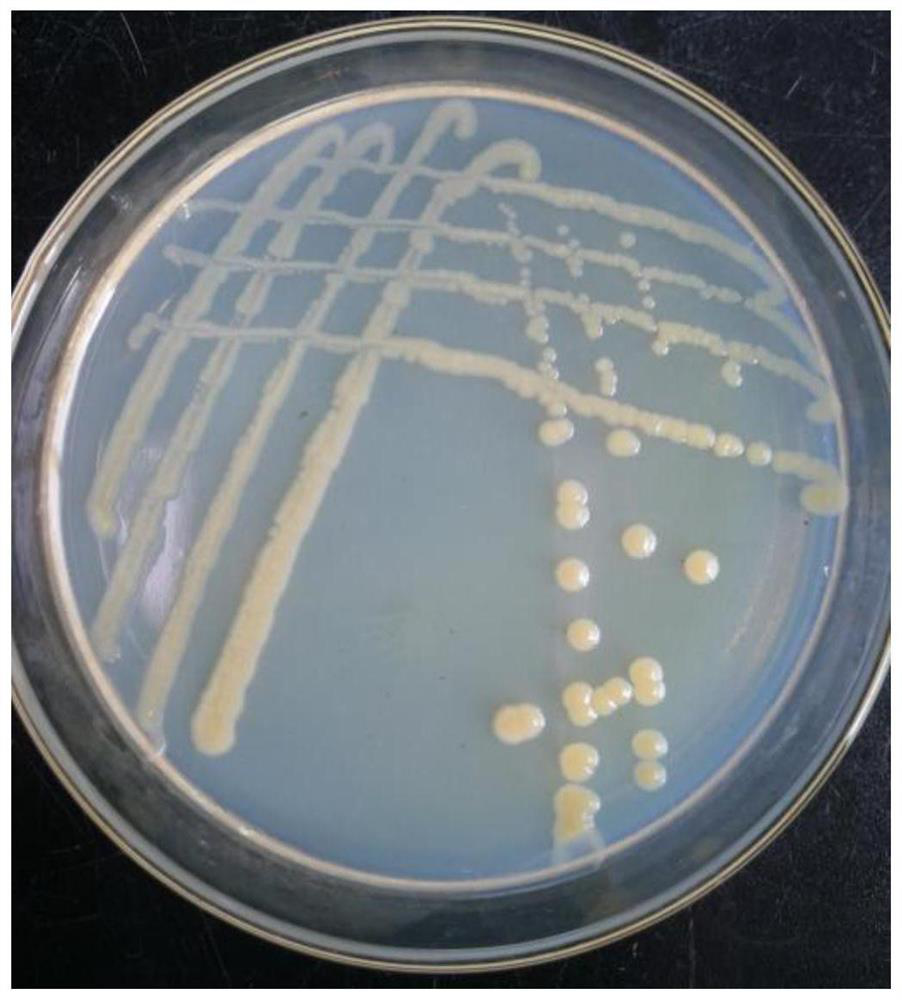
[0040] Halomonas sp YFX-6 grows well on agar plate medium, such as figure 1 As shown, the colonies are regular in shape, round and transparent, uniform in size, 2 to 4 mm in diameter, moist on the surface, flat on the edge, Gram stain negative, motile, and grow aerobically. The growth temperature of the strain is 20-35°C, pH 6-9, and the optimum growth conditions: the growth temperature is 30°C, pH 7.5.
[0041] DNA was extracted from the single colony obtained in step 5) in Example 1, and the strain was subjected to DNA sequencing, and its 16S rRNA gene sequence was shown in SEQ ID No.1. In the present invention, the bacterium is also called Halomonas sp FX-6.
Embodiment 3
[0043] The nitrogen compound degradation ability of Halomonas sp YFX-6 bacteria obtained in Example 1 was determined. Specific steps are as follows:
[0044] Step 1), get the bacterium liquid of Halomonas sp HX-1 obtained in Example 1 and the IL-3 and YFX-6 obtained by simultaneous screening, centrifuge at 3000 rpm for 10 minutes, discard the supernatant, Add actual water to the pellet and resuspend to obtain Halomonas sp YFX-6;
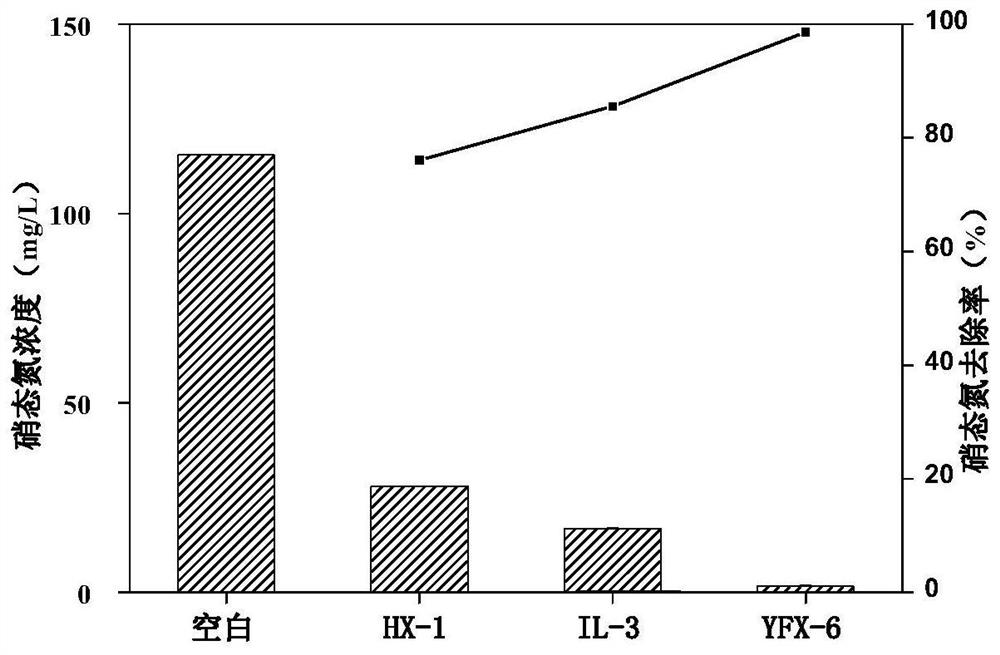
[0045]Step 2), take 20mL of Halomonas sp YFX-6 and the HX-1 and IL-3 screened at the same time, centrifuge according to step 1, and add them to the test bottles numbered 2, 3, and 4 respectively , No. 1 is the control group without adding bacteria. And adding nitrate nitrogen to each test bottle is 117.42mg / L grain fruit high salt (2%Nacl) treated water and sodium acetate trihydrate (carbon-to-nitrogen ratio is 8) to a total volume of 100mL, wherein grain fruit The salinity Nacl in the waste water is supplemented to the salinity 10%, promptly adds...
PUM
 Login to View More
 Abstract
Description
Claims
Application Information
 Login to View More