

Recovery treatment method and recovery treatment device for glass etching waste liquid
A technology for etching waste liquid and recycling treatment, applied in nitrogen fertilizer, hydrogen fluoride, fluorine/hydrogen fluoride and other directions, can solve the problems of environmental pollution and waste of glass etching waste liquid, and achieve the effect of solving environmental pollution and waste problems and reducing the three wastes.
- Summary
- Abstract
- Description
- Claims
- Application Information
AI Technical Summary
Problems solved by technology
Method used
Image

Examples
Embodiment Construction
[0024] The following will clearly and completely describe the technical solutions in the embodiments of the present invention with reference to the accompanying drawings in the embodiments of the present invention. Obviously, the described embodiments are only some, not all, embodiments of the present invention. Based on the embodiments of the present invention, all other embodiments obtained by persons of ordinary skill in the art without making creative efforts belong to the protection scope of the present invention.
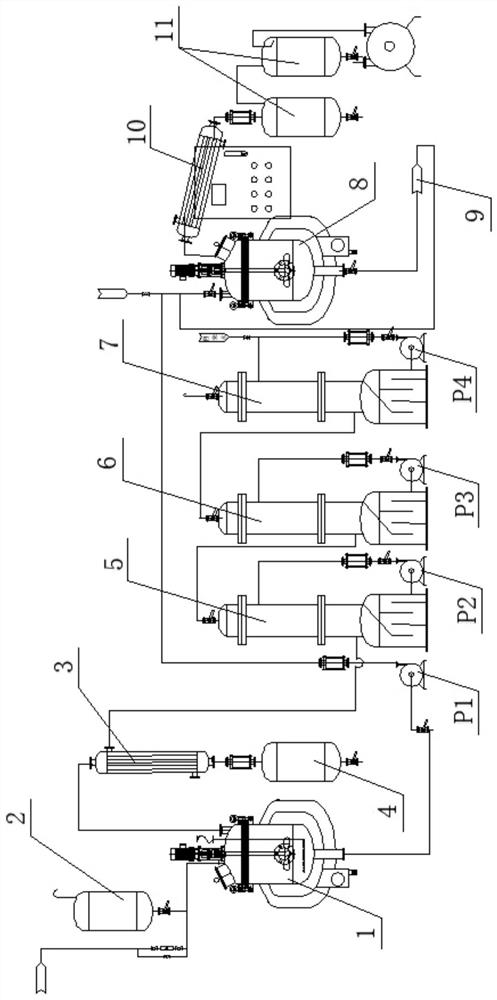
[0025] See figure 1 , a recovery treatment device for glass etching waste liquid, including defluorination reaction connected in sequence, 1, condenser 3 and hydrofluoric acid storage tank 4, three-stage falling film water connected to the gas outlet of condenser 3 Absorption system (first-level falling film absorption tower 5, second-level falling film absorption tower 6 and third-level falling film absorption tower 7), neutralization tank 8 connected to the ...
PUM
 Login to View More
 Abstract
Description
Claims
Application Information
 Login to View More