Zero-VOC emission color paste for POS machine
A POS machine and color paste technology, applied in the production of pigment paste, bulk chemicals, etc., to achieve the effect of improving stability and storage stability
- Summary
- Abstract
- Description
- Claims
- Application Information
AI Technical Summary
Problems solved by technology
Method used
Image



Examples
Embodiment 1
[0061] A zero-VOC emission color paste for POS machines, comprising: 50 parts by weight of water, 30 parts of toner (titanium dioxide), 10 parts of zero-VOC surfactant, and 10 parts of humectant (polyethylene glycol) , rheology modifier 5 parts, pH regulator (polyethyleneimine) 1 part.
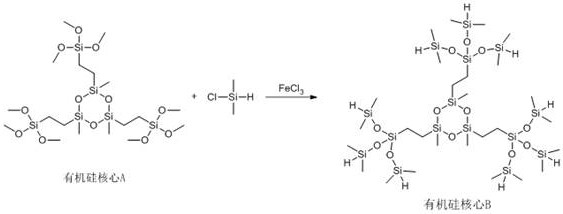
[0062] Wherein, the zero-VOC surfactant is a hyperbranched polymer whose core is an organosilicon structure and whose end group structure is a phosphate ester structure, and its preparation method is as follows:
[0063] (S.1) Add 0.1 mol of methylhydrocyclotrisiloxane, 0.3 mol of vinyltrimethoxysilane, 100 ml of toluene and 0.1 g of Castel catalyst into the reactor, and hydrosilylation occurs at 75 °C After the reaction was completed, 1 g of activated carbon was added to stir and adsorb for 30 minutes, and the solvent was filtered and rotated to obtain the organosilicon core A;
[0064] (S.2) Take 0.1 mol of organosilicon core A, 0.9 mol of dimethylchlorosilane, 200 ml of toluene and 0.1 g o...
Embodiment 2
[0076] A color paste for POS machines with zero VOC emissions, comprising: 50 parts by weight of water, 45 parts of toner (carbon black), 20 parts of zero-VOC surfactant, 15 parts of humectant (polyethylene oxide) 10 parts rheology modifier, 5 parts pH adjuster (triethanolamine) and 5 parts fungicide.
[0077] Wherein, the zero-VOC surfactant is a hyperbranched polymer whose core is an organosilicon structure and whose end group structure is a phosphate ester structure, and its preparation method is as follows:
[0078] (S.1) Add 0.1mol of methylhydrocyclotetrasiloxane, 0.48mol of vinyltrimethoxysilane, 100ml of toluene and 0.1g of Castel catalyst into the reactor, and hydrosilylation occurs at 90°C After the reaction was completed for 5 hours, 1 g of activated carbon was added to stir and adsorb for 30 minutes, and the solvent was filtered and rotated to obtain the organosilicon core A;
[0079] (S.2) Add 0.1 mol of silicone core A, 1.8 mol of dimethylchlorosilane, 200 ml of...
Embodiment 3
[0091] A zero-VOC emission color paste for POS machines, comprising: 50 parts by weight of water, 40 parts of toner (iron oxide), 15 parts of zero-VOC surfactant, 12 parts of humectant (polyvinyl alcohol), 8 parts of rheology modifier, 3 parts of pH regulator (polyurea) and 2 parts of leveling agent.
[0092] Wherein, the zero-VOC surfactant is a hyperbranched polymer whose core is an organosilicon structure and whose end group structure is a phosphate ester structure, and its preparation method is as follows:
[0093] (S.1) Add 0.1 mol of methylhydrocyclooctasiloxane, 0.93 mol of vinyltrimethoxysilane, 100 ml of toluene and 0.1 g of Castel catalyst into the reaction vessel, and hydrosilylation occurs at 80°C After the reaction was completed for 4 hours, 1 g of activated carbon was added to stir and adsorb for 30 minutes, and the solvent was filtered to obtain the organosilicon core A;
[0094] (S.2) Take 0.1 mol of silicone core A, 2.7 mol of dimethylchlorosilane, 300 ml of ...
PUM
 Login to View More
 Abstract
Description
Claims
Application Information
 Login to View More