Check patentability & draft patents in minutes with Patsnap Eureka AI!

Nano material for realizing hydrophobic and anti-fogging properties of glasses

A nano-material, hydrophobic technology, applied in glasses/goggles, other chemical processes, instruments, etc., can solve problems such as poor experience, shedding damage, blurred vision, etc., to ensure anti-fog effect, easy to replace and use, improve The effect of ease of use

Active Publication Date: 2022-01-14
广西五行材料科技有限公司
View PDF15 Cites 0 Cited by
  • Summary
  • Abstract
  • Description
  • Claims
  • Application Information

AI Technical Summary

Problems solved by technology

[0002]Spectacle lenses are particularly prone to fogging in environments with temperature differences. For example, when going from indoors to outdoors in winter, the reason is that the water vapor in the environment with large temperature differences reaches In the saturated state, tiny liquid droplets condense on the surface of the lens to form fog, which affects the light transmission of the lens, resulting in blurred vision and causing a lot of inconvenience to people wearing glasses
[0003]Aiming at this problem, the current solution on the market is to coat the lens with an anti-fog coating film, but the hardness of the existing anti-fog coating is generally low after curing. After being used for a period of time, problems such as scratches and peeling damage will occur. At this time, not only the coating needs to be re-coated, but also the original coating must be removed, which brings bad experience to the user.

Method used

the structure of the environmentally friendly knitted fabric provided by the present invention; figure 2 Flow chart of the yarn wrapping machine for environmentally friendly knitted fabrics and storage devices; image 3 Is the parameter map of the yarn covering machine
View more

Image

Smart Image Click on the blue labels to locate them in the text.
Viewing Examples
Smart Image
  • Nano material for realizing hydrophobic and anti-fogging properties of glasses

Examples

Experimental program
Comparison scheme
Effect test

Embodiment 1

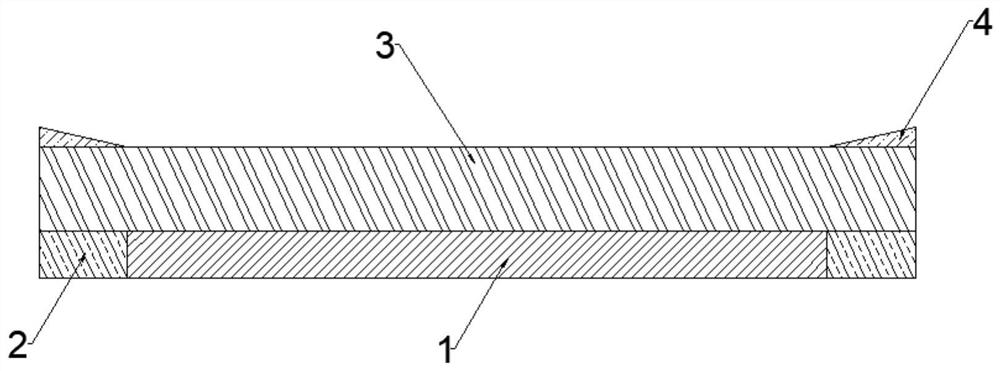
[0033] A nano-material for hydrophobic and anti-fogging of glasses, comprising an inner coating 1, an inner edge layer 2, and an anti-fog coating 3, and the anti-fog coating 3 is covered on the outside of the inner layer 1 and the outer layer 2;

[0034] The composition of inner coating 1 comprises sodium stearate;

[0035] The composition of inner edge layer 2 comprises konjac gum;

[0036] Anti-fog coating 3 comprises the following components by weight percentage:

[0037] 15% titanium dioxide;

[0038] 8% excipients;

[0039] The remainder of the solvent;

[0040] Excipients include silicon nitride;

[0041] Solvents include water and polyethylene glycols.

[0042] The inner coating 1 and the inner edge layer 2 are partially overlapped or connected.

[0043] Titanium dioxide is processed as follows: titanium dioxide is first added to the lye, stirred evenly, heated to 130°C for reaction, the filter residue is taken, washed, dried, and crushed; then sodium dodecylsulfo...

Embodiment 2

[0055] A nano-material for hydrophobic and anti-fogging of glasses, comprising an inner coating 1, an inner edge layer 2, and an anti-fog coating 3, and the anti-fog coating 3 is covered on the outside of the inner layer 1 and the outer layer 2;

[0056] The composition of inner coating 1 comprises sodium stearate;

[0057] The composition of inner edge layer 2 comprises konjac gum;

[0058] Anti-fog coating 3 comprises the following components by weight percentage:

[0059] 32% titanium dioxide;

[0060] 13% excipients;

[0061] The remainder of the solvent;

[0062] Excipients include silicon nitride;

[0063] Solvents include water and polyethylene glycols.

[0064] The inner coating 1 and the inner edge layer 2 are partially overlapped or connected.

[0065] Titanium dioxide is processed as follows: titanium dioxide is first added to the lye, stirred evenly, heated to 160°C for reaction, the filter residue is taken, washed, dried, and crushed; then sodium dodecylsulf...

the structure of the environmentally friendly knitted fabric provided by the present invention; figure 2 Flow chart of the yarn wrapping machine for environmentally friendly knitted fabrics and storage devices; image 3 Is the parameter map of the yarn covering machine
Login to View More

PUM

PropertyMeasurementUnit
particle diameteraaaaaaaaaa
Login to View More

Abstract

A nano material for realizing hydrophobic and anti-fogging properties of glasses is disclosed in the invention, and comprises an inner coating, an inner edge layer and an anti-fogging coating, and the outer sides of the inner layer and the outer layer are covered with the anti-fogging coating; the inner coating comprises sodium stearate; the inner edge layer comprises konjac glucomannan; the anti-fogging coating comprises, by weight, 15-32% of titanium dioxide, 8-13% of an auxiliary material, and the balance of a solvent; the auxiliary material comprises silicon nitride; and the solvent comprises water and polyethylene glycol. The anti-fogging material disclosed by the invention is composed of the inner coating, the inner edge layer, the anti-fogging coating and the outer edge layer, and the cooperation among the raw materials such as titanium dioxide is fully utilized, so that the anti-fogging material has self-cleaning performance and good anti-fogging plot effect; the used outer edge pattern layer can prevent water from entering other coatings inside, so that the antifogging effect is ensured; and the nano material is convenient to disassemble and replace, so that the usability is improved.

Description

technical field [0001] The invention belongs to the technical field of glasses preparation, and in particular relates to a nanometer material used for hydrophobic and anti-fogging of glasses. Background technique [0002] Spectacle lenses are particularly prone to fogging in environments with temperature differences. For example, when going from indoors to outdoors in winter, the reason is that the water vapor in the environment with large temperature differences reaches saturation and condenses to form tiny droplets on the surface of the lenses to form fog. Then it affects the light transmittance of the lens, causes blurred vision, and brings a lot of inconvenience to the people who wear glasses. [0003] To solve this problem, the current solution on the market is to coat the lens with an anti-fog coating film, but the hardness of the existing anti-fog coating is generally low after curing, and after a period of use, it dissolves and causes problems such as scratches, peel...

Claims

the structure of the environmentally friendly knitted fabric provided by the present invention; figure 2 Flow chart of the yarn wrapping machine for environmentally friendly knitted fabrics and storage devices; image 3 Is the parameter map of the yarn covering machine
Login to View More

Application Information

Patent Timeline
no application Login to View More
Patent Type & Authority Applications(China)
IPC IPC(8): G02B1/18C09K3/18G02C7/02
CPCG02B1/18C09K3/18G02C7/02
Inventor 陈海玲黄时海李胜黄飞韦柯柯
Owner 广西五行材料科技有限公司
Features
  • R&D
  • Intellectual Property
  • Life Sciences
  • Materials
  • Tech Scout
Why Patsnap Eureka
  • Unparalleled Data Quality
  • Higher Quality Content
  • 60% Fewer Hallucinations
Social media
Patsnap Eureka Blog
Learn More