Check patentability & draft patents in minutes with Patsnap Eureka AI!

Oxidized disulfide oil solvent compositions

a technology of disulfide oil and composition, which is applied in the field of solvent compositions, can solve the problems that hydroprocessing is not a favored method, and achieve the effects of improving the lubricity of transportation fuels, high efficiency, and high selective removal of benzen

Active Publication Date: 2021-09-07
SAUDI ARABIAN OIL CO
View PDF4 Cites 10 Cited by
  • Summary
  • Abstract
  • Description
  • Claims
  • Application Information

AI Technical Summary

Benefits of technology

ODSO compounds demonstrate high selectivity in aromatic extraction and lubricity enhancement, providing a cost-effective and environmentally friendly alternative to traditional solvents, with water-soluble and water-insoluble forms suitable for various industrial applications.

Problems solved by technology

This use can raise environmental concerns where the combustion gases with sulfur-containing constituents are emitted in the refinery.
The disulfide oils can undergo hydroprocessing, but hydroprocessing is not a favored method for disposal of waste oil because additional hydrogen is required and consumed in the process.

Method used

the structure of the environmentally friendly knitted fabric provided by the present invention; figure 2 Flow chart of the yarn wrapping machine for environmentally friendly knitted fabrics and storage devices; image 3 Is the parameter map of the yarn covering machine
View more

Image

Smart Image Click on the blue labels to locate them in the text.
Viewing Examples
Smart Image
  • Oxidized disulfide oil solvent compositions
  • Oxidized disulfide oil solvent compositions
  • Oxidized disulfide oil solvent compositions

Examples

Experimental program
Comparison scheme
Effect test

example 1

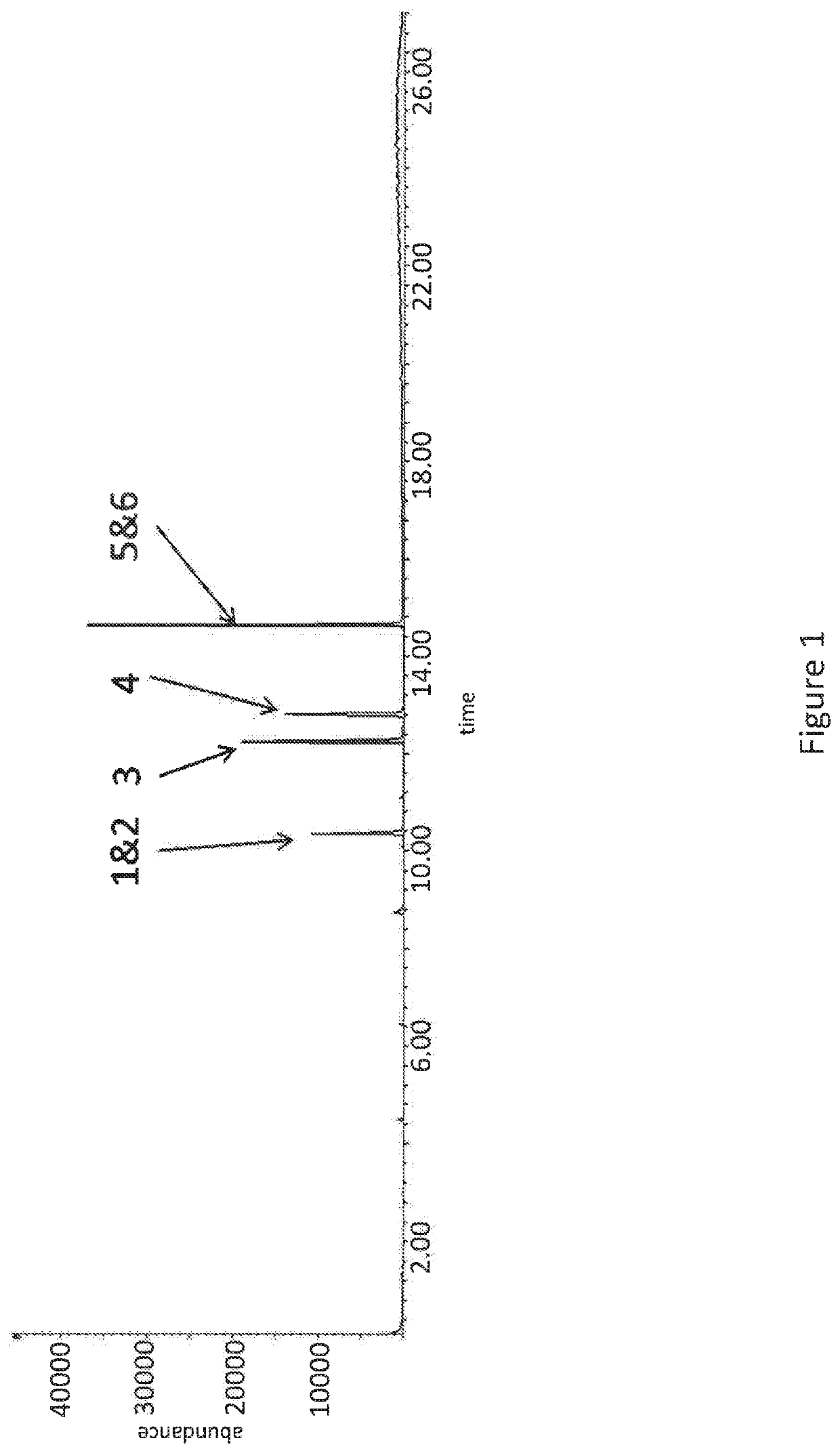
[0061]FIG. 1 depicts the experimental GC-MS chromatogram for a non-polar water insoluble ODSO solvent (Composition 1) of the present invention. The GC-MS spectra shows that the following compounds were present in the ODSO solvent of Composition 1:[0062]Peak 1—methylmethanethiosulfonate (H3C—SOO—S—CH3);[0063]Peak 2—dimethyldisulfoxide (H3C—SO—SO—CH3);[0064]Peak 3—methylethanethiosulfonate (H3C—SOO—S—CH2CH3);[0065]Peak 4—ethylmethyldisulfoxide (H3C—SO—SO—CH2CH3);[0066]Peak 5—ethylethanethiosulfonate (H3CH2C—SOO—S—CH2CH3); and[0067]Peak 6—diethyldisulfoxide (H3CH2C—SO—SO—CH2CH3).

[0068]Trace levels of ODSO compounds comprising 3+ oxygen atoms (not shown in the GC-MS data) are also present. It is clear from the GC-MS chromatogram shown in FIG. 1 that Composition 1 comprises a mixture of ODSO compounds that form the ODSO solvent composition.

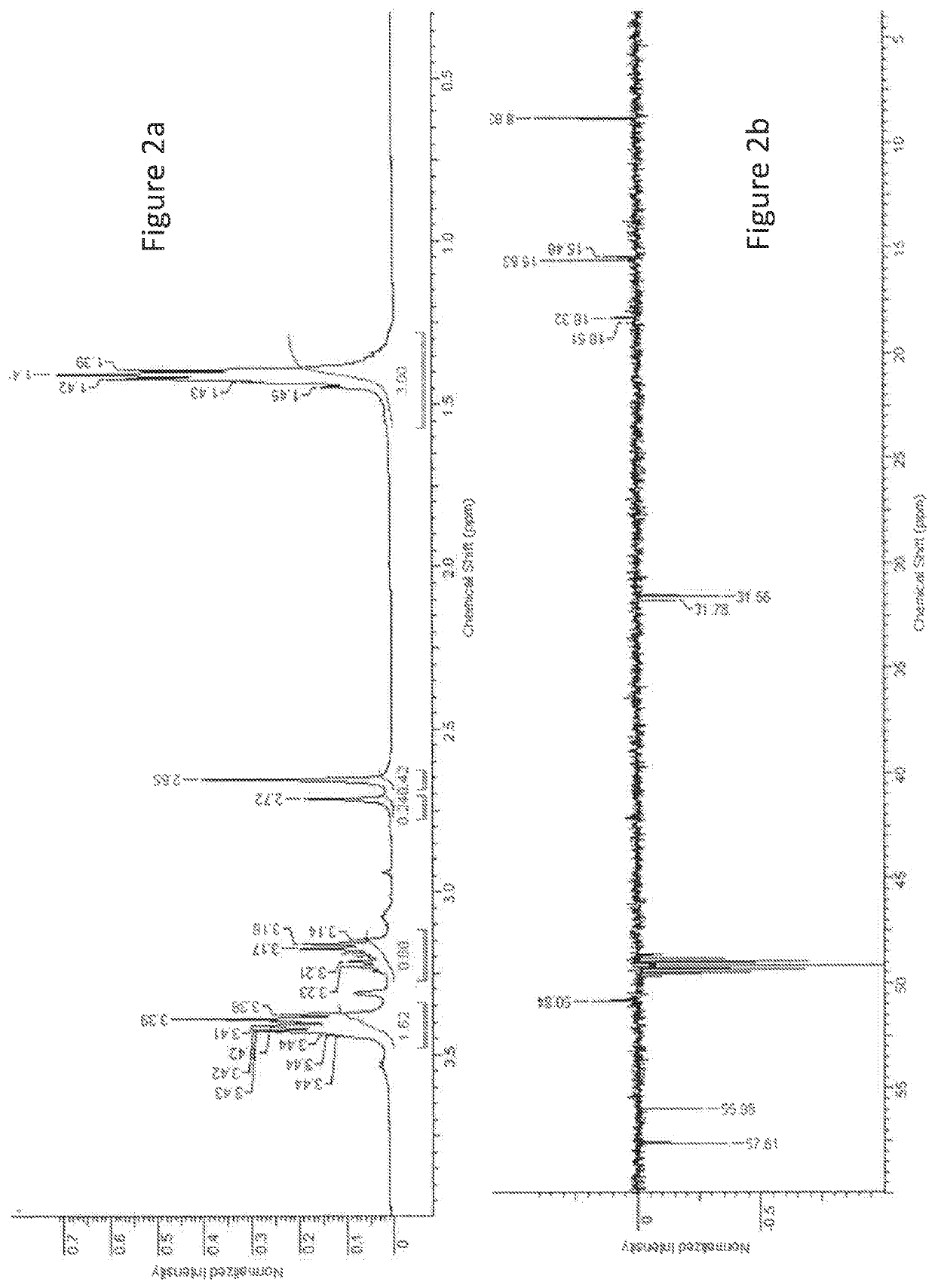
[0069]FIG. 2A is the experimental 1H-NMR spectrum for the non-polar water insoluble ODSO solvent (Composition 1).

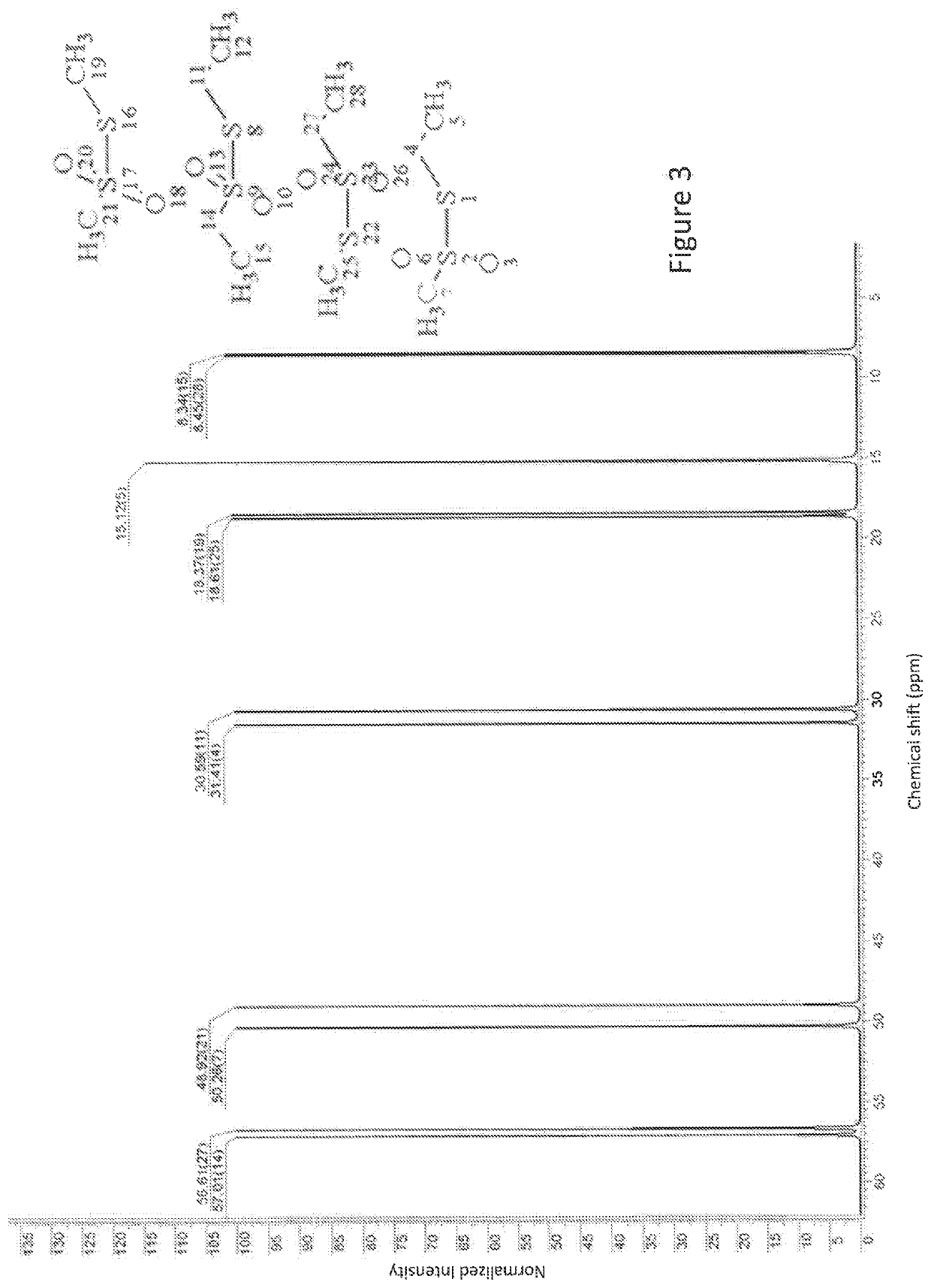
[0070]FIG. 2B is the experimental (as...

example 2

[0088]FIG. 4a is the experimental 1H-NMR spectrum for a polar water-soluble ODSO solvent composition identified as Composition 2.

[0089]FIG. 4b is the experimental 13C-DEPT-135-NMR spectrum for Composition 2. Composition 2 was mixed with a CD3OD solvent and the spectrum was taken at 25° C. Similar to the peaks in FIG. 2b, in FIG. 4b methyl carbons have a positive intensity while methylene carbons exhibit a negative intensity. The peaks in the 48-50 ppm region belong to carbon signals of the CD3OD solvent.

[0090]When comparing the experimental 13C-135-DEPT-NMR spectrum of FIG. 4b for Composition 2 with the saved database of predicted spectra, it was found that a combination of the predicted alkyl-sulfoxidesulfonate (R—SO—SOO—OH), alkyl-sulfonesulfonate (R—SOO—SOO—OH), alkyl-sulfoxidesulfinate (R—SO—SO—OH) and alkyl-sulfonesulfinate (R—SOO—SO—OH) most closely corresponded to the experimental spectrum. This suggests that alkyl-sulfoxidesulfonate (R—SO—SOO—OH), alkyl-sulfonesulfonate (R—S...

example 3

[0093]In order to demonstrate its solvent effect, a comparative example of the use of the ODSO solvents of the present disclosure in an aromatic extraction process was conducted. An n-dodecane stock solution to which BTX was added was prepared for use as a feedstock for the extraction of aromatics using (1) a sulfolane solvent and (2) a water-soluble oxidized disulfide oil (ODSO) solvent. The number of carbon atoms in the individual water soluble OSDO compounds of the ODSO solvent used in this comparative example was in the range of from 2 to 4 carbon atoms. The prepared feedstock contained approximately 5 wt. % of benzene, 5 wt. % of toluene, 5 wt. % of o-xylene, 5 wt. % of m-xylene and 5 wt. % of p-xylene, as indicated in Table 2.

[0094]

TABLE 2Sulfolane Extraction (wt. %)ODSO Extraction (wt. %)NormalizedNormalizedStockExtractSelectivityStockExtractSelectivityBenzene4.120.691004.490.26100Toluene4.40.37504.950.027m-4.810.58725.0800Xylenep-Xylene4.670.21274.9500o-Xylene4.660.09124.930...

the structure of the environmentally friendly knitted fabric provided by the present invention; figure 2 Flow chart of the yarn wrapping machine for environmentally friendly knitted fabrics and storage devices; image 3 Is the parameter map of the yarn covering machine
Login to View More

PUM

PropertyMeasurementUnit
temperatureaaaaaaaaaa
Login to View More

Abstract

Oxidized disulfide oil (ODSO) solvent compositions are derived from by-product disulfide oil (DSO) compounds produced as by-products from the generalized mercaptan oxidation (MEROX) processing of a refinery feedstock. The oxidized disulfide oil (ODSO) solvent compositions comprise at least a primary oxidized disulfide oil (ODSO) compound selected from either water soluble or water insoluble oxidized disulfide oil (ODSO) compounds and in some embodiments at least 0.1 ppmw of a secondary oxidized disulfide oil (ODSO) compound that is a water soluble oxidized disulfide oil (ODSO) compound.

Description

RELATED APPLICATIONS[0001]This application is a Divisional application and claims benefit of the priority of U.S. patent application Ser. No. 16 / 210,266 filed Dec. 5, 2018, the contents of which is incorporated herein by reference in its entirety.BACKGROUND OF THE INVENTIONField of the Invention[0002]This invention relates to solvent compositions.Description of Related Art[0003]A solvent is a compound or composition that can dissolve a solute to produce a solution. A solvent is usually a liquid, but can be a solid, gas, or supercritical fluid. Solvents have various applications in the chemical, pharmaceutical, oil and gas industries, and are commonly used in chemical syntheses and purification processes. The amount of solute that can be dissolved in a certain volume of solvent generally varies with temperature.[0004]Common uses for organic solvents are in dry cleaning (e.g., tetrachloroethylene), as paint thinners (e.g., toluene, turpentine), as nail polish removers and adhesive com...

Claims

the structure of the environmentally friendly knitted fabric provided by the present invention; figure 2 Flow chart of the yarn wrapping machine for environmentally friendly knitted fabrics and storage devices; image 3 Is the parameter map of the yarn covering machine
Login to View More

Application Information

Patent Timeline
no application Login to View More
Patent Type & Authority Patents(United States)
IPC IPC(8): C07C317/04C07C315/02C10G53/14C07C7/10C07C319/30C10G27/10
CPCC07C317/04C07C315/02C10G53/14C07C7/10C07C319/30C10G27/10C07C327/60C07C381/02C07C381/04C07C327/22C07C2531/34
Inventor KOSEOGLU, OMER REFAHODGKINS, ROBERT PETERAL-HAJJI, ADNANMULLER, HENDRIKAL-AWANI, NADRAHADAM, FREDERICK MARIESALEEM, QASIM
Owner SAUDI ARABIAN OIL CO
Features
  • R&D
  • Intellectual Property
  • Life Sciences
  • Materials
  • Tech Scout
Why Patsnap Eureka
  • Unparalleled Data Quality
  • Higher Quality Content
  • 60% Fewer Hallucinations
Social media
Patsnap Eureka Blog
Learn More