
Apparatus for treating exhaust gas of thermal plant
- Summary
- Abstract
- Description
- Claims
- Application Information
AI Technical Summary
Benefits of technology
Problems solved by technology
Method used
Image

Examples
experimental example 1
Exhaust Gas Treatment Experiment
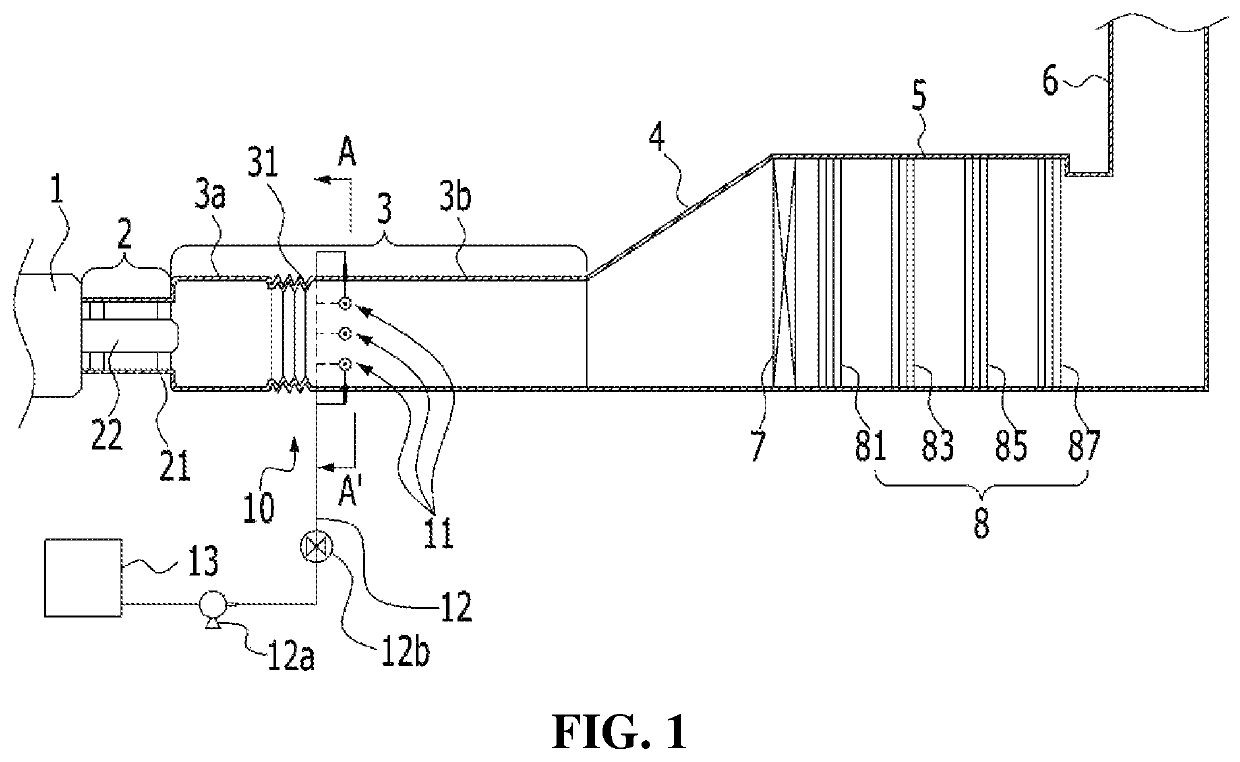
[0084]An apparatus for treating exhaust gas was installed in a reduced model of a combined cycle power plant in a form shown in FIG. 11, and an exhaust gas treatment experiment was performed by injecting a liquid reducing agent (ammonia) in the same molar ratio as nitrogen oxides using injection nozzles. Herein, a catalyst of a catalyst module was a zeolite-based selective catalytic reduction catalyst (a catalyst formed by wash coating Fe-beta zeolite (Zeolyst) on a honeycomb support) was used. A catalyst of a first additional catalyst module was a vanadium-based selective catalytic reduction catalyst mainly composed of V2O5, and a catalyst of a second additional catalyst module was a platinum catalyst which is an oxidation catalyst. Herein, positions of the injection nozzles in a duct are located at positions corresponding to ⅜ of the above-described lineal distance c from a hub, and positions of ends of the injection nozzles are located at positions...
experimental example 2
Confirmation of Changes in Distribution of Pollutant Treatment Fluid at Rear End of Duct According to Changes in Positions of Injection Nozzles in Duct
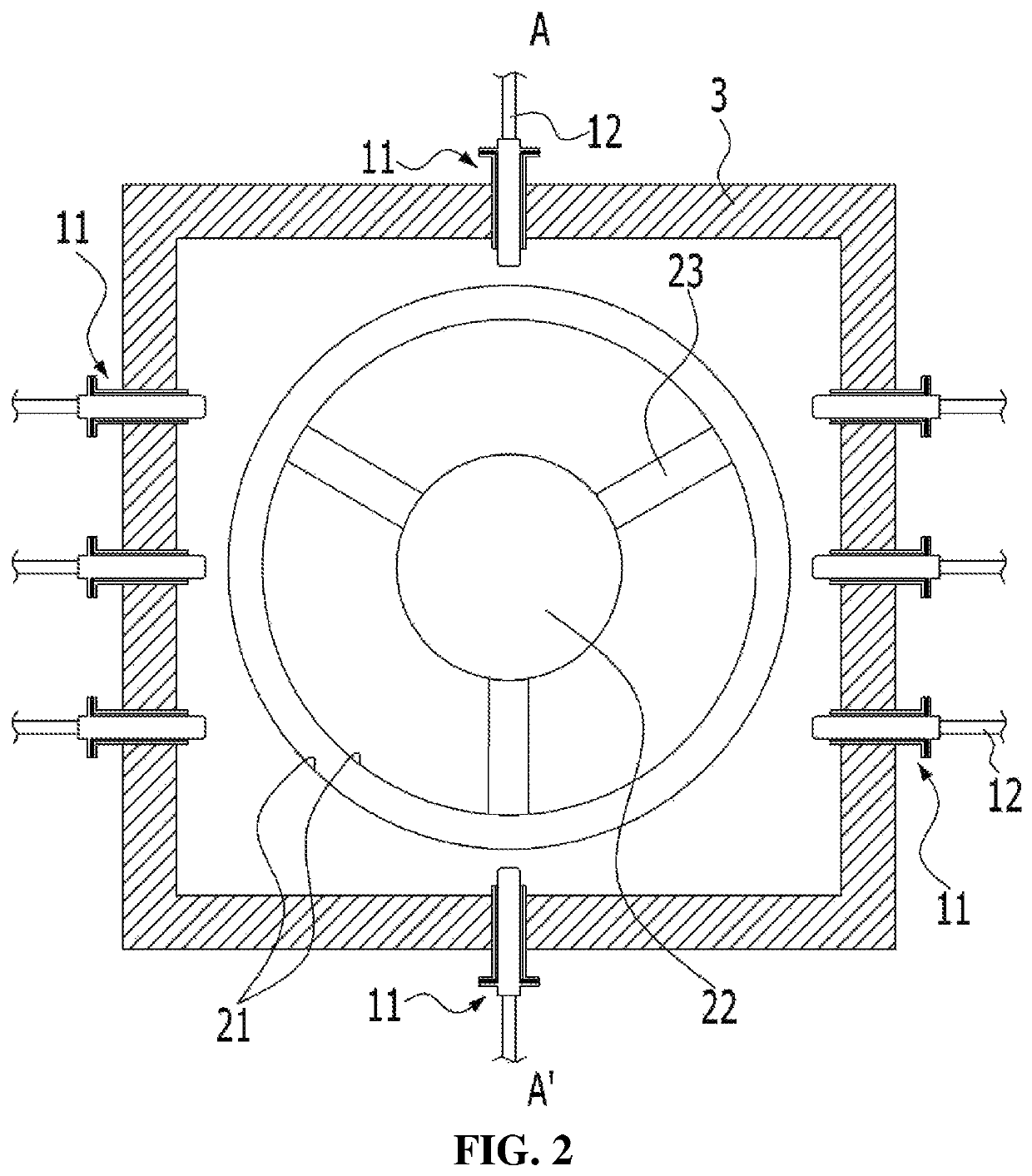
[0088]The following experiment was carried out to confirm changes in mixing distribution of a pollutant treatment fluid according to changes in positions of injection nozzles in a duct. Ammonia water was injected through the injection nozzles inside the duct as shown in FIGS. 1 to 4, and concentration distribution of ammonia was measured in a duct expansion pipe connected to a rear end of the duct. Herein, air which simulates the condition of the fluid discharged from a gas turbine during startup of the gas turbine was injected at the position of the gas turbine. The injection nozzles were arranged on cross section of the duct in a form as shown in FIG. 2, but the experiment was carried out by increasing a spaced distance from a hub along the longitudinal direction of the duct at a constant ratio with respect to the above-described li...
experimental example 3
Confirmation of Changes in Distribution of Pollutant Treatment Fluid at Rear End of Duct According to Changes in Positions of Ends of Injection Nozzles
[0091]The following experiment was carried out to confirm changes in distribution of a pollutant treatment fluid according to changes in positions of ends of injection nozzles. In detail, the experiment was carried out by changing several conditions among the conditions of experimental example 2 in such a manner that positions of the injection nozzles in a duct is fixed at ⅜ position with respect to the lineal distance c from a hub and the positions of the ends of the injection nozzles were changed at a constant ratio with respect to the perpendicular line a. Ammonia water injected through the injection nozzles was controlled such that ammonia concentration was 10±1 ppm as a theoretical value in a measuring part, and the other experimental conditions were maintained the same. From this, results as shown in Table 3 were obtained.
[0092]...
PUM
| Property | Measurement | Unit |
|---|---|---|
| Fraction | aaaaa | aaaaa |
| Fraction | aaaaa | aaaaa |
| Fraction | aaaaa | aaaaa |
Abstract
Description
Claims
Application Information
 Login to View More