
5- substituted tetralones as inhibitors of ras farnesyl trransferase
a technology of ras farnesyl trransferase and substituted tetralones, which is applied in the direction of biocide, drug composition, cardiovascular disorder, etc., can solve the problems of protein deficiency in feedback regulation ability, uncontrolled cellular proliferation, and various surgical revascularization techniques
- Summary
- Abstract
- Description
- Claims
- Application Information
AI Technical Summary
Benefits of technology
Problems solved by technology
Method used
Image

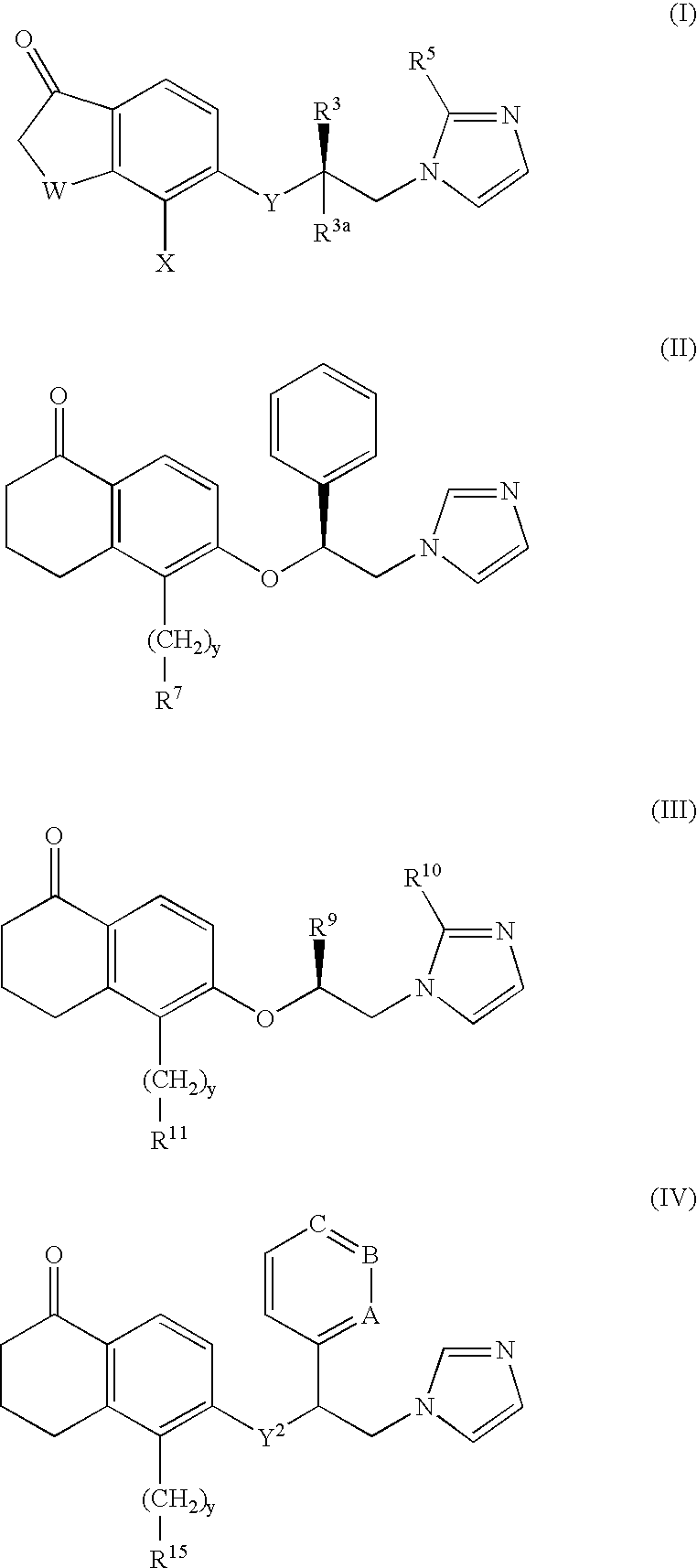
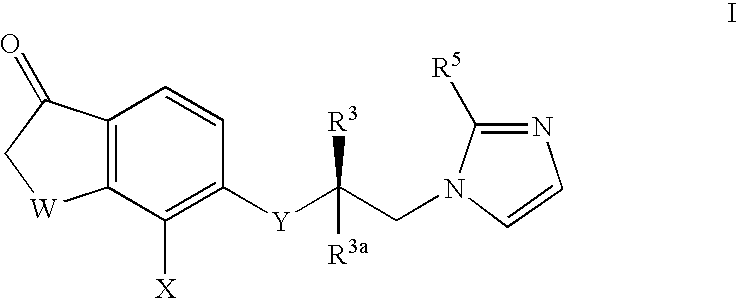
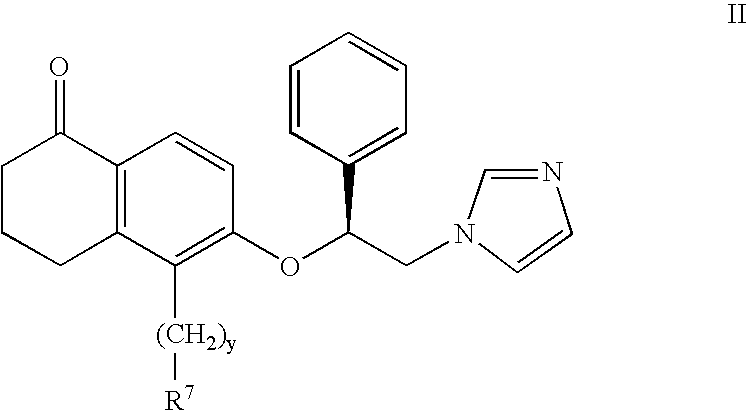
Examples
example 2
[0500] Synthesis of 6-((1S)-2-Imidazolyl-1-phenylethoxy)-5-[(phenylsulfiny-l)methyl]-2,3,4-trihydronaphthalen-1-one (Compound 2)
[0501] To an ice cold solution of compound 1 (0.60 g, 1.32 mmol) in 10 mL tetrahydrofuran is added a solution of NaIO.sub.4 (3.3 mL 0.5M in H.sub.2O). The mixture is stirred 3 days at 25.degree. C. Another portion of NaIO.sub.4 solution (6.6 mL 0.5M in H.sub.2O) is added and after stirring for 6 hours at 25.degree. C., the mixture is filtered and the filtrate is extracted with chloroform. The organic phase is washed with brine, dried over anhydrous magnesium sulfate, and filtered. The filtrate is evaporated to a solid (550 mg). The mixture is purified by reverse phase silica gel chromatography giving the product (Compound 2) as a trifluoroacetate salt (100 mg, 16% yield). MS: APCI: M+1: 471.1 (M: 470.6). NMR spectrum is consistent with structure. Calcd. for C.sub.28H.sub.26N.sub.2O.sub.3S.0.10H.sub.2O.1.45 TFA:
4 Theory: C 58.20, H 4.34, N 4.39, H.sub.2O 0.2...
example 3
[0502] Synthesis of 6-((1S)-2-Imidazolyl-1-phenylethoxy)-5-[(phenylsulfiny-l)methyl]-2,3,4-trihydronaphthalen-1-one (Compound 3)
[0503] 1. 5-Benzenesulfonylmethyl-6-hydroxy-2,3,4-dihydronaphthalen-1-one 57
[0504] To a suspension of 6-hydroxy-5-phenylsulfanylmethyl-2,3,4-trihydron-aphthalen-1-one (7.0 g, 0.025 mol) in 300 mL dichloromethane is added a solution of 73% meta-chloroperbenzoic acid (11.82 g, 0.05 mol) in 150 mL dichloromethane. The suspended solids dissolve, followed by precipitation of another white solid. After stirring 3 hours at 25.degree. C., an additional portion of 73% meta-chloroperbenzoic acid (2.95 g, 0.0125 mol) in 11 mL dichloromethane is added. The mixture is then stirred for 1 hour and extracted with saturated potassium carbonate solution (475 mL). The organic phase is washed with brine, dried over anhydrous magnesium sulfate, filtered, and evaporated to a solid. The pH of the carbonate is adjusted to 8 with concentrated HCl and washed with ethyl acetate. The ...
example 4
[0507] Synthesis of Methyl 2-{[2-((1S)-2-imidazolyl-1-phenylethoxy)-5-oxo--6,7,8-trihydronaphthyl]methylthio}benzoate (Compound 4)
[0508] 1. Methyl 2-(2-hydroxy-5-oxo-6,7,8-trihydronaphthalenylmethylthio) benzoate 58
[0509] To a solution of methyl thiosalicylate (14.38 g, 85.5 mmol) in oxygen-free tetrahydrofuran (100 mL) is added diisopropylamine (3.68 g, 0.0285 mol) 5-chloromethyl-6-hydroxy-2,3,4-trihydronaphthalen-1-one, prepared as described in Chem. Pharm. Bull. 1977;25(11):2988-3002 (6.0 g, 0.0285 mol) is dissolved in tetrahydrofuran (125 mL) and the solution added dropwise to the preceding solution at 25.degree. C. over 45 minutes. The mixture is stirred for 22 hours, concentrated in vacuo, and the residue layered with ethyl ether. Water is added to the mixture giving a solid precipitate. The solid is filtered, washed with water, and dried at 25.degree. C. The solid is recrystallized from ethyl acetate and dried in vacuo giving a white solid (7.3 g, 75% yield). MS: APCI: M+1: 3...
PUM
| Property | Measurement | Unit |
|---|---|---|
| Electrical conductance | aaaaa | aaaaa |
| Molar density | aaaaa | aaaaa |
| Molar density | aaaaa | aaaaa |
Abstract
Description
Claims
Application Information
 Login to View More