Optical sensor, method of manufacturing and driving an optical sensor, method of detecting light intensity
- Summary
- Abstract
- Description
- Claims
- Application Information
AI Technical Summary
Benefits of technology
Problems solved by technology
Method used
Image



Examples
first embodiment
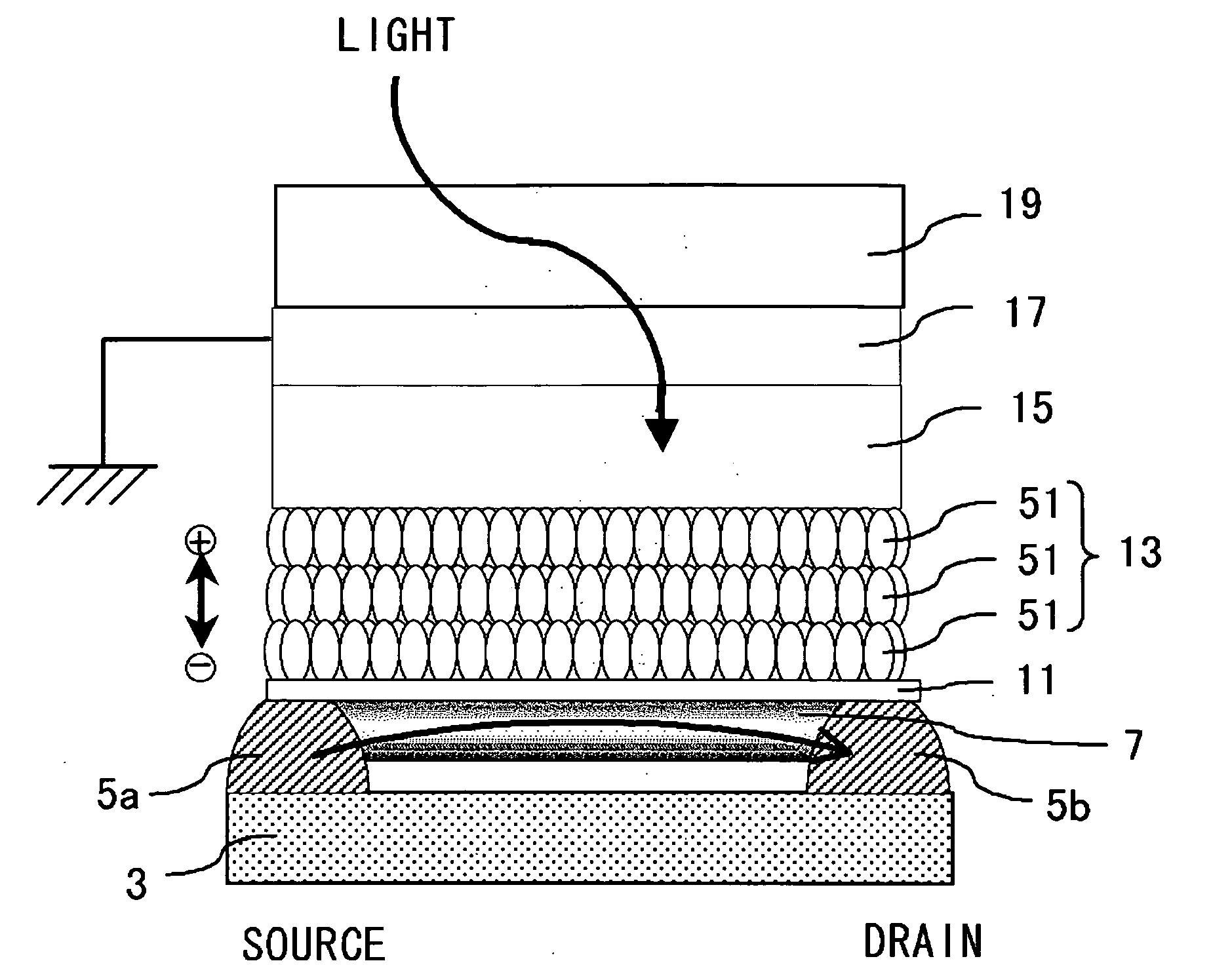
[0084] The optical sensor according to this embodiment is shown in FIGS. 2 and 3. The source electrode 5a and the drain electrode 5b connected via the carbon nanotube 7 are provided on the substrate 3, and the insulating layer 11 is formed on the respective surfaces of the source electrode 5a and the drain electrode 5b connected via the carbon nanotube 7. The carbon nanotube 7 is an SWCNT. The protein monolayer film 51 is provided on the insulating layer 11 to serve as the light sensitively polarizable layer 13. On the light sensitively polarizable layer 13, a transparent protective layer 15 is provided for protecting the light sensitively polarizable layer 13, and a transparent conductive layer 17 and a transparent substrate 19 are provided in this sequence on the protective layer 15. In FIG. 2 the transparent conductive layer 17 is grounded, while it is also possible to apply an offset voltage to the transparent conductive layer 17. In this case, for example the substrate 3 can be...
second embodiment
[0149] The step (ii) “Connecting the source electrode 5a and the drain electrode 5b with the carbon nanotube 7” of the first embodiment can be performed in the following method.
[0150] To start with, as shown in FIGS. 15A and 15B, the alignment layer of the carbon nanotube 7 is adsorbed to the substrate 3 where the source electrode 5a and the drain electrode 5b are provided in a similar manner to the first embodiment.
[0151] Then as shown in FIG. 15C, a resist layer 25 having an opening at a position corresponding to an upper portion of the source electrode 5a and the drain electrode 5b is formed. Forming the resist layer 25 can be executed by a photo-resist method, for example.
[0152] Thereafter as shown in FIG. 15D, a metal layer 27 is formed all over the substrate 3 on which the resist layer 25 is provided. A material of the metal layer 27 can be appropriately selected out of the metals or alloys that can be used for the source electrode 5a and the drain electrode 5b. The source ...
third embodiment
[0155] The step (ii) “Connecting the source electrode 5a and the drain electrode 5b with the carbon nanotube 7” of the first embodiment can be performed in the following method.
[0156] Still another method of connecting the source electrode 5a and the drain electrode 5b with the carbon nanotube 7 includes spreading a dispersion of the carbon nanotube 7 over the substrate 3 on which the source electrode 5a and the drain electrode 5b are provided, and moving an appropriate carbon nanotube 7 to a predetermined position with a probe of an AFM or the like.
[0157] As a result, the carbon nanotube 7 can be more precisely disposed between the source electrode 5a and the drain electrode 5b.
PUM
 Login to View More
 Abstract
Description
Claims
Application Information
 Login to View More