
Modified release dosage forms of skeletal muscle relaxants
a technology of skeletal muscle relaxant and release dosage form, which is applied in the direction of biocide, muscular disorder, drug composition, etc., can solve the problem of patient compliance with oral administration thrice daily
- Summary
- Abstract
- Description
- Claims
- Application Information
AI Technical Summary
Benefits of technology
Problems solved by technology
Method used
Image

Examples
example 1
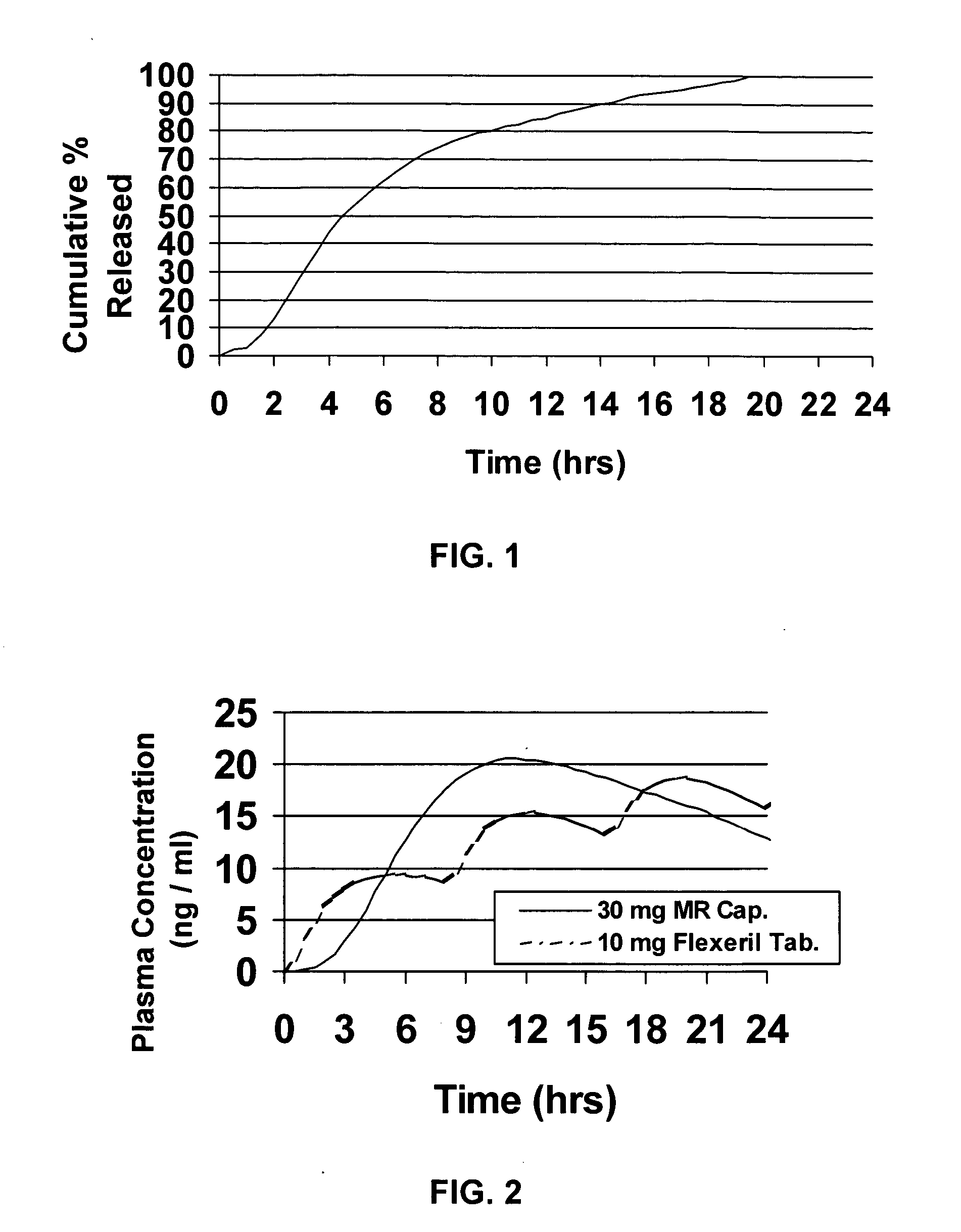
[0052] Cyclobenzaprine is well absorbed after oral administration, but there is a large intersubject variation in plasma levels. It is eliminated quite slowly with a half-life as long as one to three days. The present treatment regimen of 10 mg three times daily is an issue of patient compliance, especially the elderly. Hence, a modified release dosage form (capsule) was designed with a release profile shown in FIG. 1. To determine if this is the proper release profile, the pharmacokinetics data of cyclobenzaprine following a single dose of 10 mg Flexeril® tablets administered 3 times a day was taken from the literature. A pharmacokinetic model was developed from this data using WinNonlin™ Version 1.5.
[0053] The resulting model parameters are listed below:
Model ParameterValueVolume of Distribution / F429LK010.2031hr−1K100.1004hr−1K120.0828hr−1K210.0398hr−1Tlag0hrDose2 × 10mg Tablets
[0054] Theoretical plasma levels were simulated using the pharmacokinetic model given above and the t...
example 2
[0055] Cyclobenzaprine Hydrochloride (1,200 g) was slowly added to an aqueous solution of polyvinylpyrrolidone such as Povidone USP (K-29 / 32, 80 g) and mixed well. # 25-30 mesh sugar spheres (2,640 g) were coated with the drug solution in a Glatt fluid bed coater, equipped with a 9″ bottom spray Wurster insert to provide IR beads with a coating weight of about 9%. The drug containing particles were dried, and a seal coat of OPADRY® Clear (2% w / w) was first applied and dried in the Glatt fluid bed unit as a precautionary measure to drive off excessive surface moisture. The composition and batch quantities of the IR Beads were given in 5 to 10 kg. Following the second coating process the IR Beads were passed through 14 and 25 mesh screens. Beads remaining on the 14-mesh screen were discarded as oversized beads and beads passing through the 25-mesh screen were discarded as undersized beads.
[0056] The next step in the process was to apply an extended release polymer membrane by sprayin...
example 3
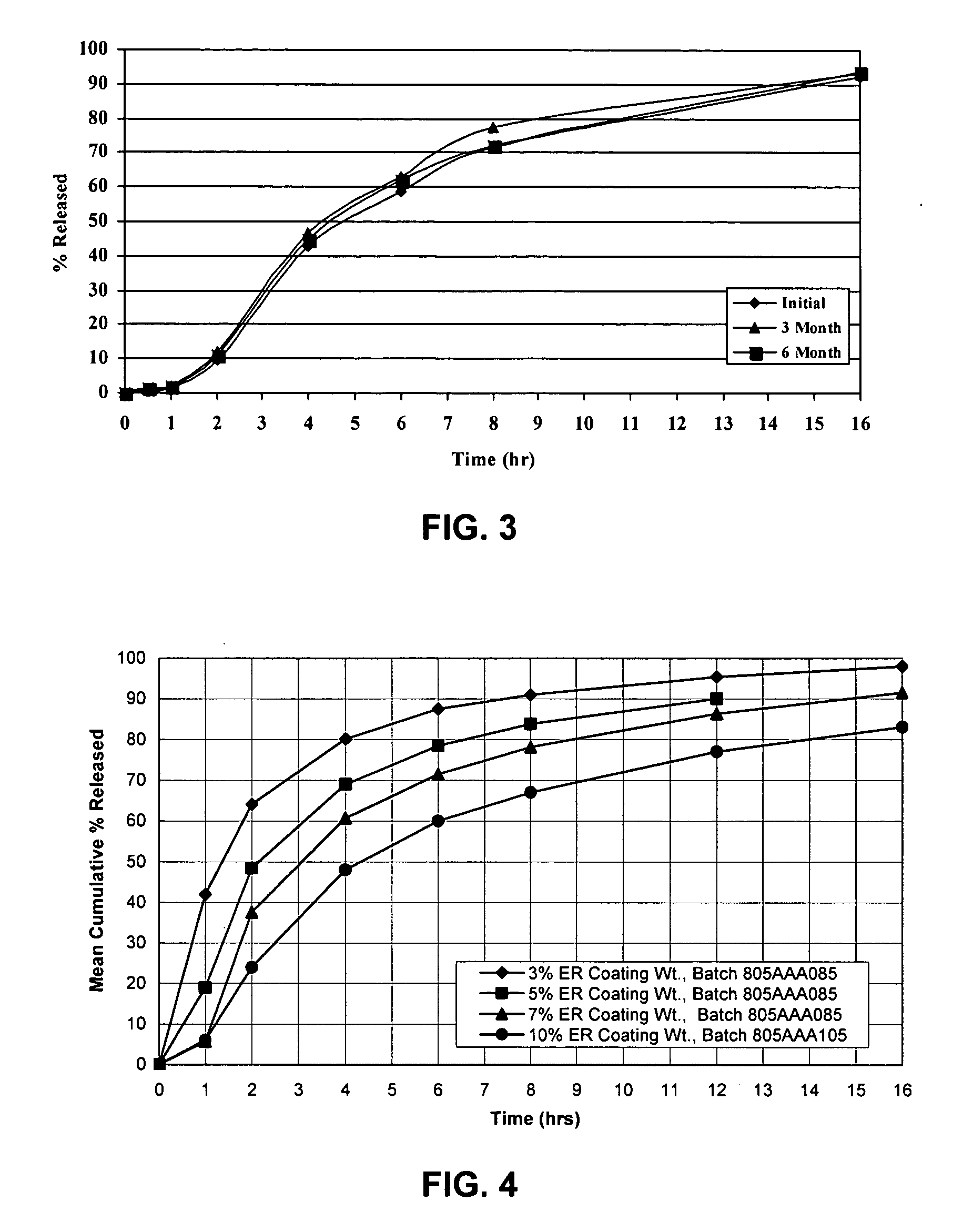
[0057] Cyclobenzaprine Hydrochloride (2.5 kg) was dissolved in 50 / 50 acetone / purified water. 25-30 mesh Sugar spheres, (7.3 kg) were coated with the drug solution in a Glatt fluid bed coater, equipped with a 9″ bottom spray Wurster insert. The drug containing particles were dried, and a seal coat of OPADRY® Clear (2% w / w) was first applied and dried in the Glatt fluid bed unit as a precautionary measure to drive off excessive surface moisture. 910 g of ethylcellulose (Ethocel Premium Standard 10 cps) and 90 g of diethyl phthalate were dissolved in 98 / 02 acetone / purified water and applied onto the IR Beads (9 kg) in the Glatt GPCG 5 in accordance with the present invention. The release rates of the ER Beads will vary depending upon the film weight of the ER coating. One batch of IR Beads was coated for a final weight gain of 7% based on the weight of coated beads wherein samples of the ER Beads were removed during the ER coating process to yield beads with increasing coating weights....
PUM
| Property | Measurement | Unit |
|---|---|---|
| concentration | aaaaa | aaaaa |
| weight % | aaaaa | aaaaa |
| wt. % | aaaaa | aaaaa |
Abstract
Description
Claims
Application Information
 Login to View More