[0018] The present invention relates to a vehicle mountable satellite antenna as defined in the claims which is operable while the vehicle is in motion. The satellite antenna of the present invention can be installed on top of (or embedded into) the roof of a vehicle. The antenna is capable of providing high
gain and a narrow antenna beam for aiming at a satellite direction and enabling
broadband communication to vehicle. The present invention provides a vehicle mounted satellite antenna which has low
axial ratio, high efficiency and has low
grating lobes gain. The vehicle mounted satellite antenna of the present invention provides two simultaneous polarization states.
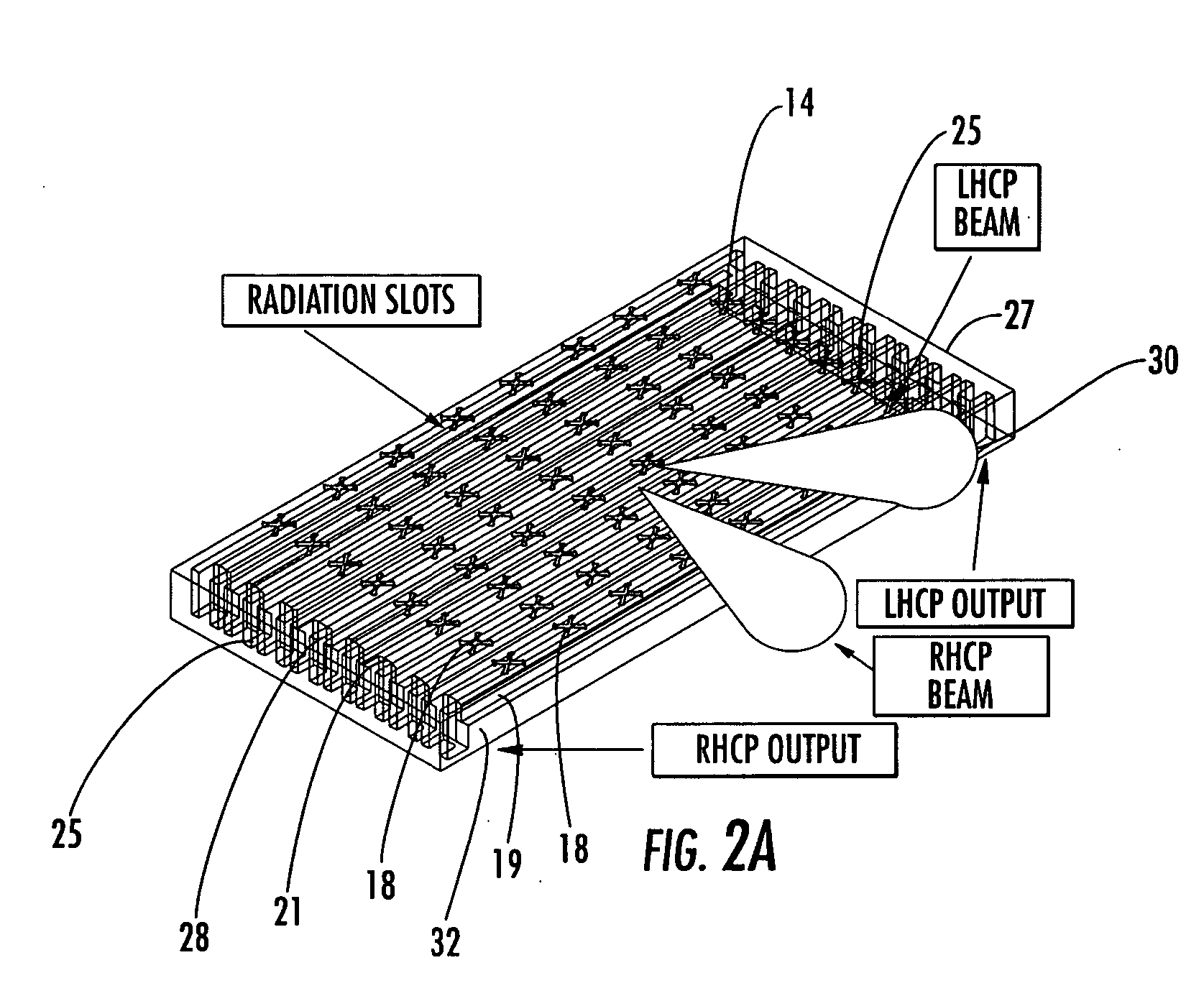
[0019] In one embodiment, the present invention provides a ridged
waveguide instead of a conventional rectangular
waveguide to alleviate the effects of
grating lobes. The
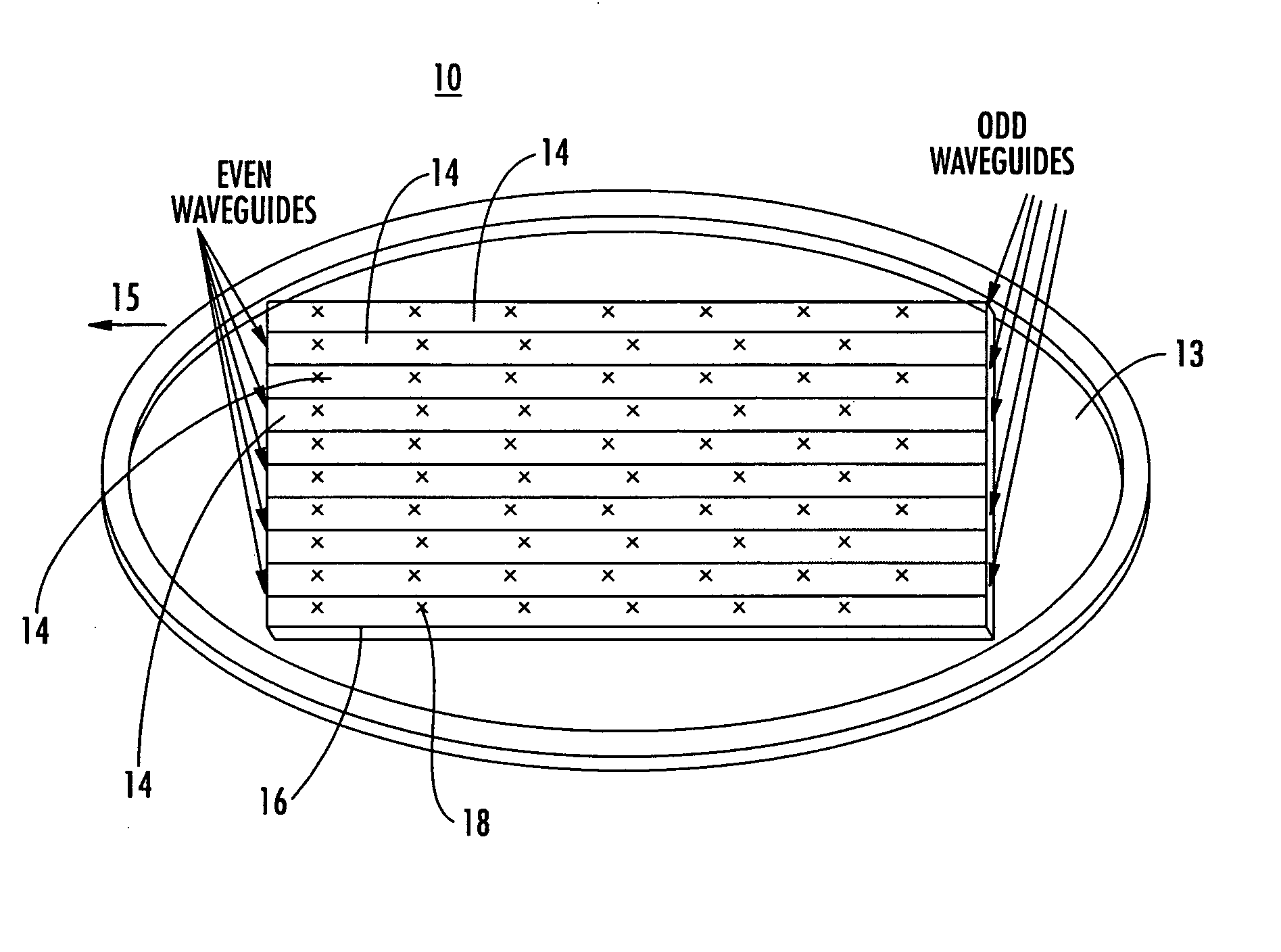
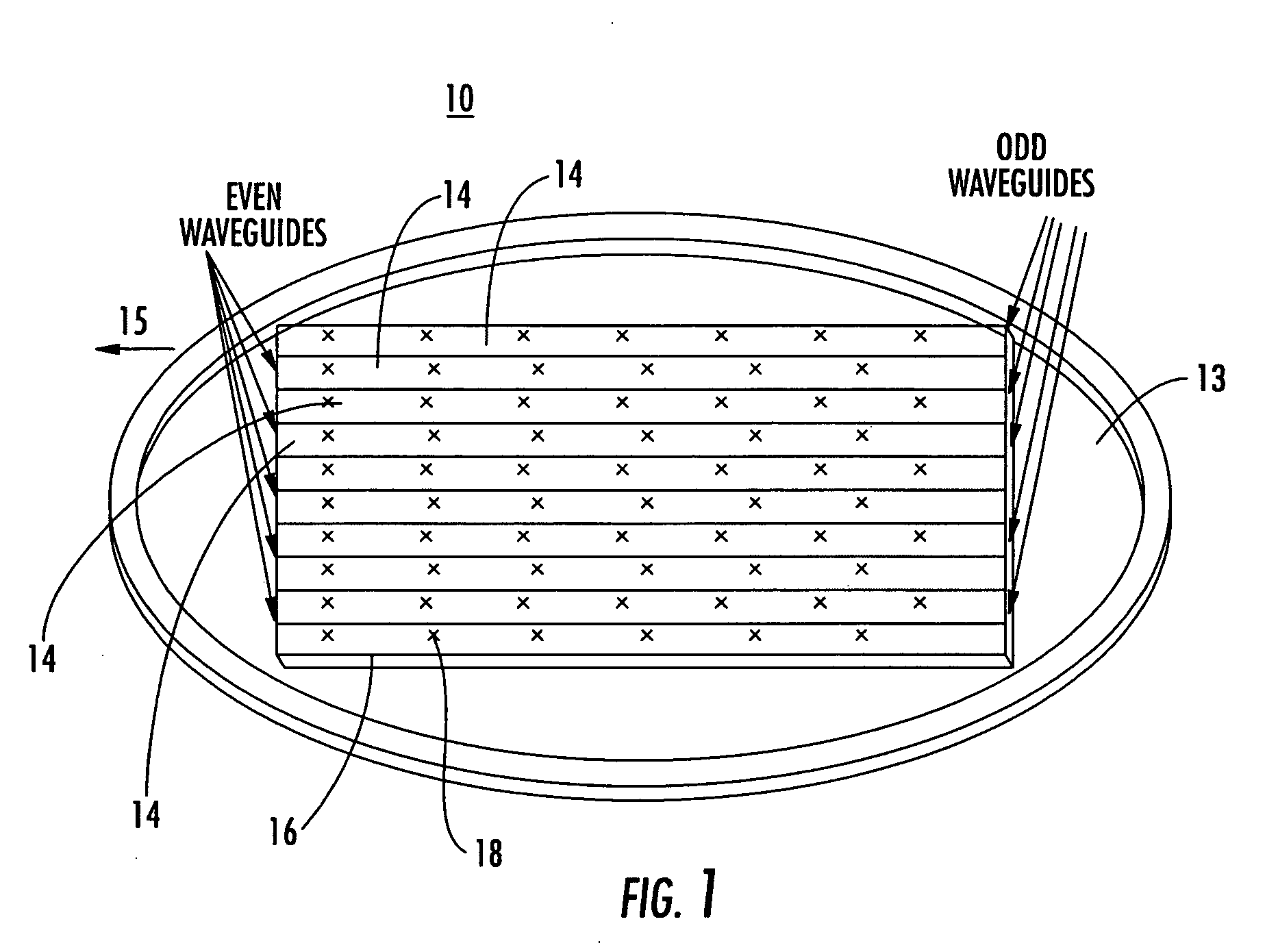
ridge waveguide provides a ridged section longitudinally between walls forming the waveguide. A plurality of radiating elements are formed in a radiating surface of the ridged waveguide. The use of a ridged waveguide reduces the width of the waveguide, and thus, the spacing between the antenna slots. This suppresses the strength of the
grating lobe. In conventional approaches, the length between cross slots along the waveguide is approximately one waveguide. The
resultant beam points upward in the plane orthogonal to the waveguide axis. The present invention reduces the length between cross slots along the waveguide to further suppress the
grating lobe. This results in further beam tilting away from the plane orthogonal to the waveguide axis. However, as long as the beam can be pointed to highest required
elevation angle, the beam tilting does not have adverse effects on the overall
system performance.
[0021] In one embodiment, a
hybrid mechanic and electronic steering approach provides a more reasonable cost and performance trade-off. The antenna aiming in the elevation direction is achieved via control of an electronic
beamforming network. The antenna is mounted on a rotatable platform under mechanical steering and
motion control for aiming the antenna in the
azimuth direction. Such approach significantly reduces the complexity and increases the reliability of the
mechanical design. The antenna height is compatible to the two-dimensional electronic steering phased-array antenna. Additionally, the number of the electronic
processing elements required is considerably reduced from that of the conventional two-dimensional electronic steering phased-array antenna, thereby allowing for low cost and large volume commercial production.
[0022] The present invention provides electronically generated left, right, up, and down beams for focusing the antenna beam toward the satellite while the vehicle is moving. All of the beams are simultaneously available for use in the motion
beam tracking. This provides much faster response and less
signal degradation.
[0023] The waveguide couples the EM energy from all radiating elements in the waveguide axis direction and combines the energy together. It has been found that the loss through the
waveguide coupling and combining is significantly lower than that using conventional approach utilizing passive
microwave processing elements printed on the circuit board at the proposed
operating frequency. In addition, the present invention also reduces the number of
low noise amplifiers used in the antenna
system because only one set of
low noise amplifiers for each waveguide is used, as opposed to conventionally use of one set of
low noise amplifier for each
radiating element.
[0024] The ridged waveguide of the present invention produced a more concentrated
field line near the center line of the broadwall, thereby reducing the width of the broadwall from a typical value for a conventional rectangular waveguide to about 0.398 inches at an example frequency in the direction of broadcast satellite range of about 12.2 GHz to about 12.7 GHz.


 Login to View More
  Login to View More