
Information-embedding apparatus, encoder, tamper-detecting apparatus, information-embedding method, tamper-detecting method, and recording medium having program recorded therein for executing both of the methods
a technology of information embedding and detecting apparatus, which is applied in the field of information embedding apparatus and detecting apparatus, can solve the problems of inability to practice verification by comparing one hash value with another, the art according to patent reference no. 1 is impossible to detect the possibility of tampering in a digital image that has experienced image compression, and the processing of detecting the possibility of tampering in the digital image is complicated
- Summary
- Abstract
- Description
- Claims
- Application Information
AI Technical Summary
Benefits of technology
Problems solved by technology
Method used
Image

Examples
first embodiment
[0071] (First Embodiment)
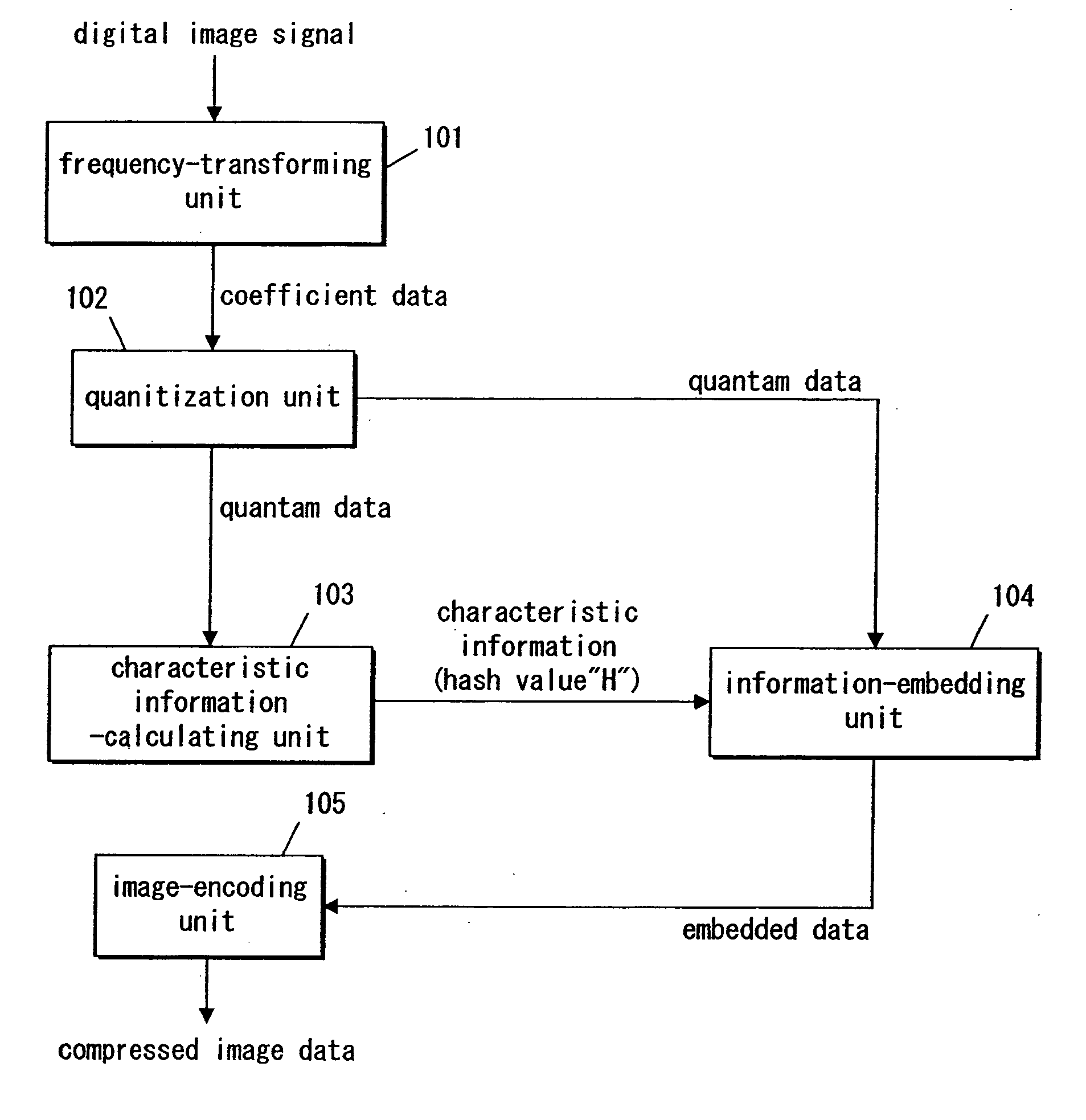
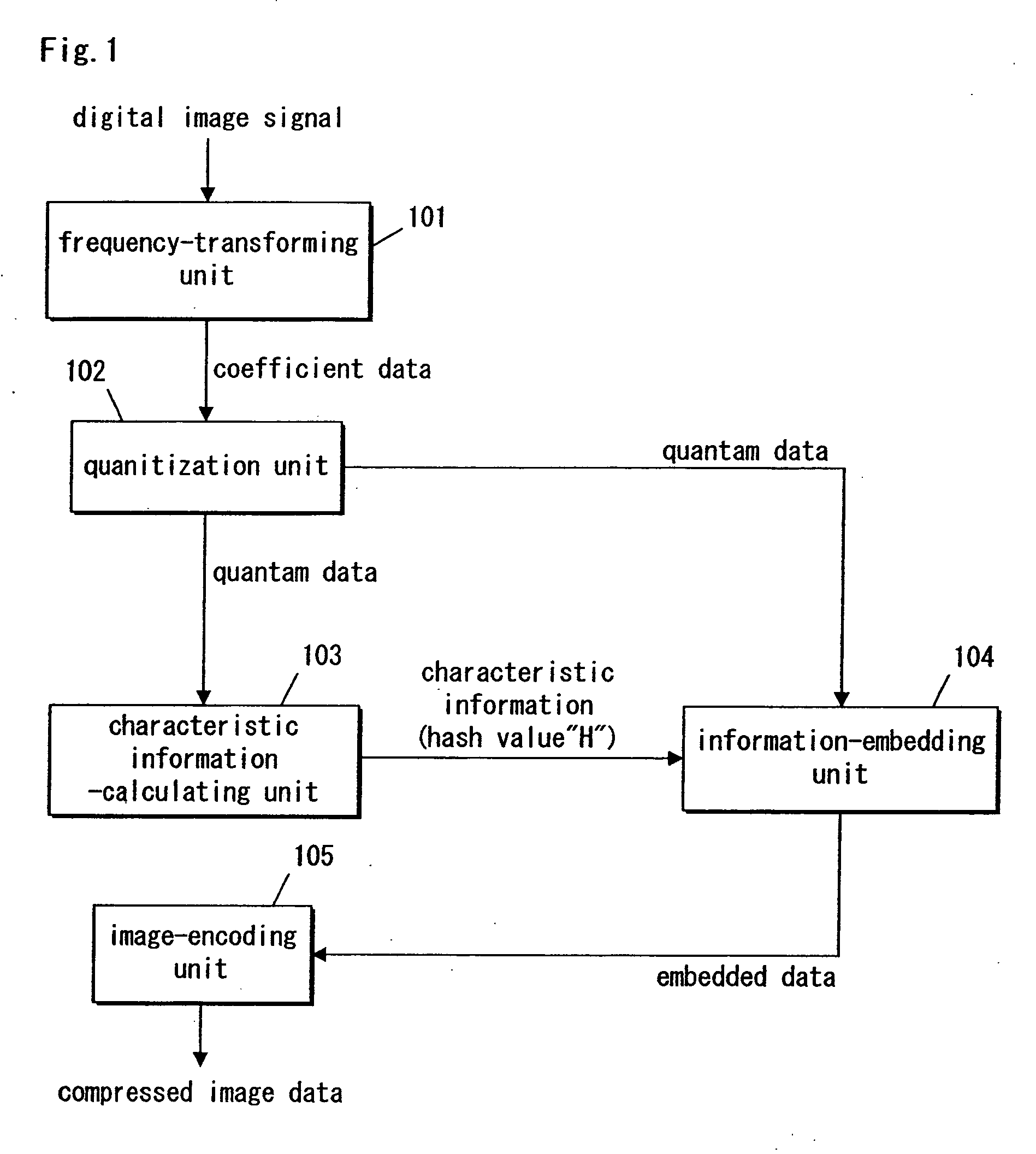
[0072]FIG. 1 is a block diagram illustrating an information-embedding apparatus according to a first embodiment. As illustrated in FIG. 1, the information-embedding apparatus according to the present embodiment includes a frequency-transforming unit 101, a quantization unit 102, a characteristic information-calculating unit 103, an information-embedding unit 104, and an image-encoding unit 105. The information-embedding apparatus including the image-encoding unit 105 may be an encoder.
[0073] The frequency-transforming unit 101 practices the frequency transformation of a digital image signal, thereby providing frequency coefficients (coefficient data).
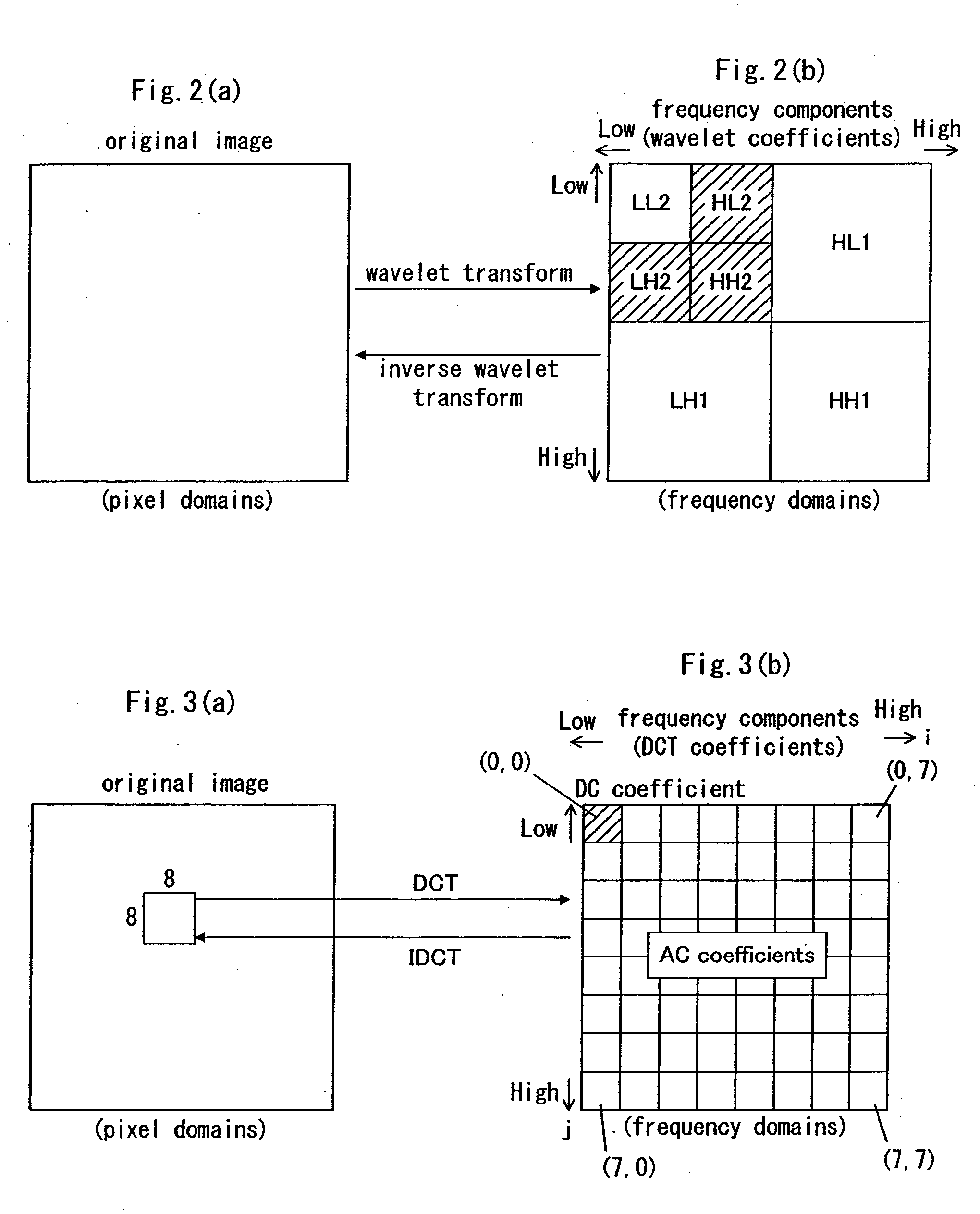
[0074] The frequency-transforming unit 101 may practice, by way of the frequency transformation, any one of the following: discrete wavelet transform; subband decomposition; discrete cosine transform; and Fourier transform.
[0075] The quantization unit 102 quantizes the coefficient data from the frequency-tran...
second embodiment
[0110] (Second Embodiment)
[0111]FIG. 6 is a block diagram illustrating a tamper-detecting apparatus according to a second embodiment. The tamper-detecting apparatus 300 according the present embodiment cooperates with the information-embedding apparatus according to the previous embodiment. First and second characteristic information are hash values derived from an original value.
[0112] As illustrated in FIG. 6, the tamper-detecting apparatus 300 includes an image-decoding unit 301, a characteristic information-calculating unit 302, a characteristic information-extracting unit 303, and a tamper-determining unit 304.
[0113] The image-decoding unit 301 decodes compressed image data, thereby providing frequency coefficients (quantum data). In other words, all that is actually required of the image-decoding unit 301 is to provide the frequency coefficients. Accordingly, a inverse quantization unit and a variable length-decoding unit are inessential for the image-decoding unit 301.
[011...
third embodiment
[0130] (Third Embodiment)
[0131]FIG. 8 is a block diagram illustrating an information-embedding apparatus according to a third embodiment. As illustrated in FIG. 8, the information-embedding apparatus according to the present embodiment includes a frequency-transforming unit 101, a quantization unit 102, a characteristic information-calculating unit 103, an information-embedding unit 701, and an image-encoding unit 105.
[0132] The above units except for the information-embedding unit 701 are similar in construction to those described in the first embodiment. The same reference characters are hereinafter given for components common to those described in the first embodiment; therefore, descriptions related thereto will be omitted. The following mainly discusses differences between the present embodiment and the first embodiment.
[0133] The information-embedding unit 701 embed characteristic information into both quantum data at a second frequency domain and quantum data at a third fre...
PUM
 Login to View More
 Abstract
Description
Claims
Application Information
 Login to View More