
Carbamic acid compounds comprising a bicyclic heteroaryl group as hdac inhibitors
a technology of carbamide and heteroaryl group, which is applied in the field of biologically active compounds, can solve the problems of ineffective treatment, serious adverse effects on the quality of life of patients, cosmetically unacceptable, etc., and achieve the effect of inhibiting cell cycle progression and promoting apoptosis
- Summary
- Abstract
- Description
- Claims
- Application Information
AI Technical Summary
Benefits of technology
Problems solved by technology
Method used
Image

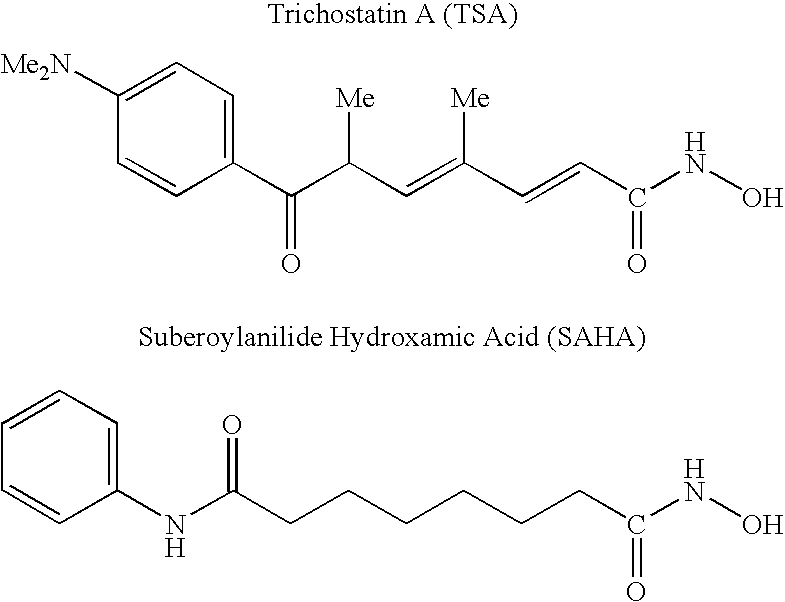
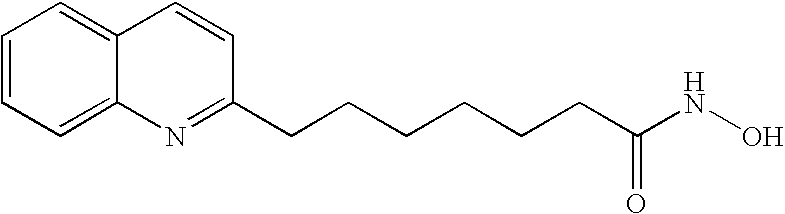
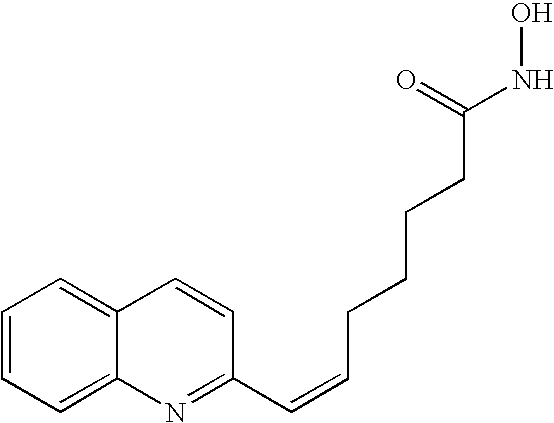
Examples
examples of specific embodiments
[0457] Some individual embodiments of the present invention include the following compounds.
1.Quinolin-2-ylPX117449 2.Quinolin-2-ylPX118839 3.Quinolin-2-ylPX118828 4.Quinolin-2-ylPX118864 5.Quinolin-2-ylPX118865 6.Quinolin-2-ylPX118867 7.Quinolin-2-ylPX118869 8.Quinolin-2-ylPX118886 9.Quinolin-2-ylPX11888710.Quinolin-2-ylPX11909211.Quinolin-2-ylPX11909512.Quinolin-2-ylPX11913713.Quinolin-2-ylPX11913314.Quinolin-2-ylPX11913515.Quinolin-2-ylPX11913816.Quinolin-3-ylPX11898717.Quinolin-4-ylPX11888518.Quinolin-5-ylPX11903819.Quinolin-5-ylPX11908820.Quinolin-6-ylPX11903921.Quinolin-7-ylPX11906822.Quinolin-8-ylPX11907123.Quinoxalin-2-ylPX11884024.Quinoxalin-2-ylPX11886625.Quinoxalin-2-ylPX11909426.Benzoxazol-2-ylPX11883527.Benzothiazol-2-ylPX11891528.Quinolin-2-yl (ether)PX119141
Chemical Terms
[0458] The term “carbo,”“carbyl,”“hydrocarbon” and “hydrocarbyl,” as used herein, pertain to compounds and / or groups which have only carbon and hydrogen atoms (but see “carbocyclic” below).
[0459...
example 1
Methyl (E)-3-(2-quinolinyl)-2-propenoate (2)
[0815] To a solution of trimethyl phosphonoacetate (3.0 ml, 18.6 mmol) in tetrahydrofuran (40 ml) under argon atmosphere at 0° C., 60% sodium hydride in oil (0.73 g, 18.3 mmol) was added at once and the resulting mixture was stirred at room temperature for 1 hour. To the reaction mixture, a solution of quinolin-2-carbaldehyde (1) (1.0 g, 6.2 mmol) in tetrahydrofuran (40 ml) was added. After stirring for 1 hour at room temperature, the reaction mixture was partitioned between ethyl acetate (150 ml) and 2N HCl (150 ml). The organic layer was separated, washed with water (100 ml), brine (50 ml), and dried (Na2SO4). The solvent was removed in vacuum and the residue was chromatographed on silica gel with chloroform-ethyl acetate (9:1) as eluent to give the title compound (1.07 g, 81%) as oil. 1H NMR (DMSO-d6, HMDSO), δ: 3.78 (3H, s); 7.11 (1H, d, J=16.0 Hz); 7.48-8.16 (5H, m); 7.81 (1H, d, J=16.0 Hz); 8.43 (1H, d, J=8.6 Hz).
example 2
(E)-3-(2-Quinolinyl)-2-propenoic acid (3)
[0816] To a solution of methyl (E)-3-(2-quinolinyl)-2-propenoate (2) (1.07 g, 5.02 mmol) in methanol (24 ml), a water solution of 1N NaOH (16 ml, 16.0 mmol) was added and the reaction mixture was stirred at room temperature for 3.5 hours. The mixture was supplemented with water (40 ml) and washed with ethyl acetate (40 ml). The aqueous layer was separated and the pH of the medium was brought to 5. The mixture was extracted with ethyl acetate (3×40 ml) and the combined extracts were dried (Na2SO4). The solvent was evaporated and the residue was dried in vacuum to give the title compound (0.49 g, 49%) as viscous oil. 1H NMR (DMSO-d6, HMDSO), δ: 7.02 (1H, d, J=15.7 Hz); 7.52-8.15 (5H, m); 7.75 (1H, d, J=15.7 Hz); 8.42 (1H, d, J=9.0 Hz); 12.69 (1H, br s).
PUM
| Property | Measurement | Unit |
|---|---|---|
| particle size | aaaaa | aaaaa |
| concentration | aaaaa | aaaaa |
| concentration | aaaaa | aaaaa |
Abstract
Description
Claims
Application Information
 Login to View More