
Programmable semiconductor device
a technology of programmable semiconductors and semiconductor devices, applied in semiconductor devices, semiconductor/solid-state device details, electrical devices, etc., can solve the problems of requiring additional process steps including mask levels and lithographic processes
- Summary
- Abstract
- Description
- Claims
- Application Information
AI Technical Summary
Benefits of technology
Problems solved by technology
Method used
Image

Examples
Embodiment Construction
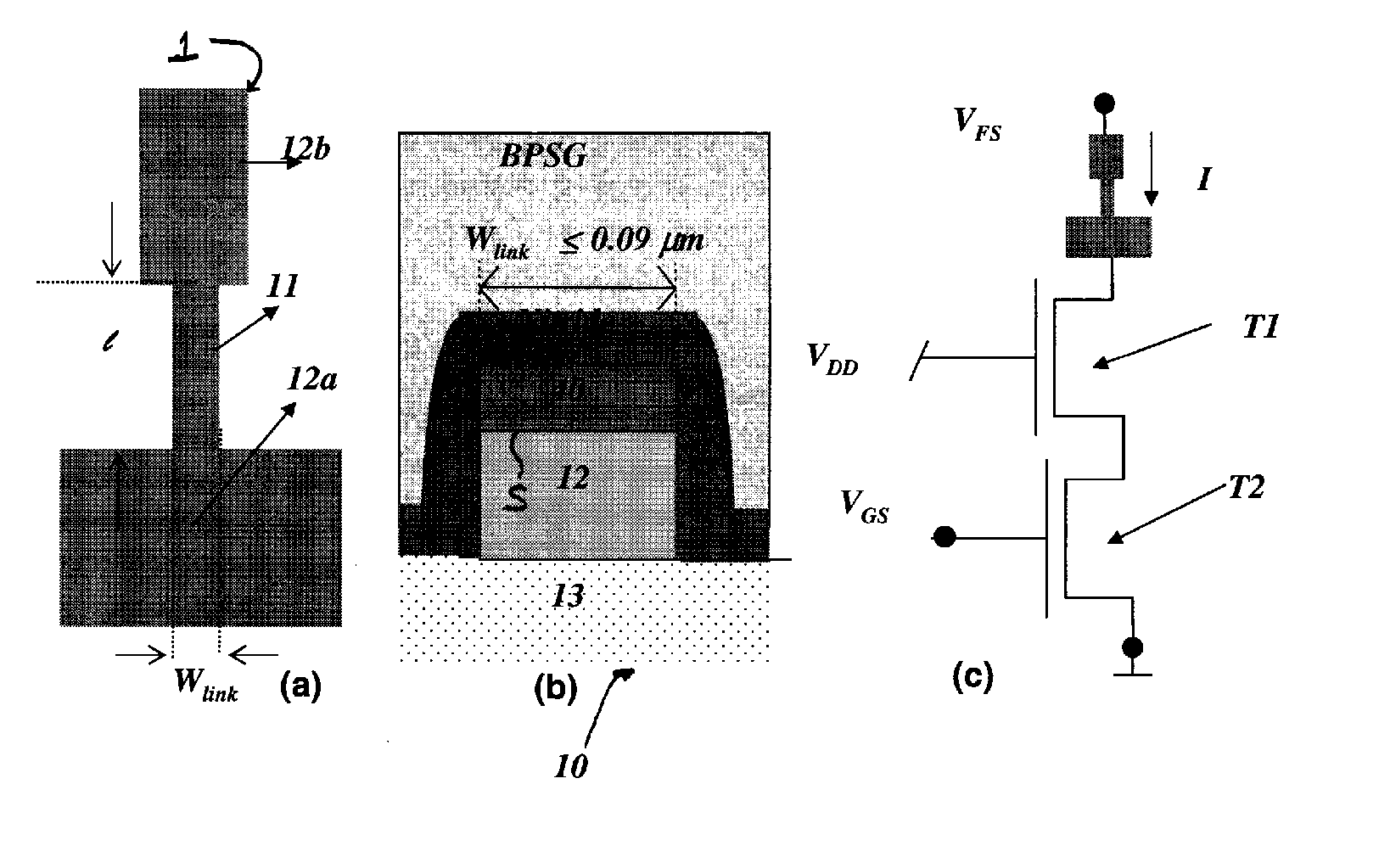
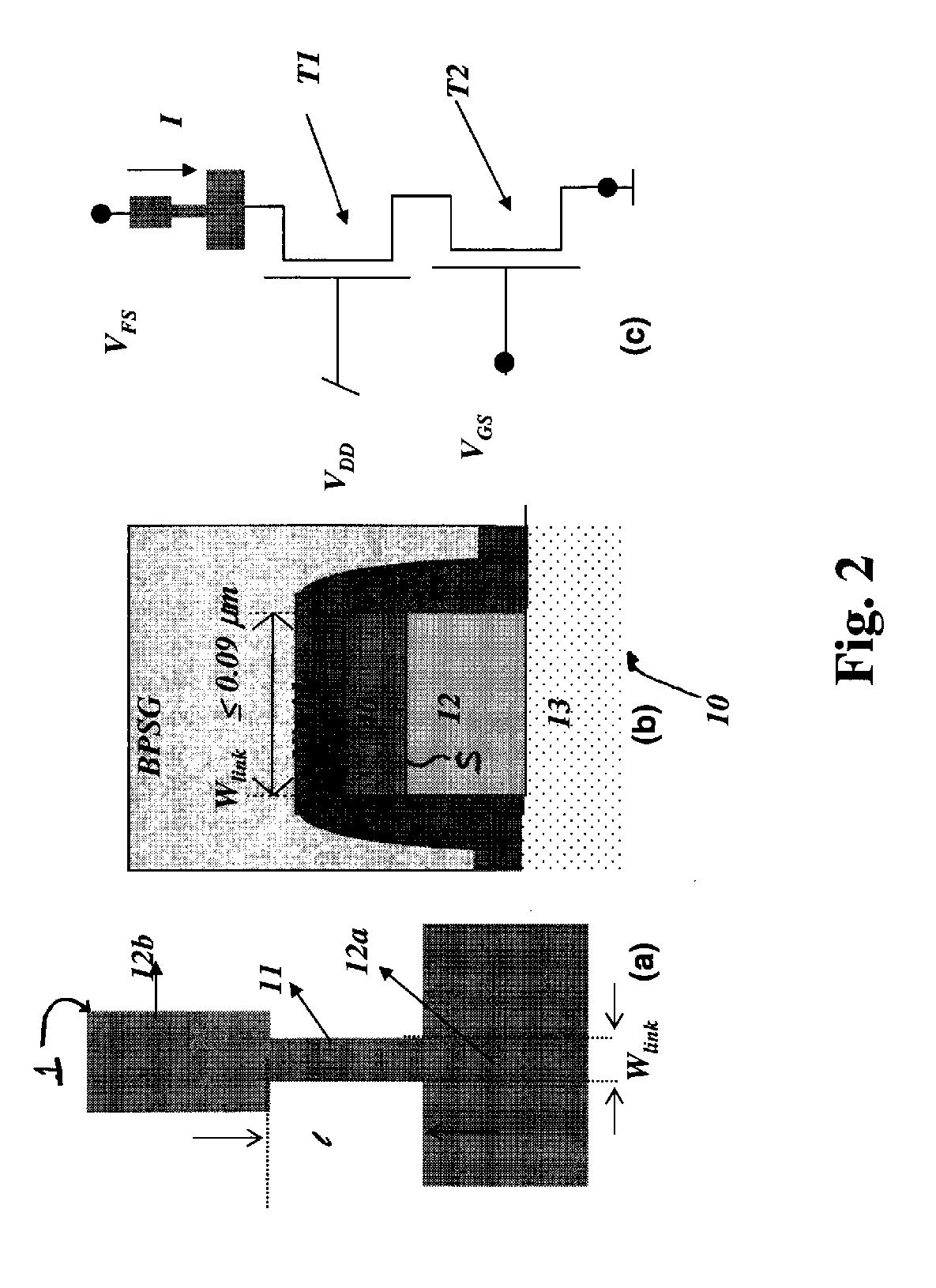
[0032]FIG. 2a is a top view of a fuse according to the present invention, wherein the fuse ends 12a, 12b are asymmetrical. The fuse link portion has an approximately (±10%) uniform width W. Following the terminology used in semiconductor technologies, a square is used to denote a film of equal width and length; the fuse length can be viewed as made of several squares of the fuse material. The nominal minimum width W of the fuse link corresponds to the technology node scale used. For example, if one uses 90 nm technology then the nominal width W of the fuse link 11 is therefore 90 nm. FIG. 2b shows a cross sectional view of the fuse and its placement (for example) in a CMOS semiconductor chip. The fuse link is situated over an insulator, in this case over an isolation oxide (13). The fuse itself includes a bottom layer 12 of polysilicon and a top layer 40 of metallic material. Preferably, the cathode (12a) and the anode (12b) have dissimilar shapes and have larger cross sections than...
PUM
 Login to View More
 Abstract
Description
Claims
Application Information
 Login to View More