[0025] The present invention has been proposed in view of the above-described situation. It is an object of the present invention to provide a high-frequency measurement unit capable of performing accurate high-frequency measurement with respect to a predetermined frequency range by acquiring a small number of calibration coefficients. Another object of the present invention is to provide an automatic adjustment unit that automatically adjusts an adjustment position of a
variable capacitor to facilitate the setting of a target load impedance ZL in a
dummy load. Further, still another object of the present invention is to provide an automatic adjustment unit that facilitates the examining, in advance of the
actual use of the plasma processing unit, what conditions permit the
impedance matching unit to achieve impedance matching.
[0031] Preferably, the high-frequency measurement unit of the present invention may further comprise a phase detection unit that detects a phase of the high-frequency signal based on the high-frequency
voltage signal detected by the
voltage detection unit and the high-frequency current signal detected by the current detection unit. In this embodiment, the calibration coefficient storage unit may further store phase calibration coefficients Cdmin, Cdmax used for calibrating a
phase difference θmin at the
lower limit frequency fmin and a
phase difference θmax at the upper limit frequency fmax to a proper
phase difference θSmin and a proper phase θSmax respectively, where the phase differences are detected by the phase detection unit. The calibration coefficient calculation unit may further calculate a phase calibration coefficient Cdm for the frequency fm based on the
lower limit frequency fmin, the upper limit frequency fmax, the frequency fm detected by the
frequency detection unit, and the phase calibration coefficients Cdmin, Cdmax stored in the calibration coefficient storage unit. The measured value calibration unit may further calibrate a phase difference θm detected by the phase detection unit to a proper phase difference θSm, where this calibration is based on the phase calibration coefficient Cdm calculated by the calibration coefficient calculation unit.
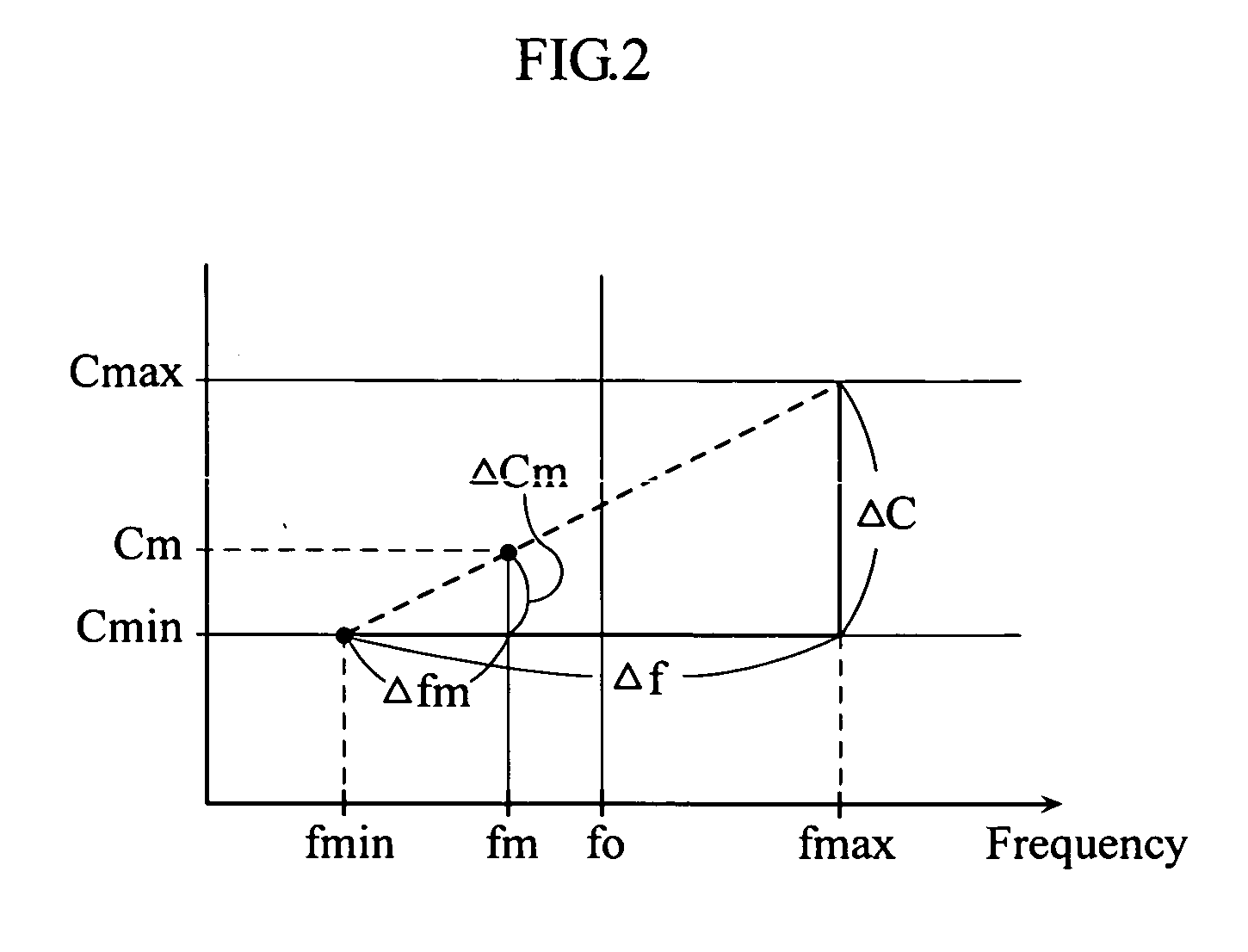
[0034] According to the high-frequency measurement unit of the present invention, even when the frequency fm of the high-frequency signal fluctuates in a predetermined range, the calibration coefficient Cm corresponding to the frequency fm is calculated by linear interpolation based on the calibration coefficient Cmin corresponding to the
lower limit frequency fmin and the calibration coefficient Cmax corresponding to the upper limit frequency fmax, both coefficients being stored in the calibration coefficient storage unit. Then, by utilizing the calibration coefficient Cm, a detected value Am such as a high-frequency
voltage or current signal is adjusted to the proper value ASm. In this manner, it is possible to perform accurate measurement of a high-frequency signal in a predetermined frequency range with use of a small number of calibration coefficients.
[0036] With the above arrangements, the electrical characteristic adjustment apparatus is capable of calculating an error evaluation value, or an index indicating the error between a measured impedance of a
dummy load and the target impedance, with one of e.g. two variable capacitors of the dummy load fixed while the other kept changing. Then, the electrical characteristic adjustment apparatus adjusts the
variable capacitor so that the error evaluation value becomes minimal. Thereafter, the electrical characteristic adjustment apparatus switches the role of the capacitors, i.e., the
variable capacitor to be fixed in
capacitance and the other
capacitor to be varied, and executes the above minimizing adjustment. In this manner, an appropriate impedance is set for the dummy load.
[0038] With the above arrangement in the electrical characteristic adjustment apparatus, it is possible to reduce the time required for finding the minimum of the error evaluation value.
[0040] With the above arrangement, it is possible to change the adjustment range of a variable
capacitor in proportion to the previous adjustment amount of the same variable
capacitor. This facilitates effective adjustment.



 Login to View More
  Login to View More