[0008] DPOAEs are the only non-invasive physiological measure offering evaluation of hearing with
high frequency resolution. DPOAEs are low-level sounds that emanate from the
cochlea representing the mechanical
distortion of outer hair cells within the region of overlap of the two primary tones with frequencies f1 and f2 and
sound pressure levels L1 and L2 and can be recorded from the external
ear canal using sensitive low-
noise microphones (Kemp 1978, Lonsbury-Martin 1997, U.S. Pat. No. 5,664,577). Due to stationary stimulation (pure tones) only a small area of the
cochlea is stimulated. Thus, DPOAEs provide a
high frequency-resolution scanning of cochlear function when elicited at different frequencies. Today, DPOAE cannot be measured at very low stimulus levels due to biological and technical
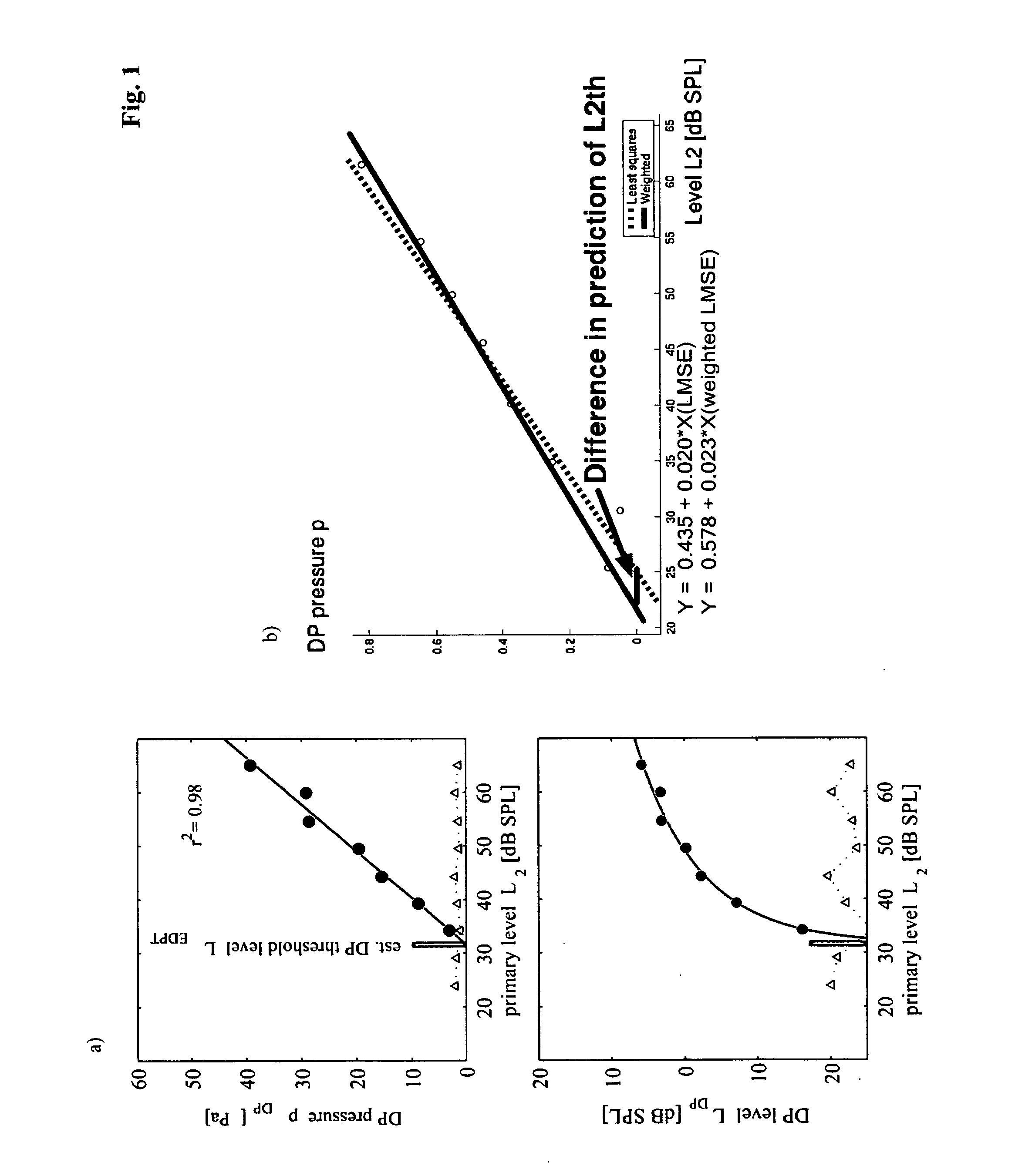
noise and therefore no direct assessment of hearing threshold is possible. However, using extrapolated DPOAE I / O-functions hearing threshold can indirectly be determined. Since DPOAE
sound pressure is a linear function of the
sound pressure level when using a primary tone level setting that accounts for the different compression of the two primaries at the generation site of the
cochlea, at the f2-place (e.g. L1=0.4 L2+39, see Kummer et al. 2000), DPOAE sound pressure I / O-functions can be easily fitted by
linear regression analysis and thus the intersection of the regression line with the primary tone level axes provides the primary tone level which would generate a DPOAE at the hearing threshold (Janssen et al. 2000, EP1027863A1, DE 19905743A1).
[0010] To improve hearing
threshold estimation weighted extrapolation can be applied. Using weighted Least
Mean Square Extrapolation
regression analysis considering
signal-to-noise ratio and close to threshold emissions as independent weighting factors the accuracy of the linear fit can be enhanced (Oswald et al. 2002, ARO Meeting, Abstract 1540) as shown in FIG. 1b.
[0025] The accuracy with which a
hearing aid matches the specific hearing impairment in different regions of the cochlea depends on the accuracy with which the loss of sensitivity and compression of the outer
hair cell amplifiers can be assessed by audiological testing. DPOAE I / O-functions are reported to be able to quantitatively assess loss of sensitivity and loss of compression of the outer
hair cell amplifiers with
high frequency resolution (Janssen et al. 1998, Kummer et al. 1998). Thus, DPOAE I / O-functions are able to provide
hearing aid fitting parameters to adjust more precisely
gain and compression of multi-channel hearing aids. Today, threshold level, most comfortable level, uncomfortable level of hearing and
loudness growth results from subjective hearing testing are used for assessing cochlear impairment and for adjusting hearing aids. Obtaining these subjective measures takes more time. Frequency specificity of
loudness scaling is worse. Reproducibility is worse as well, compared to objective testing by means of physiological measures like OAEs and ABRs.
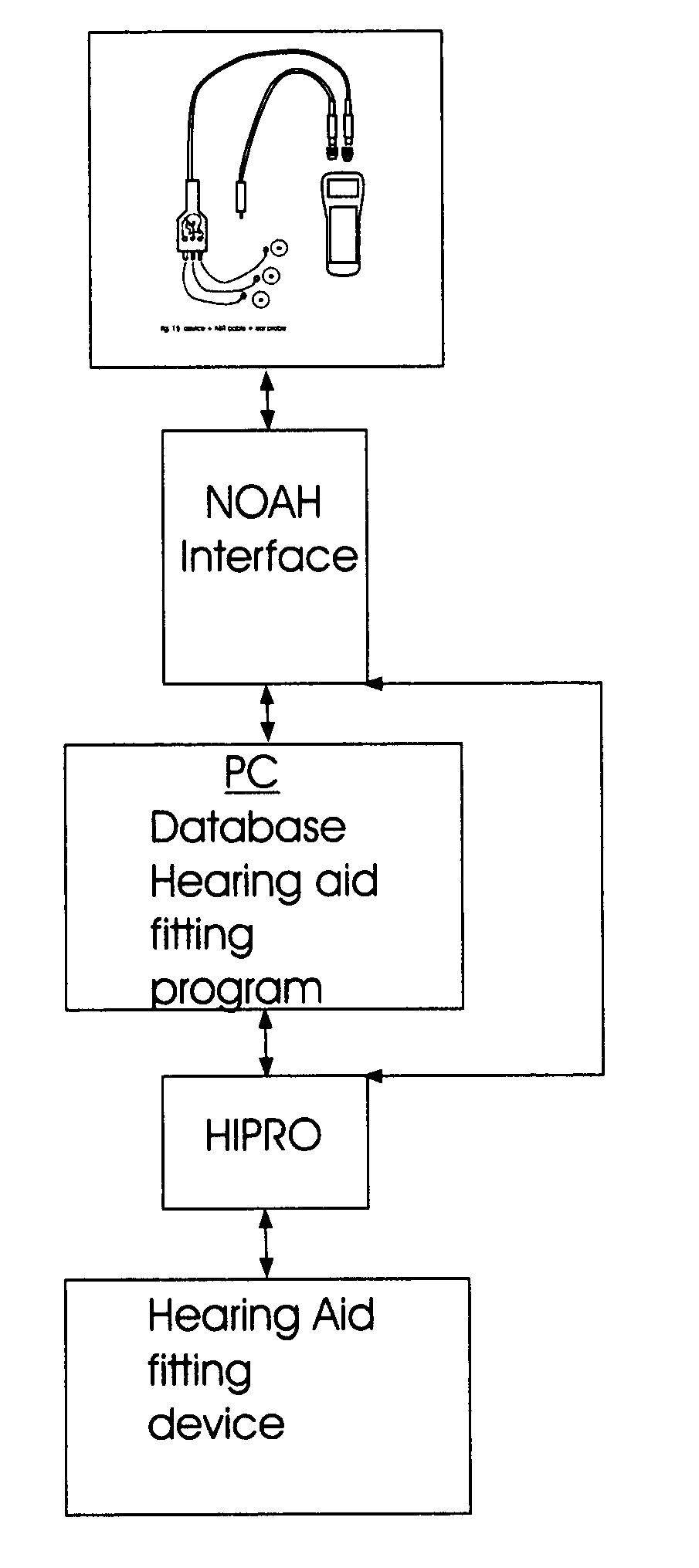
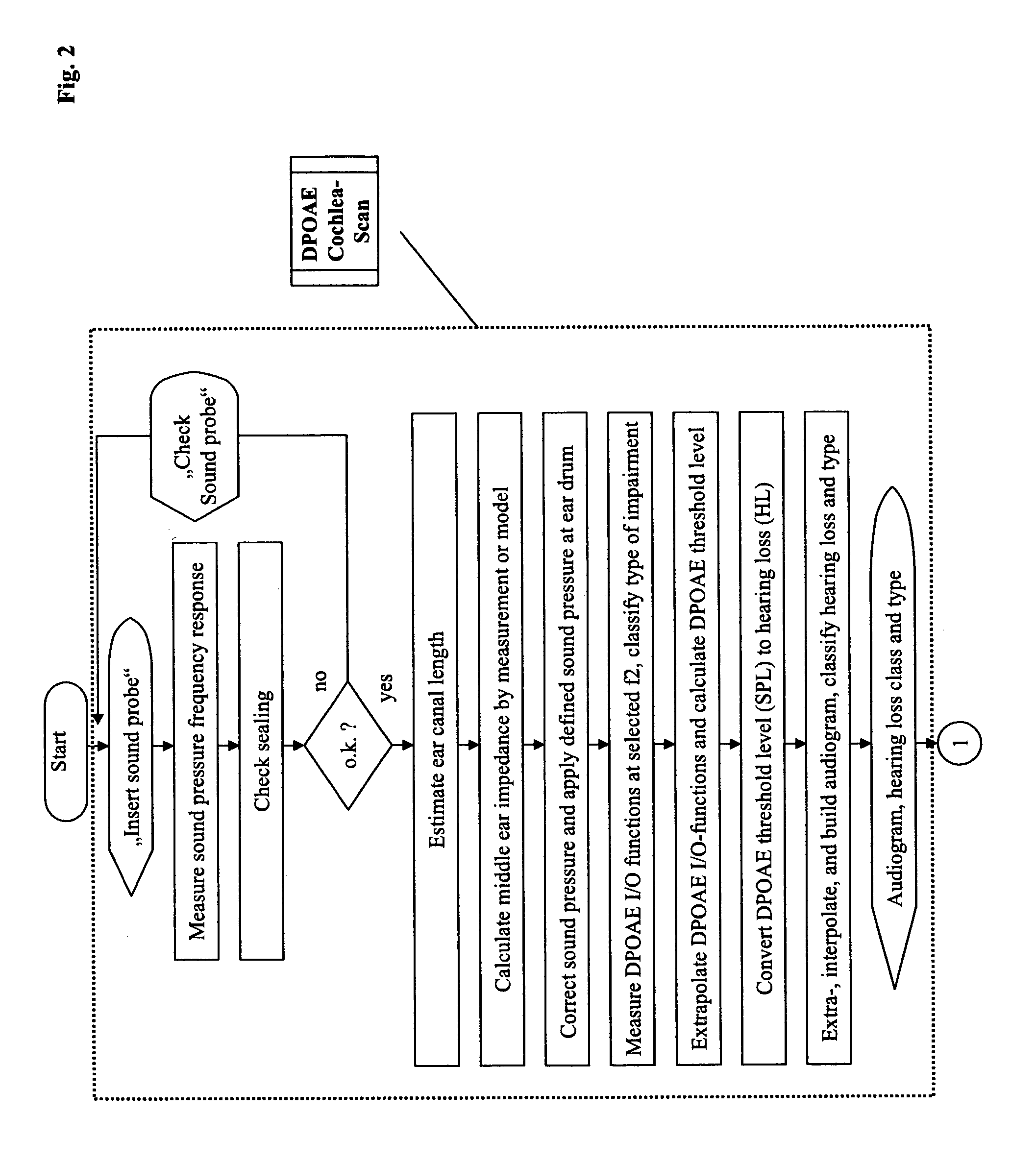
[0026] After assessing the
hearing loss by means of the
Cochlea-Scan™ measurement modules “DPOAE
Cochlea-Scan” and “ABR
Cochlea-Scan”, the method and apparatus fit hearing aids automatically after preparing and loading hearing aid specific
software. The method and apparatus is especially accurate when used to fit
high fidelity dynamic compression hearing aids, which try to compensate loss of sensitivity and loss of compression of the outer
hair cell amplifiers, such as in patients with hair-
cell-based hearing losses with recruitment, where dynamic compression hearing aids can make low-level signals uniformly and smoothly audible.
[0044] The
impact of undetected
hearing loss to a child is long term and interferes with normal development of
communication skills.
Early detection of
hearing loss allows early intervention, which can reduce the adverse effects of hearing impairment on speech and language development. Today, hearing screening devices only provide “pass / refer” responses. The present invention provides more detailed frequency specific and quantitative information on hearing loss in the same amount of time, with the simple handling of the apparatus, by unskilled personal. It also minimizes the necessity of subjecting newborns to conventional more thorough time-consuming investigations by audiological specialists. Thus, the application of the invention during hearing screening can also avoid the need for more thorough audiological testing in newborns and infants. The application offers a quick insight in whether and to what extent hearing capability is concerned and thus saves time and money.


 Login to View More
  Login to View More