

Method of making a tool component
a tool and component technology, applied in the field of making tool components, can solve the problems of abrasive compact layer development, brittle abrasive compact layer, and problems in us
- Summary
- Abstract
- Description
- Claims
- Application Information
AI Technical Summary
Benefits of technology
Problems solved by technology
Method used
Image

Examples
example 1
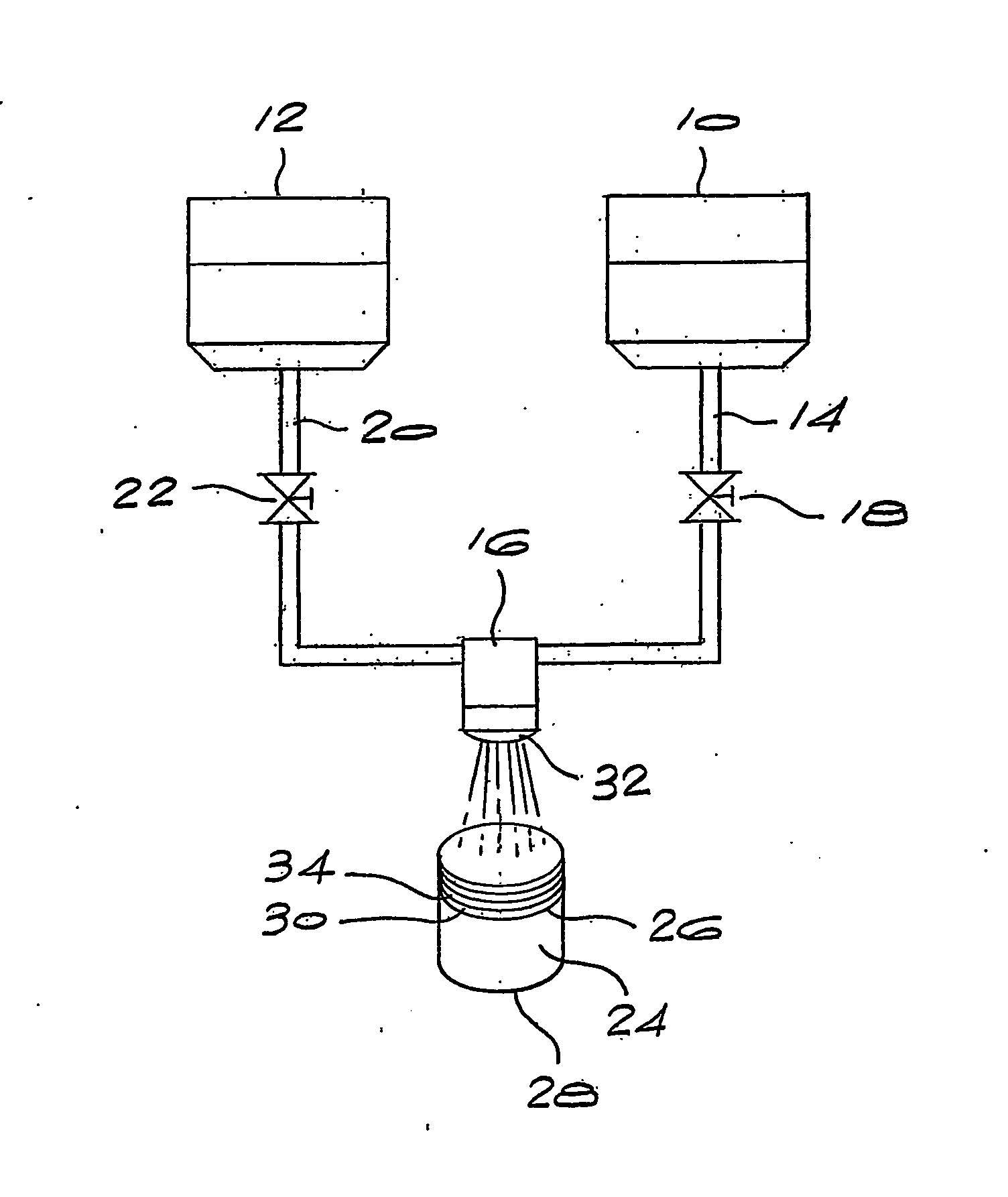
[0019] A cylindrical-shaped component was prepared with a WC / diamond gradient in the axial direction using the wet powder spraying (WPS) method of the invention. The starting layer of the cylinder was a 4 mm layer of WC / Co. This was not prepared using the wet powder spraying method, but was rather pressed from commercially available powder at 100 MPa to obtain a strong, porous support for the subsequent layer deposition. This base layer was then strengthened further by a pre-sintering treatment under hydrogen at 600° C. The porosity of this layer was chosen to achieve a similar shrinkage behaviour to the overlying layers. The WC / Co grain composition was the same as that used in the diamond graded layers.
[0020] 49 gradient layers, each of approximately 100 μm thickness, with WC / diamond ratios varying in a monotonic manner were then deposited onto the WC / Co base by the WPS method. The diamond and WC particles were provided from separate containers, each in a suspension which included...
example 2
[0023] A cylindrical-shaped component was prepared with a diamond grain size gradient in the axial direction using a wet powder spraying (WPS) method similar to that described in Example 1. The diamond layer immediately adjacent to the WC / Co base layer was chosen to have an average grain size of approximately 25 μm, whilst the diamond layer in the uppermost layer was chosen to have an average grain size of approximately 4 μm. 50 layers were deposited, each of approximately 100 μm in thickness. The ratio of the two diamond grain sizes was altered in monotonic manner in 2% compositional intervals, from 100% 25 μm diamond at the base surface to 100% 4 μm diamond at the uppermost surface.
[0024] The mass composition of the WPS suspension did not alter signficantly from the base to the top layers, as the matrix material was consistently diamond throughout. The final compact was de-binded in a similar fashion to the compact generated in Example 1, and was then treated under high pressure ...
example 3
[0025] A cylindrical-shaped component was prepared with a gradient in diamond grain size and chemical composition in the axial direction using a wet powder spraying (WPS) method similar to that described in Example 1.
[0026] The layer immediately adjacent to the WC / Co base layer contained diamond grains of 25 μm in size and WC / Co particles of 2.5 μm in size in a 75:25 (diamond:WC / Co) mass ratio. The uppermost layer contained 100% diamond material of an average of 4 μm in size. The ratio of these two source compositions was altered in monotonic manner in 2% compositional intervals, from 100% (25 μm diamond / (WC / Co) mix) at the base surface to 100% 4 μm diamond at the uppermost surface.
[0027] The final compact was then de-binded in a similar fashion to the compact generated in Example 1, and was then treated under high pressure and high temperature to achieve a fully sintered compact with diamond to diamond bonding. Residual tensile stresses were once again significantly reduced in th...
PUM
| Property | Measurement | Unit |
|---|---|---|
| Mass | aaaaa | aaaaa |
| Size | aaaaa | aaaaa |
| Particle size | aaaaa | aaaaa |
Abstract
Description
Claims
Application Information
 Login to View More