Check patentability & draft patents in minutes with Patsnap Eureka AI!

Asymmetric Imine Hydrogenation Processes

a hydrogenation process and asymmetric technology, applied in the field of catalytic hydrogenation, can solve the problems of limited widely applicable and feasible processes, low enantioselectivity or severe reaction conditions, and the production of chiral amines via this method still represents a major challeng

Inactive Publication Date: 2007-12-20
ABDUR RASHID KAMALUDDIN
View PDF3 Cites 0 Cited by
  • Summary
  • Abstract
  • Description
  • Claims
  • Application Information

AI Technical Summary

Benefits of technology

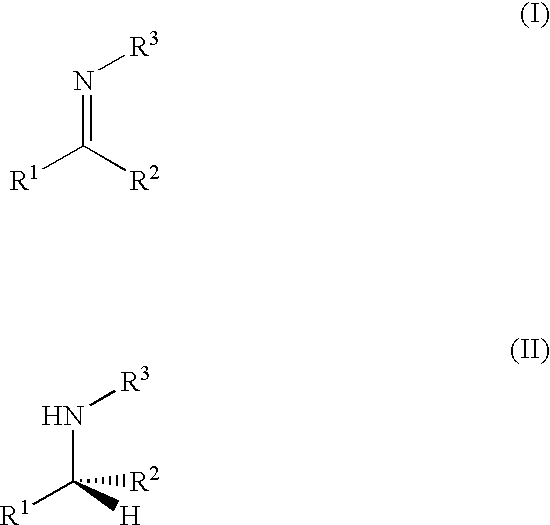
[0013] It has now been found that hydrogenation of the carbon-nitrogen double bond (C═N) of imines of Formula (I) to the corresponding amines of Formula (II) can be efficiently carried out using a catalytic system including a ruthenium complex containing (1) a diamine and (2) a diphosphine or two monodentate phosphine ligands.

Problems solved by technology

Although many highly enantioselective chiral catalysts and catalytic processes are available for the asymmetric hydrogenation and transfer hydrogenation of C═C and C═O bonds, there are only a few widely applicable and feasible processes for effective reduction of the analogous C═N function of imines.
The production of chiral amines via this methodology still represents a major challenge.
The review by James names several systems based on rhodium for the asymmetric hydrogenation of imines but they suffer from drawbacks, such as low enantioselectivity or severe reaction conditions.
The need to activate the catalyst by the addition of butyl-lithium and phenyl silane limits the scope and applicability of this process.
This system also suffers from the drawback of being very oxygen and water sensitive.
Despite the reported successes of some of these catalytic hydrogenation processes for imines, there are certain significant drawbacks.
These include high operating pressures (typically >50 bar H2), high catalyst loading and the use of expensive iridium- and rhodium-based systems.
In addition, activity and / or enantioselectivity tends to be either low or highly substrate dependent, which in some cases necessitates the development of an entire catalytic system and process for only one substrate or a very closely related group of substrates.
The imines described in this latter publication are inherently more difficult to reduce than the activated (aromatic) analogues reported by Chirotech.

Method used

the structure of the environmentally friendly knitted fabric provided by the present invention; figure 2 Flow chart of the yarn wrapping machine for environmentally friendly knitted fabrics and storage devices; image 3 Is the parameter map of the yarn covering machine
View more

Image

Smart Image Click on the blue labels to locate them in the text.
Viewing Examples
Smart Image
  • Asymmetric Imine Hydrogenation Processes
  • Asymmetric Imine Hydrogenation Processes
  • Asymmetric Imine Hydrogenation Processes

Examples

Experimental program
Comparison scheme
Effect test

example 1

General Procedure for Catalytic Hydrogenation

[0070] A solution of the required imine dissolved in benzene was added to a mixture of the catalyst (0.1-0.5%) and KOtBu (10-50 mg) in a 50 ml Parr hydrogenation reactor (fitted with a removable glass liner and a magnetic stirring bar). The reactor was then purged several times with H2 gas, pressurized to the desired pressure (10-50 bar) and stirred vigorously at the required temperature. The pressure was periodically released and the hydrogenation reaction monitored by removing a sample of the reaction mixture and measuring its 1H NMR spectrum. If required, the mixture was re-pressurized with H2 gas and the reaction continued until either the hydrogenation is complete or no further change in the composition was observed (NMR). Upon completion, hexane (10 ml) was added to the reaction mixture, which was then eluted (hexane) through a short column of silica gel in order to remove the spent catalyst and KOtBu. Evaporation of the hexane und...

example 1.1

Hydrogenation of N-(Benzylidene)methylamine

[0071]

CatalystS:CConv. (%)Time / hrRuHCl(R-BINAP)(R,R-CYDN)100010024RuHCl(R-BINAP)(R,R-DPEN)100010024RuHCl(R,R-DPPACH)(R,R-CYDN)100010024RuHCl(R,R-DPPACH)(R,R-DPEN)100010024

example 1.2

Hydrogenation of N-(1-Phenylethylidene)methylamine

[0072]

Conv.CatalystS:C(%)Time / hree(%)*RuHCl(R-BINAP)(R,R-CYDN)600982462 (S)RuHCl(R-BINAP)(R,R-DPEN)600972471 (S)RuHCl(R,R-DPPACH)(R,R-CYDN)6001002448 (S)RuHCl(R,R-DPPACH)(R,R-DPEN)6001002451 (S)

*The ee was determined from the rotation (αD) of N-methyl-1-phenylethylamine.

the structure of the environmentally friendly knitted fabric provided by the present invention; figure 2 Flow chart of the yarn wrapping machine for environmentally friendly knitted fabrics and storage devices; image 3 Is the parameter map of the yarn covering machine
Login to View More

PUM

No PUM Login to View More

Abstract

A process for the catalytic hydrogenation or asymmetric hydrogenation of imines of Formula (I) to the corresponding amines of Formula (II) is provided in which R1 is aryl; R2 is aryl, cyclic, alkyl, alkenyl or alkynyl; and R3 is alkyl. The catalytic system includes a ruthenium complex containing (1) a diamine and (2) a diphosphine or two monodentate phosphines ligands. Such process also relates to the asymmetric hydrogenation of prochiral imines to the chiral amines using chiral ruthenium complexes bearing chiral diphosphines or chiral monodentate phosphines and chiral diamines.

Description

FIELD OF THE INVENTION [0001] The present invention relates to the field of catalytic hydrogenations, particularly catalytic asymmetric hydrogenation processes of the reduction of imines to amines in which the catalytic system includes a ruthenium complex containing (1) a diamine and (2) a diphosphine or two monodentate phosphines ligands. BACKGROUND OF THE INVENTION [0002] There is continuously a growing demand for enantiomerically pure amines in the pharmaceutical, agrochemical and fine chemicals industries. Over the past decade, there has been significant efforts directed towards developing procedures for asymmetric imine hydrogenations. Although many highly enantioselective chiral catalysts and catalytic processes are available for the asymmetric hydrogenation and transfer hydrogenation of C═C and C═O bonds, there are only a few widely applicable and feasible processes for effective reduction of the analogous C═N function of imines. The production of chiral amines via this metho...

Claims

the structure of the environmentally friendly knitted fabric provided by the present invention; figure 2 Flow chart of the yarn wrapping machine for environmentally friendly knitted fabrics and storage devices; image 3 Is the parameter map of the yarn covering machine
Login to View More

Application Information

Patent Timeline
no application Login to View More
IPC IPC(8): C07C209/26C07D207/06C07D221/00C07C209/52C07C211/27C07C211/35
CPCC07C209/52C07C211/27C07C211/35
Inventor ABDUR-RASHID, KAMALUDDIN
Owner ABDUR RASHID KAMALUDDIN
Features
  • R&D
  • Intellectual Property
  • Life Sciences
  • Materials
  • Tech Scout
Why Patsnap Eureka
  • Unparalleled Data Quality
  • Higher Quality Content
  • 60% Fewer Hallucinations
Social media
Patsnap Eureka Blog
Learn More