This helps you quickly interpret patents by identifying the three key elements:
Problems solved by technology
Method used
Benefits of technology
Benefits of technology
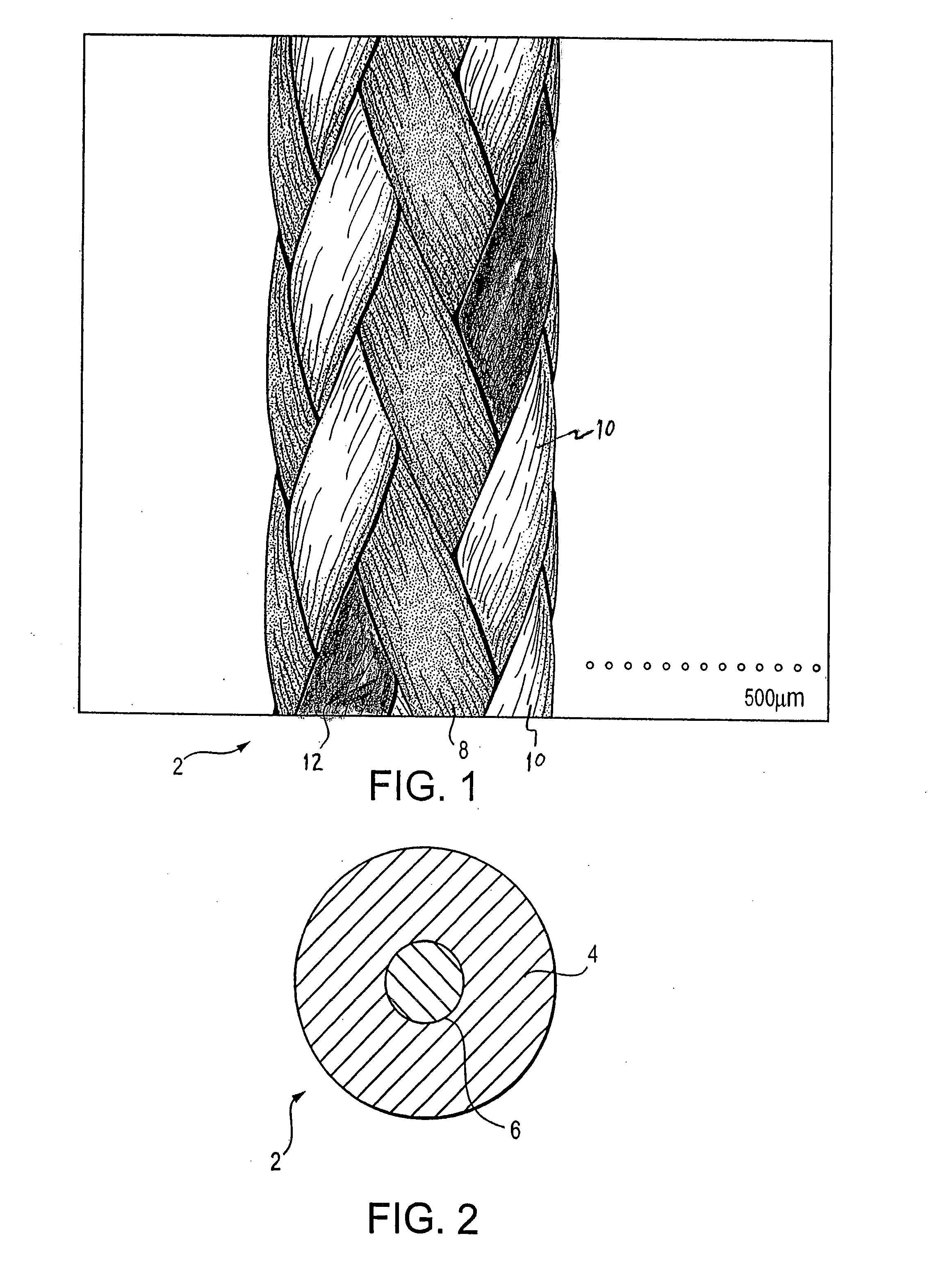
[0006] The present invention advantageously provides a high strength surgical suture with improved tie down characteristics. The suture features a braided cover made of a blend of ultrahigh molecular weightlong chain polyethylene fiber and a fiber of one or more long chain synthetic polymers, preferably polybutester. The ultrahigh molecular weight polyethylene provides strength. The polybutester provides improved tie down properties.
[0007] Handling properties of the high strength suture also are enhanced using various materials to coat the suture. In addition, strands of a contrasting color may optionally be added to the braided threads to enhance visibility. The colored strands preferably are dyed filaments of polybutester or nylon.
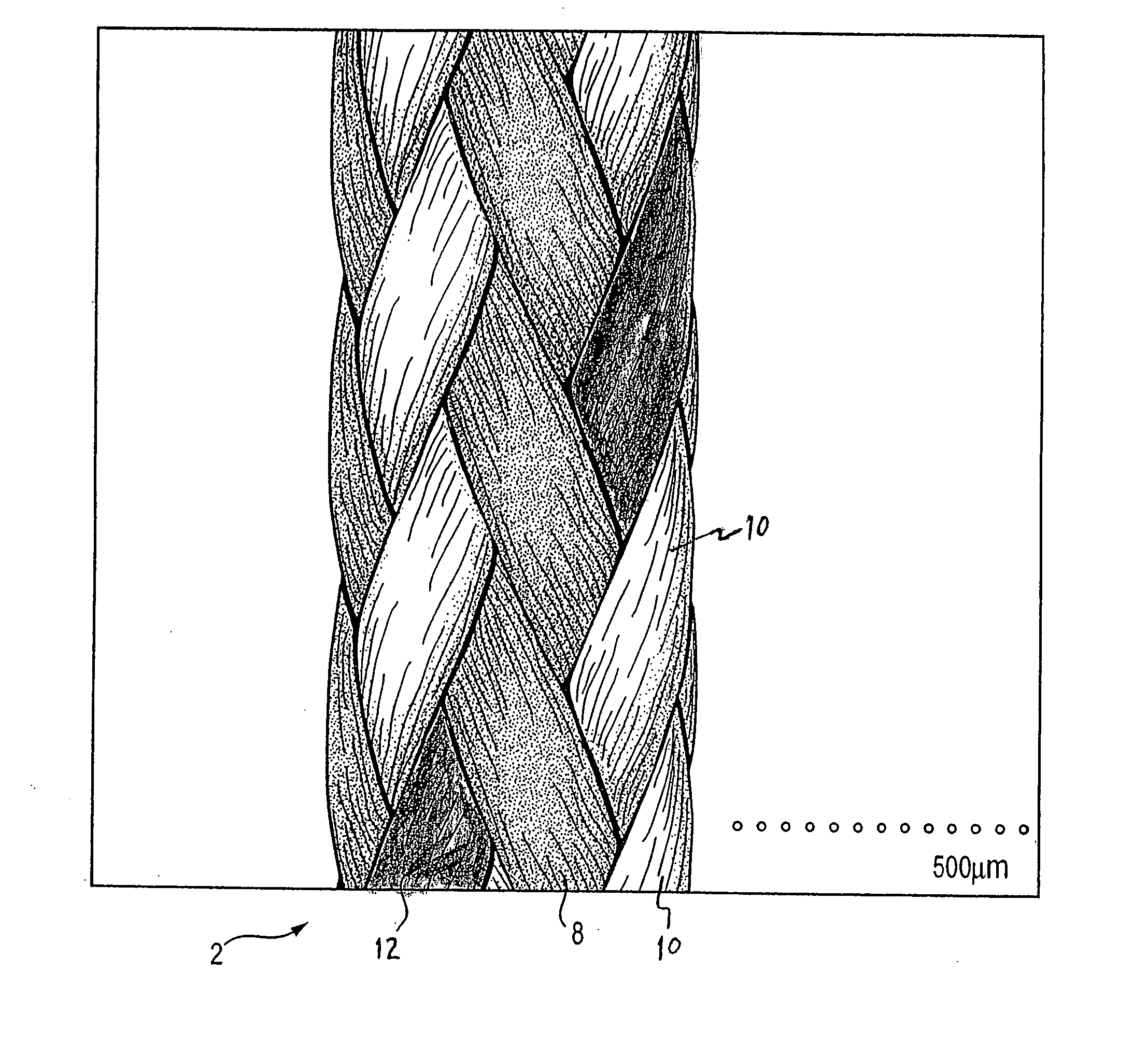
[0012] The suture can be uncoated, or coated with wax (beeswax, petroleumwax, polyethylene wax, or others), silicone (Dow Corning silicone fluid 202A or others), silicone rubbers (Nusil Med 2245, Nusil Med 2174 with a bonding catalyst, or others) PTFE (Teflon, Hostaflon, or others), PBA (polybutylate acid), ethyl cellulose (Filodel) or other coatings, to improve lubricity of the braid, knot security, or abrasion resistance, for example. As an added advantage, as mentioned above, all or some of the nylon fibers (or the polybutester fibers) in the cover are provided in a contrasting color for visibility and identification purposes. A few trace threads having a contrasting color, preferably of a readily dyed fiber such as polybutester or nylon, in the cover aid surgeons in identifying the travel direction of the suture during surgery, particularly during arthroscopic operations. Providing the trace threads in a regularly repeating pattern is particularly useful, allowing the surgeon to distinguish different ends of lengths of suture, and determine the direction of travel of a moving length of suture. Of the more easily dyed fibers, nylon is preferred in that it accepts dye readily.
Problems solved by technology
This material is much stronger than ordinary surgical suture; however, it has poor knot tie down characteristics for use in surgical applications.
Method used
the structure of the environmentally friendly knitted fabric provided by the present invention; figure 2 Flow chart of the yarn wrapping machine for environmentally friendly knitted fabrics and storage devices; image 3 Is the parameter map of the yarn covering machine
View more
Image
Smart Image Click on the blue labels to locate them in the text.
Viewing Examples
Smart Image
Click on the blue label to locate the original text in one second.
Reading with bidirectional positioning of images and text.
Smart Image
Examples
Experimental program
Comparison scheme
Effect test
example 1
USP Size 5 (EP Size 7)—Without Nylon Trace
[0022] Made on a 16 carrier Hobourns machine, the yarns used in the braided cover are Honeywell Spectra 2000, polyester type 712. The cover is formed using eight carriers (strands) polybutester type 712 and Spectra. The cover is formed using eight carriers (strands) with one end of 190 decitex polybutester per carrier, and eight carriers with one end of 220 decitex Spectra per carrier. The core is formed of Spectra using one end of 440 / 1 / 3 / twisted 10 tpi “z” and 7 tpi “s” (core is not steam set). Picks per inch (PPI)=36. In forming the suture, the percent cover is 71.31, while the percent core is 28.69 (by weight). Runnage is 1991 meters per kilo.
[0023] Of the overall suture, the polybutester in the cover (8 carriers×190 decitex=1520 decitex) makes up 33% of the suture, and the Spectra in the cover (8 carriers×220 decitex=1760 decitex) makes up 38.76% of the suture. The Spectra core (3 carriers×440 decitex=1320 decitex) is 28.69% of the s...
example 2
USP Size 5 (EP Size 7)—With Nylon Trace
[0024] Made on a 16 carrier Hobourns machine, the yarns used in the braided cover are Honeywell Spectra 2000, polybutester type 712, and nylon. The cover is formed using eight strands of 144 decitex Spectra per carrier, braided with six strands of 100 decitex polybutester, and two strands of colored nylon. The core is formed of three carriers of 144 decitex Spectra braided at three to six twists per inch.
example 3
USP Size 2
[0025] The suture is 38.09% polybutester, 61.91% UHMWPE, or about 40% polybutester and about 60% UHMWPE, by weight.
[0026] The examples set forth above are for size 2 and size 5 suture. In the making of various sizes of the inventive suture, different decitex values and different PPI settings can be used to achieve the required size and strength needed. In addition, smaller sizes may require manufacture on 12 carrier machines, for example. The very smallest sizes preferably are made without a core. Overall, the suture may range from 5% to 90% (by weight) ultrahigh molecular weight polymer (preferably at least 40% ultrahigh molecular weight polymer), with the balance formed of polybutester and / or nylon. The core preferably comprises 18% or greater of the total amount (by weight) of filament.
the structure of the environmentally friendly knitted fabric provided by the present invention; figure 2 Flow chart of the yarn wrapping machine for environmentally friendly knitted fabrics and storage devices; image 3 Is the parameter map of the yarn covering machine
Login to View More
PUM
Property
Measurement
Unit
Fraction
aaaaa
aaaaa
Fraction
aaaaa
aaaaa
Color
aaaaa
aaaaa
Login to View More
Abstract
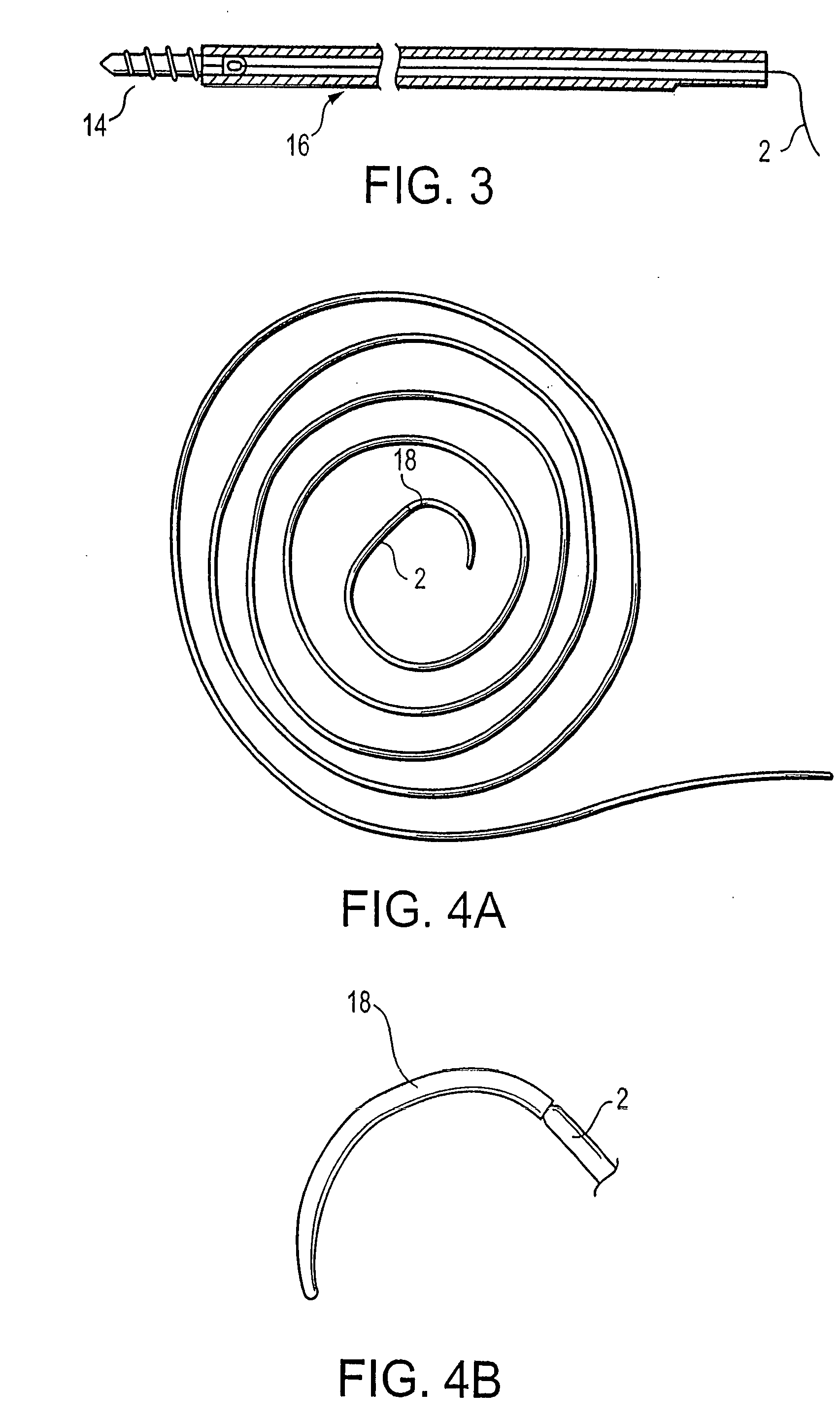
A high strength abrasion resistant surgical suture material with improved tie down characteristics. The suture features a multifilament cover formed of strands of ultra high molecular weight long chainpolyethylene braided with polybutester. Selected nylon fibers in the cover may be provided in a color contrasting with the other cover fibers to provide an identifiable trace. The cover surrounds a core formed of twisted strands of ultrahigh molecular weightpolyethylene. The suture, provided in a #2 size, has the strength of #5 Ethibond, is ideally suited for most orthopedic procedures, and can be attached to a suture anchor or a curved needle.
Description
CROSS-REFERENCE TO RELATED APPLICATIONS [0001] This application claims priority to U.S. Provisional Application No. 60 / 819,002, filed on Jul. 7, 2006, the entire contents of which are hereby incorporated by reference.BACKGROUND OF THE INVENTION [0002] 1. Field of the Invention [0003] The present invention relates to a high strength surgical suture, and more particularly to braided suture blends of ultrahigh molecular weightpolyethylene (UHMWPE) having high strength and excellent tie down characteristics. [0004] 2. Description of the Related Art [0005] Suture strength is an important consideration in any surgical suture material. One of the strongest materials currently formed into elongated strands is an ultrahigh molecular long chain weight polyethylene, typically used for fishing line and the like, which is sold under the trade names Dyneema or Spectra. This material is much stronger than ordinary surgical suture; however, it has poor knot tie down characteristics for use in surg...
Claims
the structure of the environmentally friendly knitted fabric provided by the present invention; figure 2 Flow chart of the yarn wrapping machine for environmentally friendly knitted fabrics and storage devices; image 3 Is the parameter map of the yarn covering machine
Login to View More
Application Information
Patent Timeline
Application Date:The date an application was filed.
Publication Date:The date a patent or application was officially published.
First Publication Date:The earliest publication date of a patent with the same application number.
Issue Date:Publication date of the patent grant document.
PCT Entry Date:The Entry date of PCT National Phase.
Estimated Expiry Date:The statutory expiry date of a patent right according to the Patent Law, and it is the longest term of protection that the patent right can achieve without the termination of the patent right due to other reasons(Term extension factor has been taken into account ).
Invalid Date:Actual expiry date is based on effective date or publication date of legal transaction data of invalid patent.



 Login to View More