Phosphite composition and method for producing the same
- Summary
- Abstract
- Description
- Claims
- Application Information
AI Technical Summary
Benefits of technology
Problems solved by technology
Method used
Image

Examples
example 1
Production Example of Granular Composition
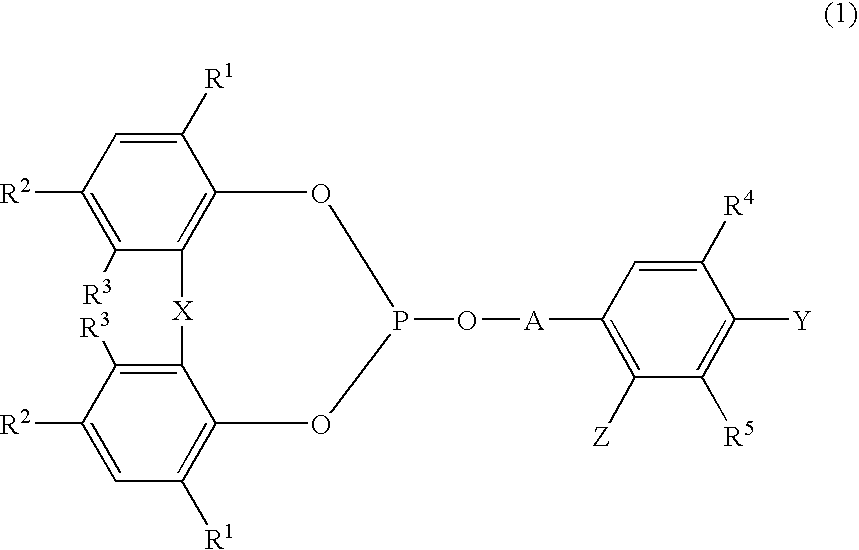
[0091]Into a mixing chamber of a Henschel mixer having a volume of 10 L which is equipped with a temperature sensor and a heated water jacket in the interior of the mixing chamber were placed 1 kg of the phosphite (1-1) and 50 g of the aliphatic hydrocarbon lubricant (2-1) as a binder. Subsequently, a liquid at 90° C. was passed through the heated water jacket, and high speed mixing was performed at a rotation number of 950 to conduct granulation. After 4 minutes and 20 seconds from the initiation of mixing, the temperature sensor in the interior of the mixing chamber indicated 84° C. (final temperature). Stirring was stopped, and 1 kg of a granular composition A was taken out from a discharge port.
example 5
Production of Polypropylene Composition and Coloring Resistance of Resulting Polypropylene Composition
[0095]One kilogram of polypropylene (MI: 3 g / 10 min), 0.5 g of calcium stearate and 1 g of the granular composition A were dry-blended, and extruded at an extrusion temperature of 230° C. with a 30 mmΦ uniaxial extruder to obtain a pellet. The pellet was injection-molded at 230° C. to obtain a sheet of polypropylene (40×60×1 mm). The coloring resistance (AYI) before and after exposure of the polypropylene sheet to 650 ppm of an NOx gas was 1.07.
Assessment Method of Coloring Resistance (ΔYI):
[0096]The polypropylene sheet was exposed to 650 ppm of an NOx gas at about 25° C. for 7 days. Yellowness indexes (YI) of the sheet before and after exposure were measured. The coloring resistance of the polypropylene composition was assessed by a difference (ΔYI) between YI after exposure and YI before exposure.
example 9
Production of Polyethylene Composition and Processing Stability of Resulting Polyethylene Composition
[0098]One kilogram of linear low density polyethylene (MI: 1 g / 10 min), 3 g of the granular composition A were dry-blended, and extruded at an extrusion temperature of 210° C. with a 30 mmΦ uniaxial extruder to obtain a pellet. The melt-mass flow rate (MFR) of the pellet was measured at 190° C. and under a load of 5 kg, and adopted as an initial MFR. The pellet was extruded repetitively three times at 250° C. Then, the MFR (190° C., 5 kg) of the pellet was measured to assess the processing stability of the polyethylene composition.
Assessment Method of Processing Stability (MFR (g / 10 min)):
[0099]JIS K 7210 (1976) (method A) was used at 190° C. and under a load of 5 kg.
PUM
| Property | Measurement | Unit |
|---|---|---|
| Temperature | aaaaa | aaaaa |
| Temperature | aaaaa | aaaaa |
| Fraction | aaaaa | aaaaa |
Abstract
Description
Claims
Application Information
 Login to View More
 - R&D
- Intellectual Property
- Life Sciences
- Materials
- Tech Scout
- Unparalleled Data Quality
- Higher Quality Content
- 60% Fewer Hallucinations
Browse by: Latest US Patents, China's latest patents, Technical Efficacy Thesaurus, Application Domain, Technology Topic, Popular Technical Reports.
© 2025 PatSnap. All rights reserved.Legal|Privacy policy|Modern Slavery Act Transparency Statement|Sitemap|About US| Contact US: help@patsnap.com