

Method of Removing Nitrous Oxide
a technology of nitrous oxide and nitrous oxide, which is applied in the direction of dispersed particle separation, separation processes, chemistry apparatus and processes, etc., can solve the problems of gas mixture becoming flammable and unsafe to handle, nsub>2/sub>o can accumulate in dangerous levels, and loss of hsub>2/sub>
- Summary
- Abstract
- Description
- Claims
- Application Information
AI Technical Summary
Benefits of technology
Problems solved by technology
Method used
Image

Examples
examples
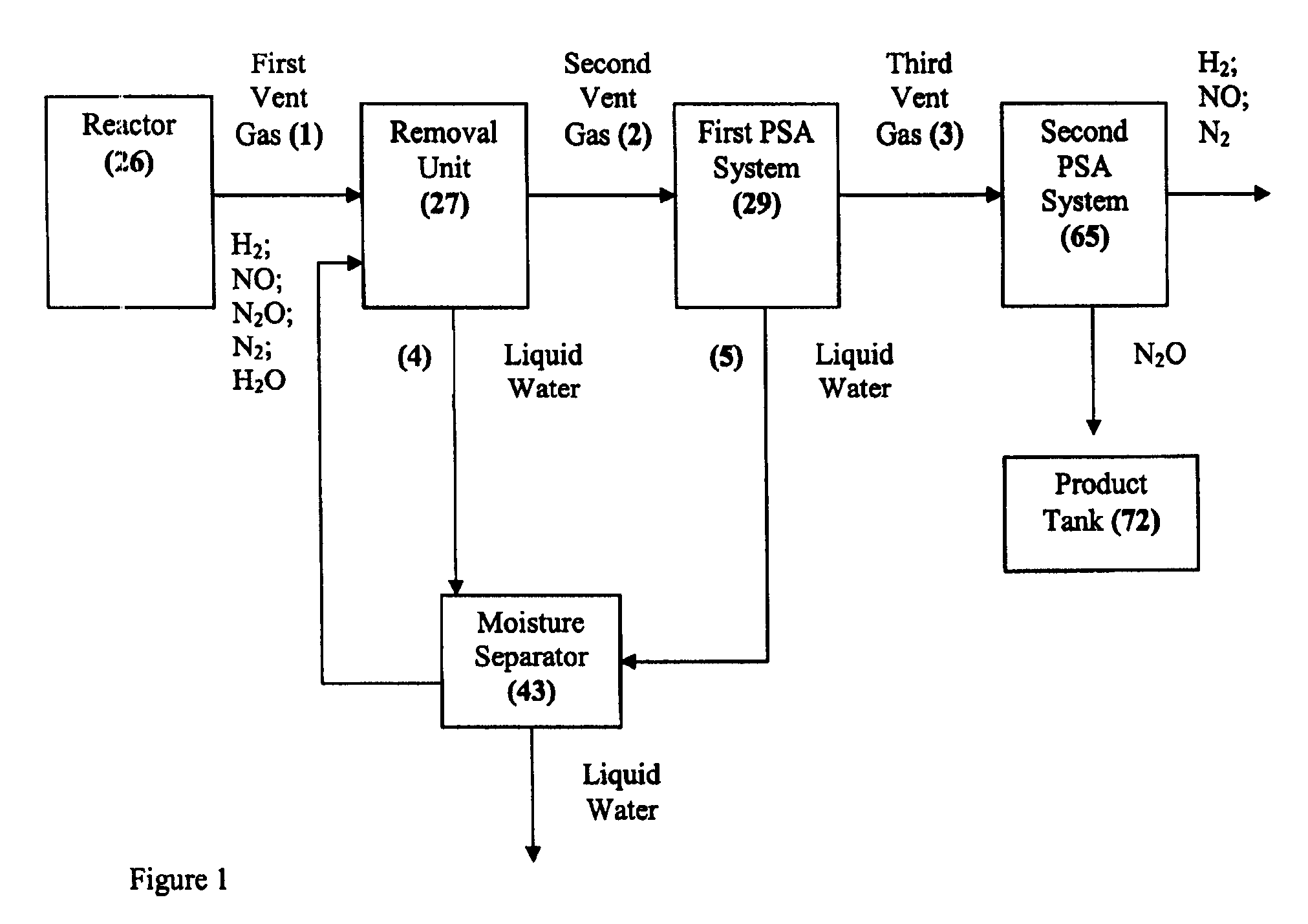
[0057]Hydroxylamine can be formed in a reactor (26) by combining nitric oxide gas (NO), nitrogen gas (N2), and hydrogen gas (H2) in an aqueous medium to partially hydrogenate the NO. As a result, nitrous oxide gas (N2O) is formed as a gaseous by-product. The N2O and H2O, in addition to unused N2, H2, and NO, are preferably removed from the reactor in a first vent gas (1).
[0058]The first vent gas (1) typically includes approximately 67% H2, 14% NO, 9% N2, 4% H2O, 8% N2O, and a trace amount of other gasses such as methane, CO2 and CO. However, the following examples utilize synthetic mixtures of the aforementioned gasses representative of a typical first vent gas (1). The synthetic mixtures of the gasses are hereafter referred to as “mixtures.”
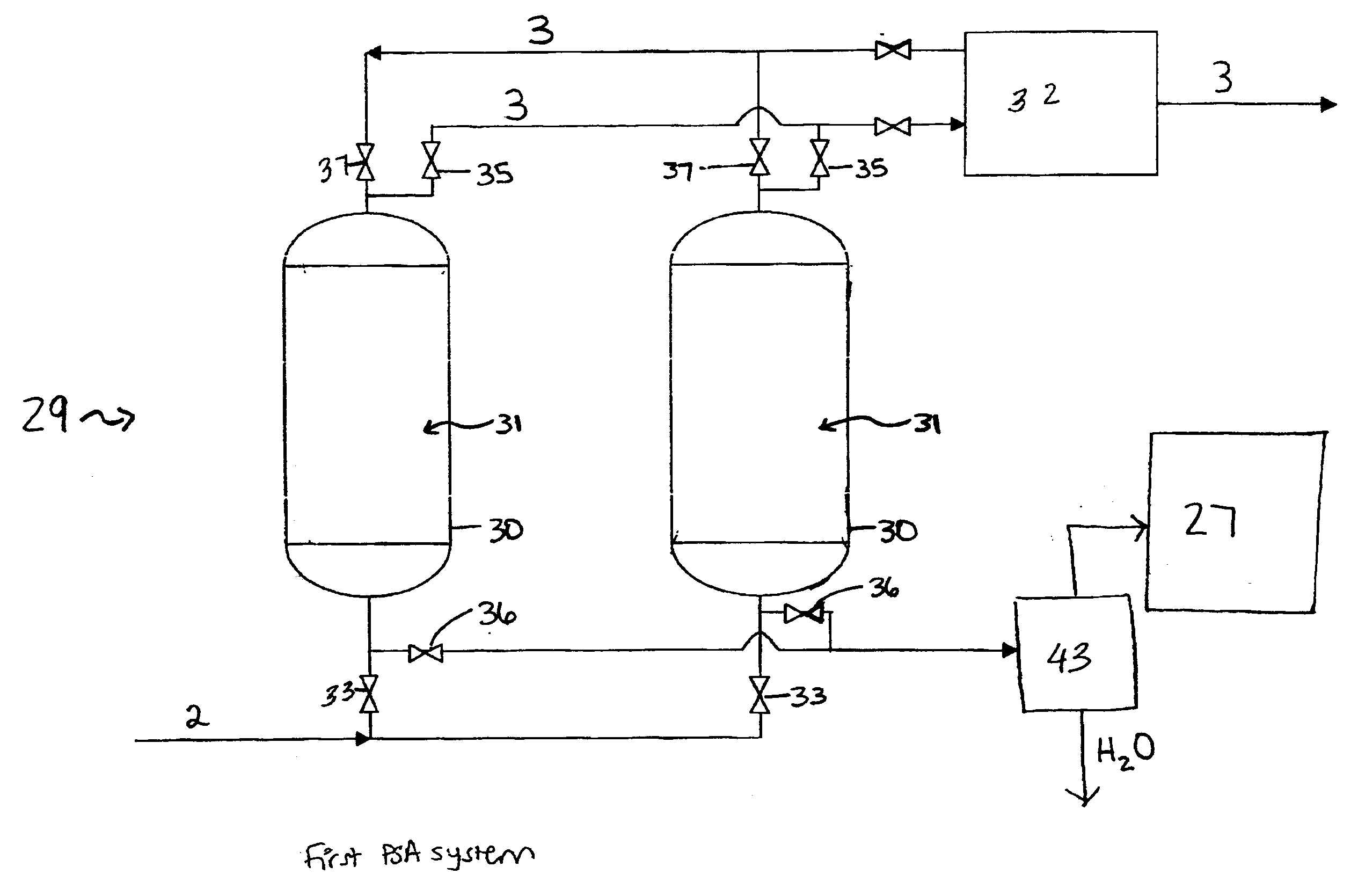
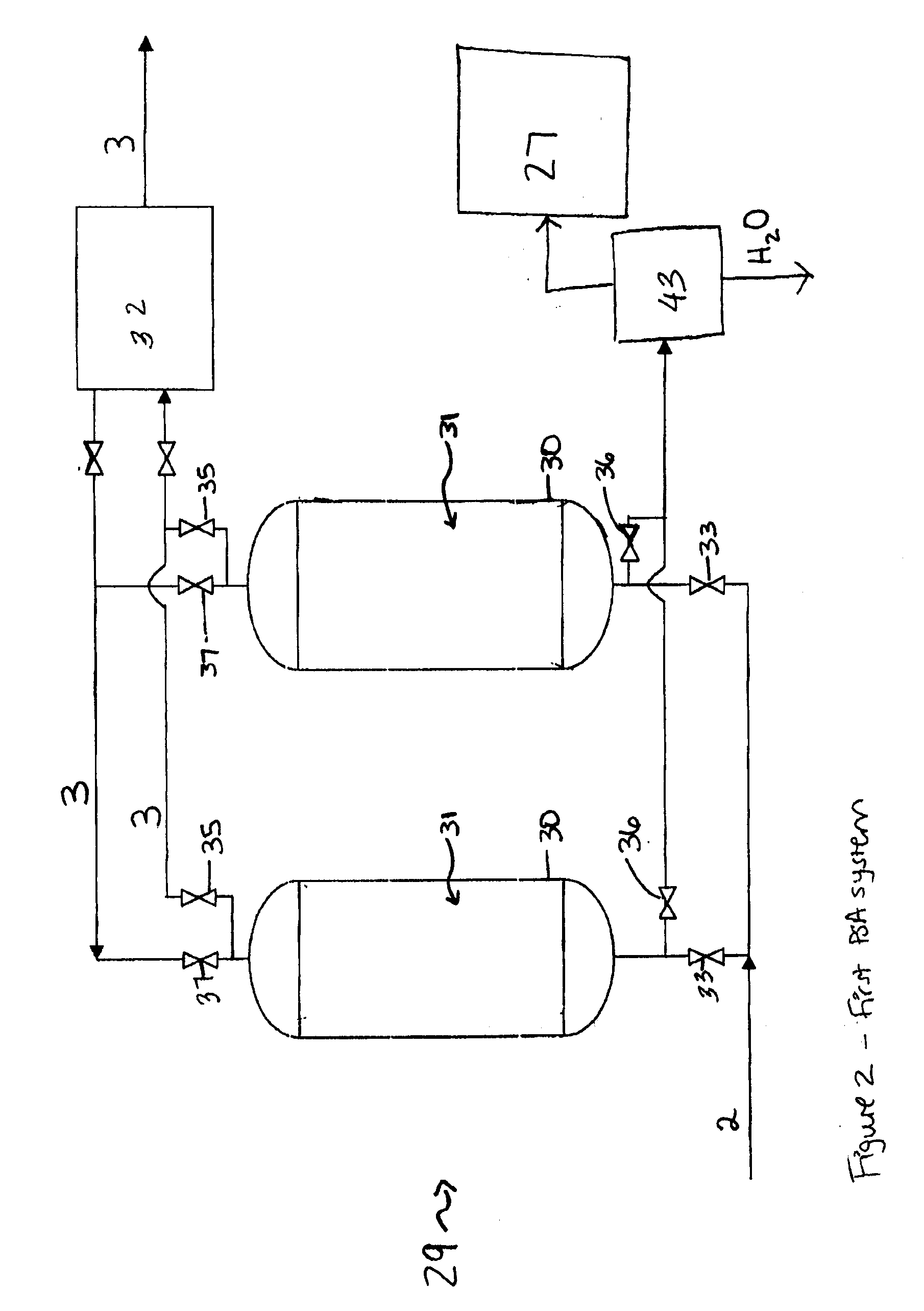
[0059]A first pressure swing adsorption (PSA) system (29) is employed and utilizes a first mixture of N2, N2O, and H2O. A second PSA system (65) is also employed and utilizes second and third mixtures. The second mixture includes N2 and N2O, whi...
PUM
 Login to View More
 Abstract
Description
Claims
Application Information
 Login to View More