
Digital Controller for Dc-Dc Switching Converters for Operation at Ultra-High Constant Switching Frequencies
a digital controller and converter technology, applied in the direction of dc-dc conversion, power conversion systems, instruments, etc., can solve the problems of long and tedious design process, inflexible and unsuitable for the integration with fast changing digital hardware, and low power consumption of analog controllers, so as to achieve power efficient operation
- Summary
- Abstract
- Description
- Claims
- Application Information
AI Technical Summary
Benefits of technology
Problems solved by technology
Method used
Image

Examples
experimental verification (
All-Digital FPGA Implementation)
[0067]The results of the verification demonstrated that the architecture of the present invention results in a significant increase of the switching frequencies at which digital controllers can be used. It is reasonable to assume that by transferring this design on an integrated circuit that is faster than the FPGA structure used, pulse width modulated signals at even higher frequencies (in the range of 100 MHz and about 120 MHz with optimization) could be achieved. This is based on implementation of the architecture to an integrated circuit in a manner that is known to those skilled in the art. Simulation results of such on-chip implementation are shown in FIG. 11, they verify operation at frequency of 115 MHz.
Closed Loop Operation
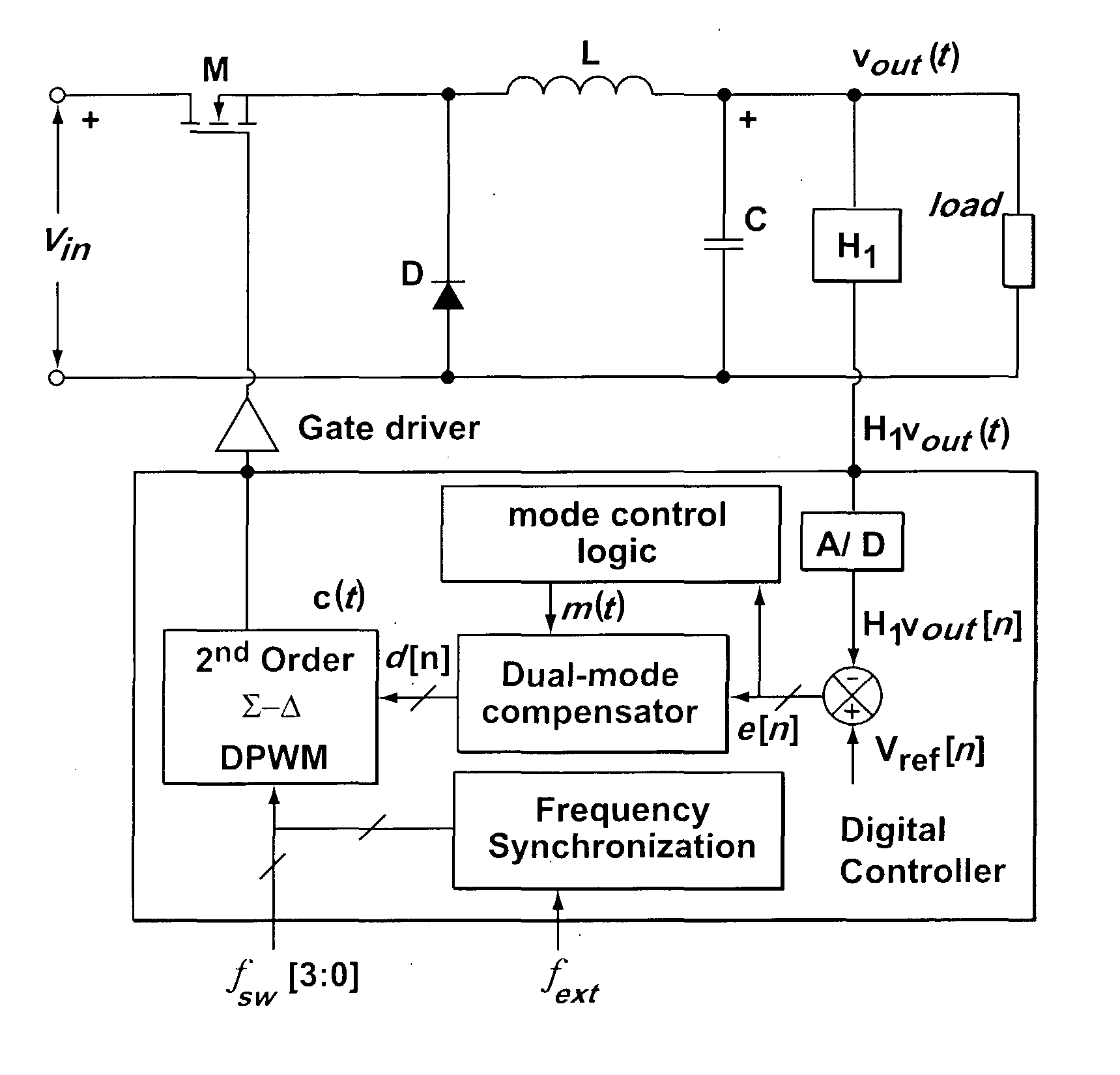
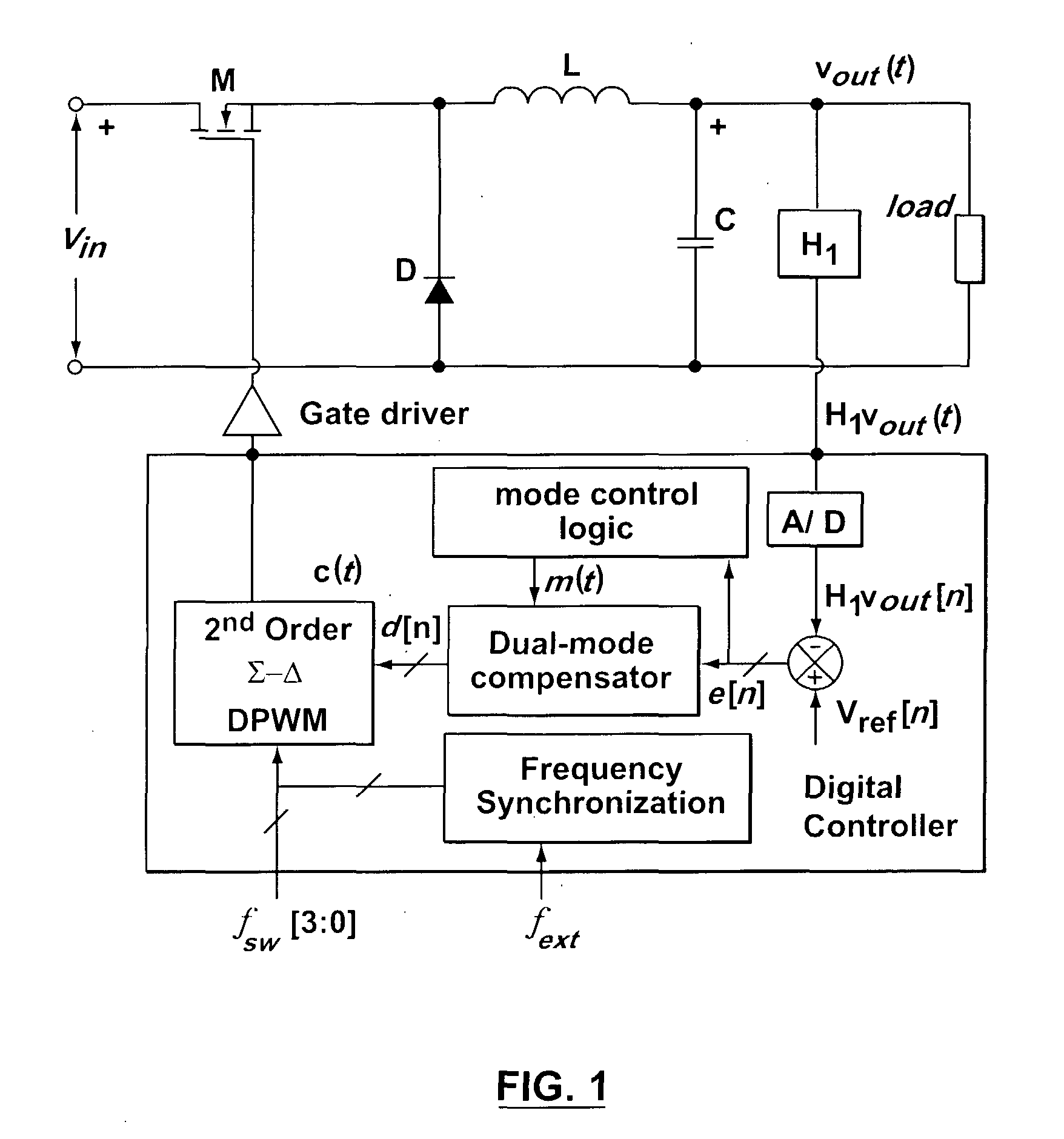
[0068]To further verify the operation of the controller, an experimental system based on block diagrams shown in FIG. 1 was constructed. To limit the switching losses of the buck converter switching frequency was decreased ...
PUM
 Login to View More
 Abstract
Description
Claims
Application Information
 Login to View More